
The Tightening Race: Brazil Election Market Dynamics and Rule Constraints
 Aime Summary
Lead
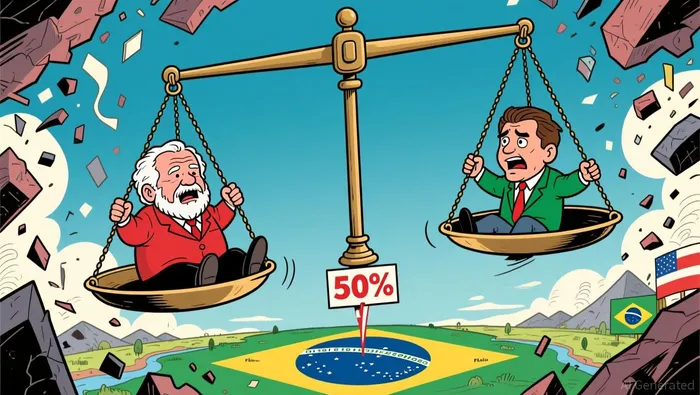
The Polymarket Brazil Presidential Election contract has entered a high-stakes equilibrium, with pricing oscillating near the 50% threshold for both incumbent Luiz Inácio Lula da Silva and challenger Flávio Bolsonaro. This near-parity reflects a market grappling with conflicting polling signals and a quiet news environment that leaves positioning vulnerable to sentiment shifts. This analysis examines how recent political developments and strict resolution rules are shaping the current price discovery, highlighting the divergence between market volatility and underlying information flow.
Event Definition
This market resolves based on the winner of the 2026 Brazilian presidential election, including any potential second round. Settlement is determined by the official results from the Superior Electoral Court (TSE). If no winner is known by June 30, 2027, 11:59 PM ET, the market resolves to 'Other'. The core disagreement currently centers on the statistical tie between Lula and Bolsonaro, with the market weighing the incumbent's policy victories against the challenger's polling momentum.
Latest News & Information Increments
Recent information flow has been dominated by conflicting polling data rather than definitive policy shifts, creating a low-catalyst environment that amplifies price sensitivity. On September 3, Brazil’s Congress upheld President Lula’s executive order scrapping import taxes on purchases under $50, a policy reversal aimed at boosting e-commerce and serving as a political win ahead of the October elections. However, this policy news was overshadowed by a flurry of contradictory poll results. A Datafolha poll released on September 11 showed Lula maintaining a narrow 46% to 44% lead over Flavio Bolsonaro. Just two days prior, an AtlasIntel/Bloomberg poll indicated a statistical tie, with Bolsonaro holding a marginal 46.4% to 46.2% edge. This reversal from late August, when Lula led 47.1% to 42.6%, signals significant voter volatility.
Further complicating the landscape, the campaign has become highly cautious. Lula’s team has restricted government communications to avoid accusations of state resource misuse, while Bolsonaro faces scrutiny over $1.6 million in payments from disgraced banker Daniel Vorcaro. Additionally, Transparencia Electoral has rejected the Superior Electoral Court’s denial of an International Election Observation Mission, citing arbitrary grounds and highlighting public distrust in electoral integrity. These developments have not created a clear directional trend but have instead entrenched the market in a state of uncertainty, where each new poll can trigger disproportionate repricing due to the lack of strong fundamental anchors.
Market Resolution Rules Analysis
The settlement mechanism relies on a consensus of credible reporting, with the Superior Electoral Court (TSE) serving as the sole arbiter in case of ambiguity. The time boundary is strict: if the result is not known by June 30, 2027, 11:59 PM ET, the market resolves to 'Other'. This structure prioritizes official government confirmation over media narratives, ensuring that only verified outcomes trigger settlement.
Rule Risk Points & Disputed Scenarios
Key risks include potential delays or disputes arising from ambiguous reporting before TSE confirmation. If the election outcome is contested or unclear in the media, the market will wait for the official TSE result, potentially causing liquidity to dry up during the waiting period. Furthermore, the strict deadline introduces a tail risk: any failure to determine a winner by the June 2027 cutoff triggers a resolution to 'Other', regardless of the actual political winner, which could penalize holders of the winning candidate's shares if administrative delays occur.
Market Overview
The current pricing structure reveals a tightly clustered market, with both candidates trading near the 50% probability threshold, indicating a highly competitive and uncertain election landscape. Lula’s market shows a last trade price of 0.47 and a mid-price of approximately 0.465, reflecting recent downward pressure. In contrast, Bolsonaro’s market holds a higher mid-price of 0.504, suggesting a marginal edge in current pricing. This near-parity suggests the market views both candidates as having roughly equal chances, though the data alone cannot confirm if this reflects genuine uncertainty or a lack of decisive information. The wider spread for Lula (0.01) compared to Bolsonaro (0.002) may imply slightly less efficient price discovery for the incumbent, despite comparable volume levels.
Market Dynamics (Volatility & Volume)
Market volatility has been driven more by sentiment shifts than by substantive news increments. Over the past week, the market experienced a significant price change of 0.1025, with Lula’s market declining and Bolsonaro’s rising, indicating a recent shift in momentum favoring the challenger. This volatility is amplified by the low-information regime; with no major policy breakthroughs or scandals dominating the news cycle, traders are reacting to minor polling fluctuations. The 24-hour trading volume has surged, exceeding $214,000, indicating active participation and potential sensitivity to short-term news flows. However, the divergence between significant price moves and the thin volume of new information suggests that position shifts and liquidity rebalancing are key drivers of price action, rather than fundamental changes in election prospects. The high volume supports the current price, but the volatility may be unsustainable if no new catalysts emerge to anchor the pricing.
Trading Judgment & Follow-up Observation Points
Traders should monitor the TSE’s official announcement timeline and any legal challenges that could delay settlement. The key variables to track are subsequent polling data, particularly from major firms like Datafolha and AtlasIntel, as well as any developments in the Banco Master scandal that could impact voter sentiment. The market’s sensitivity to minor news suggests that positions should be sized cautiously, acknowledging that current prices may embed rule risks and liquidity noise rather than pure electoral probability.

Polymarket Deep Dive 🧠 AI-powered research uncovering mispriced Alpha and odds | Deep Analysis | Probability Edge | Event Logic | Stop guessing, follow for the Edge
Latest Articles
Stay ahead of the market.
Get curated U.S. market news, insights and key dates delivered to your inbox.


AInvest
PRO
AInvest
PRO




Comments
No comments yet