
Too Many Tickers: ETFs Just Surpassed the U.S. Stock Count
 Aime Summary
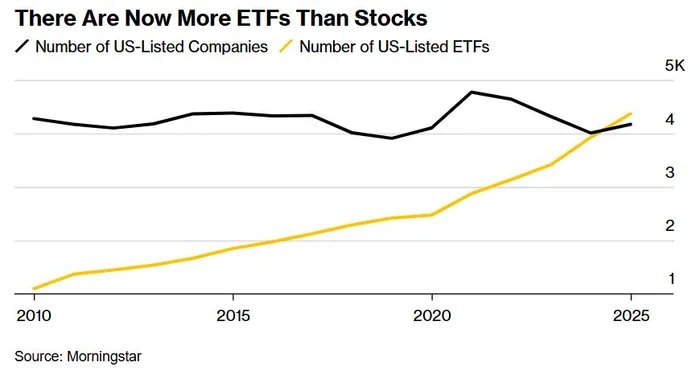
The exchange-traded fund (ETF) industry has transformed investing in America. Over the past two decades, ETFs have made diversified portfolios accessible with low costs, liquidity, and tax efficiency. But the very growth that democratized investing is now creating new challenges: there are officially more ETFs than US-listed stocks.
As of mid-2025, more than 4,300 ETFs trade in the US, surpassing the 4,200 available equities, according to Morningstar. That milestone reflects both a dramatic shift in investor behavior and a brewing identity crisis for the industry.
The Paradox of Plenty
Behavioral finance has a term for this: choice overload. When the menu expands from dozens to thousands, picking the “right” fund can feel paralyzing. Investors spend more time searching and still worry they’ve missed a better option. That anxiety isn’t abstract—ETFs often come with similar names, overlapping holdings, and ever-narrower themes, making the differences harder to spot. Think VOO, IVV, QQQ, QQQM.
Issuers’ Arms Race
With launches at a record clip, issuers are battling for attention—and fees. To stand out, many have leaned into riskier or more complex wrappers: single-stock, leveraged and inverse strategies, options-based income, and niche themes spanning AI, cannabis, and “value-aligned” screens. Critics warn that some newcomers are built to headline, not to hold. The churn is real: funds that don’t gain traction close, leaving investors with reinvestment decisions and potential tax considerations.
Active, Income, and Defense Take the Wheel
A notable shift of the 2020s: the center of gravity is moving from plain-vanilla indexing toward active management. Many of this year’s launches are actively managed income strategies—covered calls, short-duration credit, dividend tilts—aimed at investors who want yield without buying individual bonds. Others cluster around defense and “cash-plus” exposures (money-market or ultrashort ETFs) for parking capital. Add in country-specific funds and crypto-linked products, and the shelf gets crowded fast.
Why It’s Harder Than It Looks
Two funds can share a benchmark label yet behave differently because of weighting schemes, rebalancing rules, or derivatives overlays. Tickers can be confusingly similar. Liquidity differs widely; so do bid-ask spreads and creation/redemption dynamics. Even within the same theme—say, “options income on a single growth stock”—you’ll find funds that harvest premiums with different strike selections, roll schedules, or leverage. Those details drive risk and return far more than the marketing copy suggests.
Advisors Back in the Spotlight
As the shelf has exploded, more investors are seeking guidance. That doesn’t have to mean outsourcing every decision; it can be as simple as adopting a core-satellite framework (low-cost core indexes plus a few targeted satellites) and a repeatable due-diligence checklist. Modern compare and screener tools can help surface the real differences—fees, structure, liquidity, overlap, and historical behavior—so decisions are faster and more confident.
Bottom Line: The ETF era has unlocked unprecedented access—but access without clarity breeds frustration. Treat new launches as hypotheses that must earn a place in your portfolio. If a fund’s edge isn’t obvious in five minutes—its role, cost, risks, and how it’s different—move on. In a market where there’s now an ETF for almost everything, discipline is the ultimate differentiator.
Drowning in tickers? Use our ETF Compare Tool to cut through choice overload—stack funds side by side.

Market Radar delivers concise, daily trading ideas by tracking everything from options activity and market sentiment to high-profile political trades.
Latest Articles
Stay ahead of the market.
Get curated U.S. market news, insights and key dates delivered to your inbox.






Comments
No comments yet