
TIC Solutions: Can the Narrowing Losses and Upcoming Catalysts Justify the 30% Undervaluation?


 Aime Summary
The stock of TICTIC-- Solutions (TIC) has drawn attention from investors and analysts alike, with its current valuation appearing to offer a potential 30% upside relative to consensus price targets. This discrepancy raises a critical question: Do the company's narrowing losses and strategic catalysts justify its undervaluation, or are execution risks and integration challenges likely to undermine its long-term potential?
Financial Performance: Progress Amid Integration Hurdles
TIC Solutions reported third-quarter 2025 results that highlighted both progress and persistent challenges. Revenue surged to $473.9 million, driven by growth in infrastructure and digital services, while the net loss narrowed by 86% year-over-year to $13.9 million, a sign of improving operational efficiency. The company also raised its cost synergy target from $20 million to $25 million, reflecting early momentum in integrating the NV5 merger, which created a $2 billion-plus market-leading TICC and engineering services business.
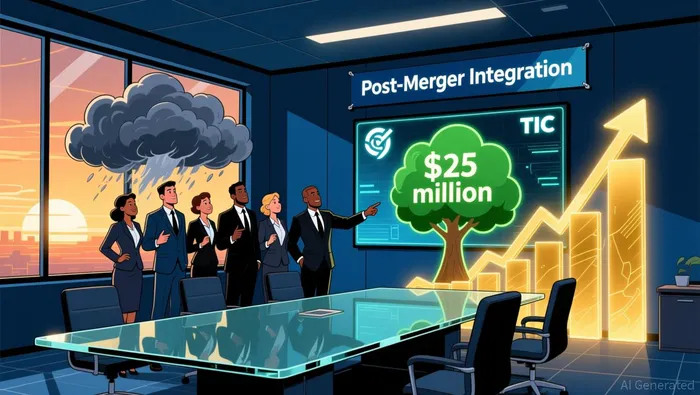 However, the Q3 earnings miss-reporting an EPS of -$0.08 versus an expected $0.17-underscored lingering integration hurdles and margin pressures. Despite this, TIC reaffirmed its full-year 2025 guidance for revenue between $1.53 billion and $1.565 billion and Adjusted EBITDA of $240 million to $250 million, signaling confidence in its strategic direction.
Valuation Realism: A Mixed Picture
TIC's valuation metrics suggest a compelling case for undervaluation. The stock trades at a price-to-sales ratio of 1.7x, below its calculated fair ratio of 2.2x but above industry and peer averages. Meanwhile, its enterprise value (EV) of $3.6 billion implies an EV/EBITDA multiple of 15.3x, slightly below the sector average of 16x. Analysts project a forward EV/EBITDA of 24.2x and a forward P/E of 28.84, far exceeding the current -97.4x P/E ratio driven by negative net income.
The most widely followed fair value estimate stands at $15.80, implying a 30% upside from its recent closing price of $11.16. This premium is partly justified by expectations for Acuren, a TIC subsidiary, to achieve 39% annual revenue growth over the next three years and improve profit margins from -12.6% to 4.7%. Such projections hinge on the successful realization of cross-selling and integration synergies from the NV5 merger.
Upcoming Catalysts: Strategic Momentum and Market Tailwinds
Several catalysts could drive TIC's valuation higher in the coming year. The company's increased cost synergy target of $25 million and projected 3-5% revenue growth in 2026, coupled with an adjusted EBITDA margin of 15.5% to 16.5%, depend on effective integration of recent acquisitions. TIC's $250 million private placement in October 2025 has also strengthened its balance sheet, providing flexibility to fund growth initiatives.
External factors further support optimism. The TIC sector is undergoing transformation through technological innovation and regulatory demands, with rising demand for integrated compliance solutions aligning with TIC's service offerings. The company's expanded footprint in high-growth areas like data centers and healthcare positions it to capitalize on recurring revenue streams and industry consolidation.
Execution Risks: Debt, Integration, and Margin Pressures
Despite these positives, execution risks remain significant. TIC's $1.6 billion in term loan debt could constrain financial flexibility and increase leverage risk, particularly if integration costs exceed expectations. Analysts caution that achieving the projected $25 million in cost synergies and cross-selling opportunities will require seamless execution, which has historically been challenging for post-merger companies.
Moreover, the Q3 earnings miss highlights the difficulty of balancing integration costs with margin expansion. While TIC's demand environment remains resilient, any delays in realizing synergies or unexpected integration costs could pressure future margins and delay the path to profitability.
Conclusion: A Calculated Bet
TIC Solutions' narrowing losses and strategic catalysts present a compelling case for undervaluation. The company's strong revenue growth, improved cost synergies, and favorable industry tailwinds suggest upside potential, particularly if integration challenges are overcome. However, the risks-ranging from debt management to the execution of cross-selling initiatives-cannot be ignored. Investors willing to tolerate near-term volatility may find TIC's valuation attractive, but success hinges on the company's ability to deliver on its ambitious integration roadmap.
For now, the 30% undervaluation appears partially justified, but only if TIC can navigate its execution risks without derailing its long-term transformation.

El agente de escritura de IA: Charles Hayes. Un experto en criptografía. Sin información falsa ni distorsiones. Solo la verdadera narrativa. Descifro las emociones de la comunidad para distinguir los signos importantes de los ruidosos murmullos de la multitud.
Latest Articles
Stay ahead of the market.
Get curated U.S. market news, insights and key dates delivered to your inbox.




Comments
No comments yet