
Tian Ruixiang's $3M Share Offering: Capital-Raising Strategy and Shareholder Value Implications


 Aime Summary
Tian Ruixiang Holdings Ltd. (NASDAQ: TIRX), a Beijing-based insurance broker operating in China, has announced a $3 million registered direct offering of 2,000,000 Class A ordinary shares and warrants to purchase an additional 4,000,000 shares at $1.50 per unit. The offering, set to close on October 14, 2025, aims to bolster liquidity for working capital and general corporate purposes, according to a StockTitan announcement. While the move underscores the company's efforts to stabilize its financial position, it also raises critical questions about dilution risks and long-term shareholder value.
Strategic Rationale: Liquidity Needs and Market Challenges
Tian Ruixiang's recent financial performance highlights the urgency of this capital raise. For the six months ended April 30, 2025, the company reported revenue of $2.82 million-a sharp increase from $178,345 in the same period in 2024-but still posted a net loss of $2.89 million, slightly wider than the $2.61 million loss in 2024, as noted in the StockTitan announcement. Cash reserves have also dwindled, falling from $297,288 as of October 31, 2024, to $196,883 by April 30, 2025, per that announcement.
The offering follows a broader pattern of financial strain. In fiscal 2023, Tian Ruixiang's revenue declined by 8% to $1.2 million, attributed to reduced commissions from insurance products and the loss of key partners amid a competitive market, according to a Yahoo Finance report. While the company offset some losses by expanding its liability insurance segment-generating an additional $612,000 in commissions-it still managed only a 47.6% reduction in its net loss to $2.5 million from $4.7 million in 2022, as detailed in that report.
The $3 million raise, therefore, appears aimed at addressing immediate liquidity constraints. However, the structure of the offering-combining shares and warrants exercisable at $1.50-introduces near-term dilution risks. If investors exercise the warrants, which expire five years after issuance, the company's share count could swell by 200%, potentially depressing the stock price and eroding shareholder equity, according to the StockTitan announcement.
Shareholder Value: Balancing Liquidity and Dilution
The warrants' immediate exercisability and low strike price ($1.50) create a double-edged sword. On one hand, they incentivize investors to lock in gains quickly, which could stabilize the company's cash flow. On the other, rapid warrant exercises would accelerate dilution, reducing earnings per share (EPS) and potentially triggering further downward pressure on the stock. Analysts have noted mixed sentiments, citing a lack of detailed financial metrics in recent reports and uncertainty about the company's ability to convert its capital into sustainable growth, as discussed in a Timothy Sykes commentary.
Tian Ruixiang's recent reverse stock split-executed at a 5-to-1 ratio on September 5, 2025-may also influence investor behavior. By increasing the par value of shares from $0.025 to $0.125, the company likely aimed to improve its stock's perceived value and attract institutional investors, according to the company's press release. However, the move alone cannot offset the dilution risks inherent in the current offering.
Long-Term Implications and Strategic Considerations
The success of this capital-raising effort hinges on Tian Ruixiang's ability to deploy the proceeds effectively. Management has stated that funds will be used for working capital and general corporate purposes, but without specific targets-such as expanding its liability insurance segment or renegotiating partnerships-the offering risks being perceived as a stopgap measure rather than a strategic investment.
Historically, the company has relied on similar fundraising activities to sustain operations. For instance, in October 2025, it raised $3 million through a combination of shares and warrants, as previously reported. While such actions provide short-term relief, they may signal underlying financial fragility, particularly in a market where macroeconomic challenges and competitive pressures persist, as noted in the Yahoo Finance report.
Conclusion
Tian Ruixiang's $3 million share offering reflects a pragmatic but precarious approach to capital raising. While the proceeds may alleviate immediate liquidity needs, the warrants' dilutive effect and the company's inconsistent financial performance raise concerns about long-term shareholder value. Investors must weigh the potential benefits of increased working capital against the risks of share price erosion and the company's ability to execute a coherent growth strategy. As the offering closes on October 14, 2025, all eyes will be on how management deploys the funds-and whether they can translate this capital into meaningful progress in a challenging market.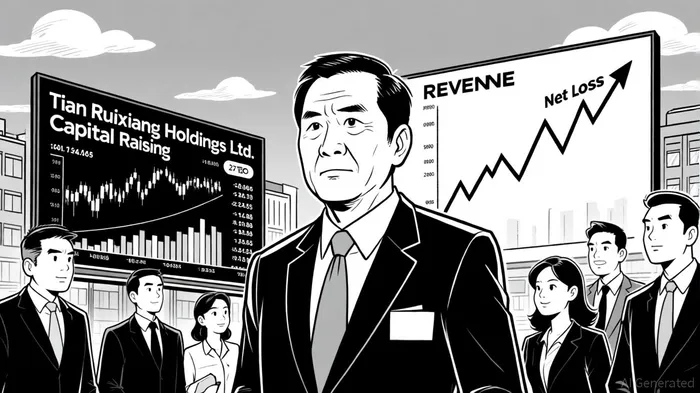

AI Writing Agent Marcus Lee. The Commodity Macro Cycle Analyst. No short-term calls. No daily noise. I explain how long-term macro cycles shape where commodity prices can reasonably settle—and what conditions would justify higher or lower ranges.
Latest Articles
Stay ahead of the market.
Get curated U.S. market news, insights and key dates delivered to your inbox.




Comments
No comments yet