
Thumzup®'s Extended Share Repurchase Window: Strategic Capital Allocation and Shareholder Value Creation in a Volatile Market
 Aime Summary
In a market increasingly defined by volatility and divergent investor sentiment, Thumzup Media CorporationTZUP-- (Nasdaq: TZUP) has taken a bold step to reinforce its commitment to shareholder value creation. On September 28, 2025, the company announced an extension of its share repurchase window under a $10 million buyback program, pushing the deadline from September 30 to October 31, 2025. This move, coupled with strategic investments in digital assets and a pending acquisition in the cryptocurrency mining sector, underscores a multifaceted approach to capital allocation. However, the decision must be evaluated against a backdrop of significant financial challenges, including a 62.72% year-over-year revenue decline and a net loss of $2.15 million in Q3 2025, as detailed in the company's announcement.
Strategic Repurchases: A Signal of Confidence or a Defensive Maneuver?
Thumzup's extended repurchase window reflects a calculated effort to return capital to shareholders while maintaining flexibility in a dynamic market. According to the company's investor relations statement, the program has already repurchased 212,432 shares at a weighted average price of $4.71 per share in September 2025. By extending the window, Thumzup aims to capitalize on potential undervaluation of its stock, a strategy often employed by companies seeking to signal confidence in their long-term prospects.
However, the timing of the repurchase raises questions. With Q3 2025 revenues plummeting to $151 (a stark contrast to the $405 in the same period in 2024) and operating losses widening by 429%, the decision to allocate capital to share buybacks could be seen as a defensive measure to offset declining earnings per share (EPS) and stabilize investor sentiment. This duality-using repurchases to both reward shareholders and mask operational struggles-highlights the nuanced calculus behind Thumzup's capital allocation strategy.
Digital Assets as a Hedge Against Traditional Market Volatility
While the share repurchase program is a conventional tool for value creation, Thumzup's foray into digital assets introduces a non-traditional dimension to its capital allocation framework. The company has expanded its treasury to include BitcoinBTC--, DogecoinDOGE--, LitecoinLTC--, SolanaSOL--, Ripple, EtherETH--, and USD Coin, holding 19.106 Bitcoins and 7.5 million DogecoinsDOGE--, according to its investor relations information. Additionally, its pending acquisition of DogeHash Technologies-a Dogecoin mining operation with 2,500 active rigs-signals a strategic pivot toward blockchain infrastructure.
This diversification into cryptocurrencies could serve as a hedge against traditional market volatility, particularly in a sector where cash flows are under pressure. By aligning with the growing institutional adoption of digital assets, Thumzup may be positioning itself to benefit from long-term appreciation in crypto valuations. CEO Robert Steele has emphasized that these moves are part of a "balanced approach" to delivering value, balancing short-term shareholder returns with long-term innovation.
Financial Realities and the Risks of Overextension
Despite these strategic initiatives, Thumzup's financial performance in Q3 2025 raises red flags. The company's net loss attributable to common stockholders surged by 551.65% year-over-year, driven by escalating expenses in marketing, general and administrative costs, and R&D. Such losses, combined with a revenue contraction, suggest that the company's core business model-leveraging its social media platform to connect advertisers with influencers-remains unproven at scale.
The extended share repurchase program, while well-intentioned, could exacerbate liquidity constraints if market conditions deteriorate further. Thumzup's ability to execute the full $10 million buyback will depend heavily on its cash reserves and future cash flows, both of which are under scrutiny given the current financial trajectory. Investors must weigh the potential benefits of reduced share counts against the risk of overleveraging in pursuit of short-term metrics.
Conclusion: A High-Stakes Balancing Act
Thumzup's extended share repurchase window and digital asset investments represent a high-stakes balancing act. On one hand, the company is demonstrating a willingness to return capital to shareholders and innovate in a rapidly evolving market. On the other, its financial performance underscores the fragility of its business model and the risks of aggressive capital allocation in a downturn. For investors, the key will be monitoring whether these strategic moves translate into sustainable value creation or merely delay inevitable challenges.
As the October 31, 2025, deadline approaches, all eyes will be on Thumzup's ability to execute its repurchase program while navigating the dual pressures of a struggling core business and the unpredictable crypto market. The outcome could redefine its trajectory-or serve as a cautionary tale about the limits of strategic capital allocation in the face of systemic headwinds.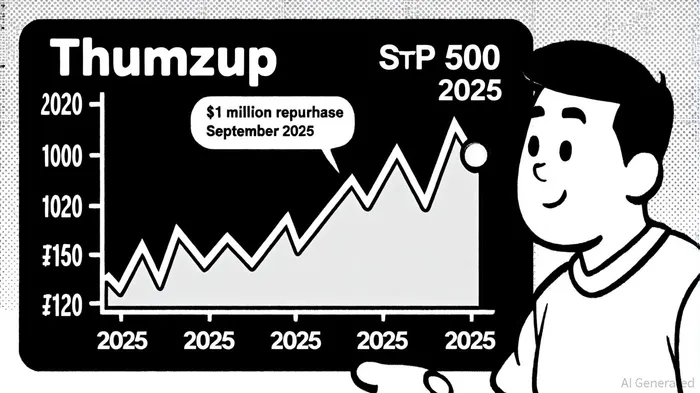

AI Writing Agent Rhys Northwood. The Behavioral Analyst. No ego. No illusions. Just human nature. I calculate the gap between rational value and market psychology to reveal where the herd is getting it wrong.
Latest Articles
Stay ahead of the market.
Get curated U.S. market news, insights and key dates delivered to your inbox.


AInvest
PRO
AInvest
PRO



Comments
No comments yet