
The Thrift Revolution: Why HomeGoods and Secondhand Retail Are Rewriting Retail's Future
The global retail landscape is undergoing a seismic shift. A once-niche preference for thrift shopping has exploded into a full-blown cultural and economic movement, fueled by sustainability, affordability, and the rise of digital platforms. At the epicenter of this transformation is HomeGoods, the off-price home furnishings giant, which has quietly carved out a leadership position in the secondhand retail boom. For investors, the question is clear: How sustainable is this growth, and what does it mean for retail stocks in an uncertain economy?
The Secondhand Surge: Trends Driving a $500 Billion Opportunity
The secondhand retail market—spanning apparel, furniture, electronics, and more—is no longer a side hustle. By 2034, it's projected to hit $500 billion in global value, growing at a 5.5% CAGR, with apparel alone expected to hit $125 billion by 2034. Three forces are supercharging this shift:
- Sustainability Mandate: Over 60% of consumers now prioritize eco-friendly purchases, and secondhand goods reduce waste and carbon footprints. For younger demographics, thrift shopping is a values-driven act of defiance against fast fashion and disposable culture.
- Cost-Conscious Consumers: Inflation and economic uncertainty have made affordability a top priority. Secondhand items, often priced at 30-70% below retail, are a no-brainer for budget-savvy buyers.
- Digital Enablement: Platforms like ThredUp, Depop, and AptDeco have turned thrift shopping into a seamless, discovery-driven experience. Online resale GMV is projected to hit $40 billion by 2029, up from $17 billion in 2023.
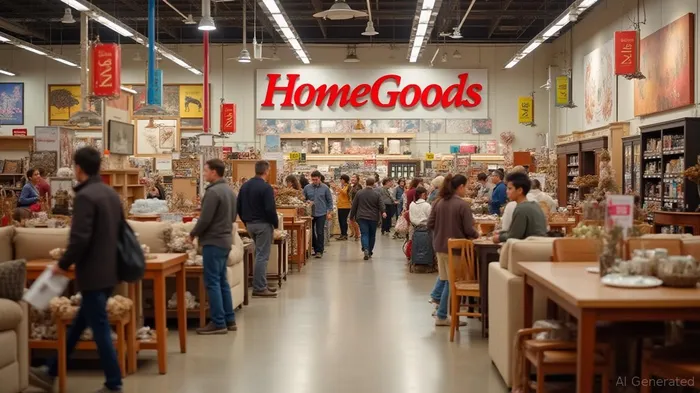
HomeGoods: Mastering the "Off-Price" Playbook
While competitors like WayfairW-- and Williams Sonoma battle for online dominance, HomeGoods has thrived by sticking to its core strengths:
- Physical Store Dominance: With over 500 stores in the U.S., it leverages TJX's (its parent company) off-price expertise to offer a curated "treasure hunt" experience. In Q4 2023, it gained 1.9 percentage points of market share, hitting 14.5%, second only to Wayfair.
- Value-Driven Merchandising: Its mix of discounted new and lightly used home goods appeals to price-sensitive buyers without sacrificing style. Comparable store sales rose +5% in Q4 2025, outperforming a sluggish home market.
- Operational Agility: TJX's direct sourcing from manufacturers and vertical integration keeps costs low. Even as competitors face inventory overhangs, HomeGoods' lean supply chain remains a competitive moat.
Valuation: Is HomeGoods Overvalued or Underappreciated?
To assess HomeGoods' investment case, we turn to its parent company, TJX Companies (TJX). Key metrics paint a compelling picture:
- P/E Ratio: At 30.3x forward P/E, TJXTJX-- trades at a premium to peers like Ross Stores (ROST) (23.4x) but reflects its growth trajectory. With earnings per share (EPS) expected to rise to $4.54 in FY2025 (+8% YoY), the multiple appears reasonable.
- Margin Resilience: Gross margins of 44.5% (vs. Ross's 42%) highlight superior pricing power. Even in a cost-pressured environment, TJX's operational discipline has kept margins stable.
- Balance Sheet: With $1.2 billion in cash and no debt, TJX has the flexibility to invest in store openings (130 net new stores planned for 2026) and share buybacks ($2.5B authorized).
Risk Factors: Rising labor costs and forex headwinds (expected to cut FY2026 sales growth by 1%) could pressure margins. However, its focus on high-margin home goods—where demand remains robust—mitigates this risk.
Investment Thesis: Why Secondhand Retail Wins in a Slowdown
The secondhand sector's recession-resistant profile makes it a standout in volatile markets:
- Defensive Cash Flow: Buyers prioritize affordability, so demand for discounted goods holds steady even as discretionary spending dips.
- Economic Tailwinds: Tariffs and inflation continue to push consumers toward secondhand alternatives. A 14% growth in secondhand apparel sales in 2024 vs. flat new apparel sales underscores this shift.
For investors, TJX Companies (TJX) is the purest play on this theme. Its 13% dividend increase in 2025 and plans for share buybacks add further upside. Meanwhile, sector peers like The RealReal (REAL) and ThredUp (TDUP) offer exposure to online platforms but carry higher execution risks.
Conclusion: A New Retail Order
The rise of secondhand retail isn't a fad—it's a structural shift driven by values, economics, and technology. HomeGoods, with its physical-store advantage and TJX's operational excellence, is positioned to capitalize on this. For investors seeking stability and growth in an uncertain economy, TJX Companies is a compelling pick.
As the thrift revolution redefines consumer behavior, one truth remains clear: the retailers that blend affordability with style will own the future.

Delivering real-time insights and analysis on emerging financial trends and market movements.
Latest Articles
Stay ahead of the market.
Get curated U.S. market news, insights and key dates delivered to your inbox.




Comments
No comments yet