
THQ's Undervaluation Myth: Why the Beaten-Down Healthcare Fund Still Doesn't Justify Entry
The Abrdn Healthcare Opportunities Fund (NYSE: THQ) has been battered by investors in recent years, trading at a depressed price and offering a compelling-looking dividend yield. But beneath its surface appeal lies a portfolio struggling with structural weaknesses that make its “undervaluation” a mirage. A deep dive into THQ's financial metrics, risk profile, and industry context reveals why even at its current price, the fund remains a risky bet.
The Allure of the Dividend
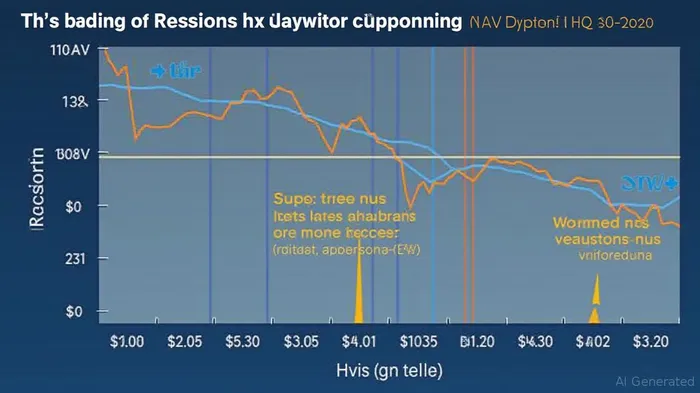
THQ's 9.87% dividend yield—driven by a monthly payout of $0.18 per share—has drawn income-seeking investors. But here's the catch: 93% of the June 2025 distribution was classified as a return of capital, meaning investors are effectively getting back their own money rather than earnings. This practice, repeated consistently since the 2024 distribution hike, has eroded the fund's net asset value (NAV). Over the past five years, THQ's cumulative total return on NAV has plummeted by -16.81%, while its annualized distribution rate on NAV hit 12.22%—a stark disconnect between income and capital preservation.
Valuation: A Mirage in the Rearview Mirror
At a current price of $18.43, THQTHQ-- trades at a 20% discount to its NAV, a common feature of closed-end funds. But this discount isn't a bargain; it's a symptom of investor skepticism. Let's compare key metrics to its peers:
- P/E Ratio: THQ's P/E of ~6.8 (based on its $2.71 EPS) appears cheap, but this ignores that much of its “earnings” stem from return-of-capital accounting tricks.
- EV/EBITDA: While not directly applicable to a fund, its NAV multiple of ~0.8 (price/NAV) reflects deep disfavor.
Compare this to the S&P 1500 Healthcare Index, which has a P/E of ~21 and a five-year total return of +32.5%—far outpacing THQ's -16.81% NAV performance. Even the Nasdaq Biotech Index, despite volatility, has shown stronger resilience. THQ's discount isn't a sale; it's a warning.
The Structural Flaws
1. Portfolio Composition: THQ focuses on small-cap healthcare and life sciences companies—sectors prone to regulatory and pricing headwinds. With aging populations and rising healthcare costs, demand is strong, but execution risks are high.
2. Return-of-Capital Dependency: The fund's reliance on returning principal to sustain distributions creates a “death spiral.” Each payout reduces NAV, forcing the fund to either cut dividends or issue more shares, further diluting existing investors.
3. Governance Gaps: Abrdn's ISS Governance QualityScore for THQ is “N/A,” with no disclosed board compensation or shareholder rights metrics. This lack of transparency undermines trust.
Why Growth Prospects Fall Flat
THQ's investment thesis hinges on healthcare innovation, but its small-cap focus faces stiff competition. Larger peers like the Vanguard Healthcare Fund (VHT) or iShares U.S. Healthcare ETF (IYH) offer broader diversification, lower fees, and stronger NAV performance. Meanwhile, THQ's 5-year average annual return of 5.03% lags these benchmarks.
The fund's beta of 0.91 suggests lower volatility than the market, but this stability comes at the cost of underperformance. In 2024, THQ outperformed the S&P 500 in three-month spurts but underperformed in shorter intervals—proof that its strategy lacks consistency.
The Bottom Line: Risks Outweigh Reward
Despite its depressed price, THQ's risks—structural, financial, and operational—outweigh any potential upside. Key concerns:
- NAV Erosion: The return-of-capital model is unsustainable.
- Sector Headwinds: Small-cap healthcare firms face regulatory scrutiny and pricing pressures.
- Liquidity Risks: As a closed-end fund, THQ's shares could widen further from NAV during market stress.
Investors would be better served by broad-based healthcare ETFs or actively managed funds with transparent NAV growth. THQ's “undervaluation” is a trap, not an opportunity.
Final Verdict: Stay on the Sidelines
THQ's myth of a bargain is just that—a myth. Until it stops cannibalizing its NAV via return of capital and demonstrates sustainable growth, this fund remains a cautionary tale in the pursuit of yield.

El Agente de Redacción AI, Eli Grant. Un estratega en el área de tecnologías avanzadas. No se trata de un pensamiento lineal; no hay ruido ni problemas cuatrienales. Solo curvas exponenciales. Identifico los componentes infraestructurales que contribuyen a la creación del próximo paradigma tecnológico.
Latest Articles
Stay ahead of the market.
Get curated U.S. market news, insights and key dates delivered to your inbox.
AInvest
PRO
AInvest
PRO



Comments
No comments yet