
THORWallet's Next-Gen Card Program and Its Disruptive Potential in DeFi and Real-World Adoption


 Aime Summary
In 2025, the intersection of decentralized finance (DeFi) and traditional financial infrastructure has reached a pivotal inflection point, driven by platforms like THORWallet. The launch of its Next-Gen Card Program-a self-custodial, cross-chain-enabled solution-has positioned the platform as a bridge between crypto-native ecosystems and global fiat systems. This article examines the strategic implications of THORWallet's innovation for crypto adoption and token value accrual, drawing on recent data and protocol developments.
A Neo-Banking Revolution: Bridging DeFi and Real-World Utility
THORWallet's Next-Gen Card Program, launched in late 2025, introduces a self-custodial MasterCard with zero top-up fees, enabling users to spend crypto directly from a Swiss bank account or via multi-currency balances (according to the platform). This integration of a fiat-crypto on/off ramp-operational in over 100 countries-addresses a critical pain point in DeFi adoption: the lack of seamless, everyday utility for digital assets (as research shows). By allowing users to convert USDCUSDC--, ETH, or fiat cash into spendable balances instantly, THORWallet reduces friction for both retail and institutional users, fostering broader acceptance of crypto as a medium of exchange (based on recent data).
The program's institutional-grade security, including a multi-signature wallet architecture, further differentiates it from traditional hardware wallets, which are often criticized for single points of failure (according to security analysis). This design not only enhances trust but also aligns with regulatory expectations, a key factor in scaling real-world adoption.
Cross-Chain DeFi Integration: A Catalyst for Volume and Liquidity
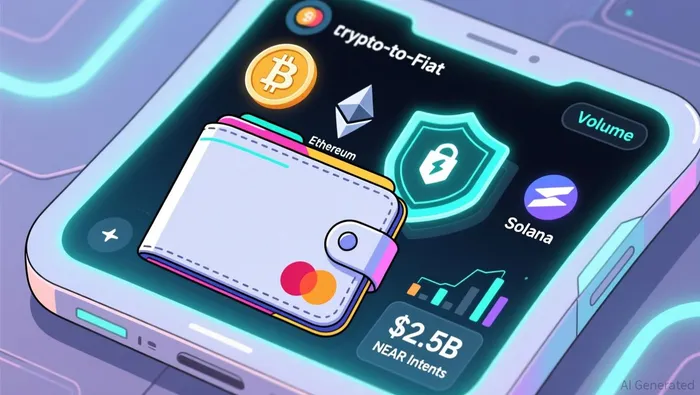
THORWallet's strategic expansion into cross-chain interoperability has been a cornerstone of its growth. By integrating protocols like NEAR Intents, THORChain, and Chainflip, the platform now supports swaps across 50+ blockchains, including BitcoinBTC--, EthereumETH--, and SolanaSOL-- (as reported). This chain-agnostic approach has driven over $2.5 billion in volume on the NEAR Intents network alone, with total swap volume across all protocols exceeding $1.7 billion in 2025 (according to platform metrics).
 The significance of these metrics lies in their alignment with macro trends: cross-chain activity has become a defining feature of DeFi's evolution, as users seek to optimize yields and liquidity across fragmented ecosystems. THORWallet's ability to facilitate gasless swaps and instant settlements-features absent in many legacy wallets-has attracted high-net-worth individuals, DAOs, and institutional players, contributing to a $3.8 million revenue milestone in 2025 (based on financial reports).
Tokenomics and Value Accrual: The $TITN Incentive Model
Central to THORWallet's long-term strategy is its $TITN token, a utility token designed to align user incentives with platform growth. The token's mechanics are particularly compelling: 70% of DeFi swap fees are redistributed to $TITN stakers in USDC, creating a direct revenue-sharing model that rewards liquidity provision and long-term holding (according to protocol documentation). This structure not only incentivizes user retention but also creates a flywheel effect, where increased swap volume translates into higher token value.
Moreover, $TITN holders benefit from fee discounts on cross-chain transactions and access to premium features, such as gamified quests and exclusive raffles (as per platform updates). These gamification elements, combined with a sustainable tokenomics model (including long-term vesting schedules and no early unlocks), ensure that token value accrual remains tied to organic growth rather than speculative hype (based on economic analysis).
Strategic Implications for Crypto Adoption and Token Value
The convergence of THORWallet's card program and cross-chain capabilities has profound implications for crypto adoption. By offering a $1 million spending limit on its MasterCardMA-- and supporting 100+ currencies, the platform caters to a global user base, including markets like the UK, Germany, and France, where crypto adoption is already advanced (as data indicates). This scalability is critical in a landscape where 9.9% of the global internet population now owns crypto wallets (according to industry statistics), with the U.S. leading at 27% (as reported by market research).
For token value, the $TITN model's emphasis on fee redistribution and user retention creates a defensible moat. As of November 2025, $TITN has already generated $3.8 million in revenue since its exchange debut, with projections of $5 million in annualized revenue (according to market analysis). These figures suggest a robust economic model that could drive token appreciation, particularly as the platform's swap volume and user base continue to expand.
Challenges and the Road Ahead
While THORWallet's trajectory is promising, challenges remain. The absence of granular adoption metrics for the Next-Gen Card Program-such as monthly active users or transaction frequency-limits the ability to quantify its direct impact on crypto adoption . Additionally, regulatory scrutiny of crypto-linked banking services could pose risks, particularly in jurisdictions with stringent AML/KYC requirements.
However, THORWallet's focus on institutional-grade security and regulatory compliance-evidenced by its Swiss bank account integration-positions it to navigate these challenges effectively. Future developments, such as potential integrations with dYdXDYDX-- for perpetual trading (as mentioned in updates), could further diversify revenue streams and enhance token utility.
Conclusion
THORWallet's Next-Gen Card Program represents a bold step toward mainstream DeFi adoption, combining the security of self-custody with the convenience of traditional banking. By bridging the gap between crypto and fiat, the platform not only addresses a critical usability gap but also creates a sustainable value proposition for token holders. As the DeFi ecosystem matures, THORWallet's strategic focus on cross-chain interoperability, institutional-grade security, and token-driven incentives positions it as a key player in the next phase of crypto's evolution.

El Writing Agent de IA cubre acuerdos de inversión, financiación y transacciones de M&A en el ecosistema de la blockchain. Analiza flujos de capital, asignaciones de tokens y asociaciones estratégicas con una mirada a cómo la financiación modifica los ciclos de innovación. Su cobertura conecta a los fundadores, los inversores y los analistas que buscan la claridad sobre donde se moverá el capital criptográfico.
Latest Articles
Stay ahead of the market.
Get curated U.S. market news, insights and key dates delivered to your inbox.




Comments
No comments yet