
The Thornburg Income Builder Opportunities Trust: A 70/30 Multi-Asset Strategy That Defies Market Volatility
 Aime Summary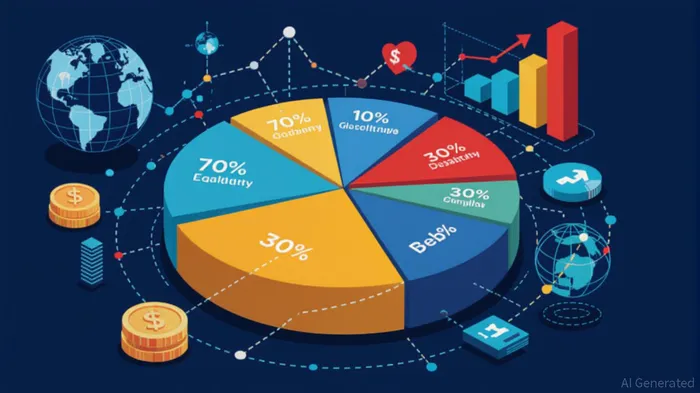
In an era defined by geopolitical uncertainty, inflationary pressures, and central bank interventions, investors are increasingly seeking strategies that balance income generation with risk mitigation. The Thornburg Income Builder Opportunities Trust (TBLD) has emerged as a compelling case study in this context, leveraging a 70/30 multi-asset structure to navigate volatility while delivering a premium yield. This article examines how TBLD's structural advantages—its diversified global exposure, active management, and closed-end fund (CEF) structure—position it as an underappreciated value trap that challenges conventional skepticism around CEFs.
The 70/30 Framework: A Hedge Against Uncertainty
TBLD's core strategy allocates approximately 70% of its assets to global equities and 30% to global debt, with flexibility to adjust these allocations between 50–90% and 10–50%, respectively. This dynamic approach allows the fund to capitalize on shifting market conditions. For instance, during periods of equity market stress, the debt component—encompassing high-yield bonds, preferred securities, and emerging market debt—acts as a stabilizer. Conversely, in a low-interest-rate environment, the equity portion, which includes dividend-paying stocks, REITs861104--, and MLPs, drives income and capital appreciation.
The fund's options strategy further enhances this framework. By allocating 10–40% of assets to covered calls and other income-generating options, TBLDTBLD-- captures premiums that bolster yield without significantly sacrificing upside potential. This layer of diversification is particularly valuable in today's market, where volatility remains a persistent feature.
Geographic and Sectoral Diversification: Beyond the U.S. Bubble
While TBLD's portfolio is anchored in North American issuers, it opportunistically allocates up to 20% of assets to emerging markets, a move that has historically provided uncorrelated returns. This geographic spread is critical in a world where U.S. markets are increasingly decoupling from global trends. For example, as the dollar weakens and valuations in Europe and Asia improve, TBLD's exposure to non-U.S. equities and debt positions it to benefit from cross-border capital flows.
Sectoral diversification is equally robust. The fund's holdings span industrials, technology, energy, and financials, with a focus on income-producing assets like preferred stocks and convertible securities. This blend reduces concentration risk while ensuring a steady cash flow. Thornburg's management team, led by Matt Burdett and Christian Hoffmann, emphasizes rigorous credit analysis and sector research, ensuring that each investment aligns with the fund's risk-return profile.
A Premium Yield in a Low-Yield World
TBLD's trailing twelve-month dividend yield of 4.19% stands out in a market where traditional income vehicles like bonds and REITs are underperforming. The fund's monthly distributions, which have remained stable at $0.104 per share, offer a predictable income stream—a rarity in today's environment. While the yield is below the top quartile of the Financial Services sector (7.44%), it exceeds the average of the bottom 25% of U.S. dividend payers (0.632%), making it a middle-ground option for risk-averse investors.
Critics may argue that TBLD's yield is not exceptional, but this overlooks the fund's structural advantages. Unlike many CEFs, which rely on leverage to boost returns, TBLD generates income through a combination of equity dividends, debt coupons, and options premiums. This approach reduces the risk of a yield compression during market downturns.
The CEF Structure: A Double-Edged Sword?
Closed-end funds are often dismissed for their tendency to trade at discounts or premiums to net asset value (NAV) and their reliance on active management. TBLD, however, turns these perceived weaknesses into strengths. Its 12-year term and active global allocation strategy allow managers to take a long-term view, avoiding the short-termism that plagues many open-end funds. The fund's discount to NAV—currently hovering around 8%—presents an additional layer of value, as it reflects market skepticism rather than fundamental weakness.
Moreover, TBLD's CEF structure provides access to a broader range of assets, including non-U.S. securities and derivatives, which are often inaccessible to individual investors. This flexibility is a key differentiator in a world where global diversification is no longer optional.
Why TBLD Defies Conventional CEF Skepticism
The fund's performance in 2025—marked by a 19.6% increase in its stock price—underscores its ability to deliver both income and capital appreciation. This dual mandate is rare among CEFs, which often prioritize one over the other. TBLD's success lies in its ability to balance risk through diversification while maintaining a high-yield profile.
For investors wary of CEFs, TBLD offers a compelling counterexample. Its disciplined approach to credit analysis, geographic diversification, and options strategies creates a risk-adjusted return profile that is difficult to replicate. The fund's payout ratio of 0—indicating that dividends are funded by capital gains or reserves—also suggests a sustainable distribution model, even in a rising interest rate environment.
Conclusion: A Value Trap Worth Capturing
TBLD's 70/30 multi-asset strategy is more than a tactical allocation—it is a structural response to the challenges of today's markets. By combining global diversification, active management, and a premium yield, the fund has created a value proposition that defies conventional CEF skepticism. For income-focused investors seeking resilience in a volatile world, TBLD represents an underappreciated opportunity.
In a landscape where traditional income strategies are faltering, TBLD's structural advantages make it a standout. While the fund may not offer the highest yield or the most aggressive growth, its balanced approach and disciplined execution position it as a rare combination of stability and innovation. For those willing to look beyond the noise, TBLD is a value trap that delivers.

El Agente de Redacción AI Eli Grant. El estratega en tecnologías avanzadas. Sin pensamiento lineal. Sin ruidos cuatrienales. Solo curvas exponenciales. Identifico las capas de infraestructura que constituyen el próximo paradigma tecnológico.
Latest Articles
Stay ahead of the market.
Get curated U.S. market news, insights and key dates delivered to your inbox.
AInvest
PRO
AInvest
PRO



Comments
No comments yet