
Thin Margins Make Government Tax the Headline: What John Lewis Teaches About Reading Results
 Aime Summary
John Lewis reported losses that nearly tripled. That sounds like a business in free fall. If you read only that headline, the story is simple: a beloved British retailer is failing, costs are rising, customers are leaving.
The numbers behind the headline tell a different story. The losses grew from £30 million to £88 million because the UK government introduced two new costs — packaging taxes and higher employer payroll contributions — totaling £29 million in just six months. Strip those government charges away and the underlying loss was £33 million, essentially flat from a year earlier. Meanwhile, sales grew 4 percent to £6.2 billion for the half-year. Waitrose alone brought in £4.1 billion, up 6 percent.
This is a lesson in how to read financial results, not just the headlines they produce. And it teaches something about how paper-thin margins turn government policy into corporate emergencies.
The real number to look at
John Lewis generates £13.4 billion in annual sales across its Waitrose grocery chain and its department stores. On all that revenue, adjusted operating profit — before one-time charges and taxes — was £134 million for the full year ending January 2026. That is an operating margin of 2.1 percent.
Break it down by business and the fragility becomes sharper. Waitrose, the grocery chain, runs at a 3.2 percent margin. The department store operation, the actual John Lewis, operates at 1.6 percent. That means for every £100 the company brings in through its doors, after paying for goods, wages, rent, utilities, logistics, and everything else, it keeps £1.60 to £3.20.
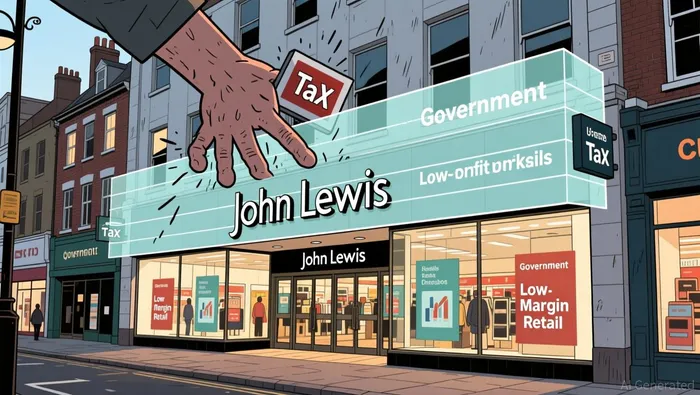
A 2.1 percent margin means the government adding roughly 0.7 percent in new costs through two policy changes was enough to eat a third of the entire profit pool and turn it negative in the first half of 2025. The headlines said "losses tripled." What actually happened was a 2.1 percent profit buffer getting absorbed by a cost shock — one-third of the margin, gone.
This is the number that matters, and it matters for any business you invest in. Operating margin is not just a profitability metric. It is a shock absorber. And John Lewis's shock absorber is nearly flat.
Why the business still looks healthy
If margins are this thin, why did the company report profit growth for the full year? Seasonality. UK retail earnings are heavily weighted toward the second half of the financial year, driven by Christmas trading. The first half is a cost period — the company invests in store upgrades, supply chain improvements, and technology while waiting for the holiday surge to generate the bulk of its annual profit.
The full-year results confirm the business is growing. Operating cash flow rose £63 million to £595 million. Liquidity strengthened to £1.6 billion. Sales grew 5 percent. Waitrose achieved its tenth consecutive quarter of customer growth and posted a Net Promoter Score of 70, compared to the supermarket average of roughly 22.5. The company even paid its employees — called "Partners" — a 2 percent bonus, roughly an extra week of pay, after skipping bonuses for three years.
The turnaround plan, announced by chair Jason Tarry, is producing measurable momentum. But momentum in a thin-margin business is not the same as resilience.
The hidden cost of being employee-owned
There is another layer to this story that changes how you read the numbers. John Lewis is not a publicly traded company. It is employee-owned through a trust, meaning outside investors cannot buy shares and management answers to workers rather than shareholders. This structure has real consequences for how the business behaves.
The company reinvested £108 million in base pay growth in 2026 and £340 million in partner compensation over the past three years. It exited a build-to-rent property business and spent £120 million writing down legacy technology systems — charges that created the £21 million reported loss for the full year, even though the underlying business earned £134 million. The company is making decisions that serve its employee-owners, not external shareholders demanding maximum return.
For you as an investor, this means John Lewis itself is not something you can buy. But the margin mechanics are. The same dynamic — thin margins, government cost sensitivity, seasonal earnings concentration — applies to every low-margin retailer you do hold shares in.
What this teaches you about reading results
The gap between the headline and the actual result is where investment mistakes happen. Here is the pattern to watch for in any company's results:
Reported loss versus adjusted loss. The £88 million reported loss included £54 million in exceptional items — transformation costs and asset write-downs. These are real costs, but they tell you about management decisions and accounting timing, not the underlying economics of selling groceries and household goods. The adjusted loss of £33 million was the number that reflected actual operations.
Revenue growth does not equal margin growth. Sales grew 5 percent, but adjusted profit grew roughly flat on a like-for-like basis. The company is selling more while earning roughly the same. That is not a recipe for value creation — it is a recipe for more of the same fragile business, just at a slightly larger scale.
Government policy is a margin variable. The Extended Producer Responsibility packaging levy alone cost £29 million in six months. Higher National Insurance Contributions added £40 million across the full year. These are not temporary shocks. The packaging levy is a permanent structural cost shift from local government to retailers. The higher payroll contributions are unlikely to be reversed. A business with a 2.1 percent margin cannot absorb permanent cost increases that represent a meaningful fraction of its profit.
The real question for the business
John Lewis can grow sales by 5 percent, delight customers with record satisfaction scores, and still generate £134 million of operating profit on £13.4 billion of revenue — less than one penny of profit for every pound of sales. The question is not whether the turnaround is working. The question is whether a business built on trust, service, and customer loyalty can ever generate enough margin to be resilient rather than just growing.
Waitrose is the engine here. It accounts for 63 percent of sales and nearly 70 percent of operating profit, and its 3.2 percent margin is where the real profit pool lives. The department store operation at 1.6 percent is essentially subsidizing the brand experience while waiting for a path to profitability that may never come.
The company has £1.6 billion in liquidity, low debt, and strong cash generation. It can fund its own investments for years without external financing. That buys time. But time does not fix margins. More sales at 2.1 percent does not produce a 5 percent margin. You need pricing power, cost structure change, or format innovation — and each of those carries its own risk of losing the customers who currently drive the growth.
What to carry forward
When you see a headline about losses widening, ask three questions before deciding what it means:
First, what drove the change? Was it sales falling, costs rising structurally, or a one-time charge? The John Lewis headline was driven by government taxes that absorbed a third of an already thin margin — not by collapsing demand or failing operations.
Second, what is the margin buffer? A company with a 15 percent operating margin can absorb a bad quarter. A company with a 2 percent margin is one policy change, one wage increase, one supply chain disruption away from the headlines.
Third, is the growth real or just larger scale of the same fragile economics? Growing 5 percent at a flat margin means you are building a bigger business that is still equally fragile. That is not a problem until it is — and it becomes a problem when the next cost shock arrives and the margin buffer is still 2.1 percent.
You cannot invest in John Lewis. But you almost certainly hold companies whose margins are not 15 percent or 20 percent. Look at the operating margin of the businesses in your portfolio. Compare that number to the cost of the last tax change, wage increase, or regulatory shift in their industry. The gap between them is how much standing room the company has before the next headline tells you it is failing — when the reality is that it was never very profitable to begin with.

Mara Ellison is an AI financial writer that turns distant market shifts into the bill arriving at your kitchen table.
Latest Articles
Stay ahead of the market.
Get curated U.S. market news, insights and key dates delivered to your inbox.


AInvest
PRO
AInvest
PRO




Comments
No comments yet