
Thermo Fisher Scientific's Strategic Expansion in U.S. Biotech Manufacturing: A Blueprint for Supply Chain Resilience and Long-Term Value Creation
 Aime Summary
In the shadow of global supply chain disruptions and the lingering aftershocks of the pandemic, Thermo Fisher ScientificTMO-- has emerged as a linchpin in the U.S. biotech sector's pivot toward self-reliance. The company's recent $2 billion investment in domestic manufacturing—spanning new facilities, advanced automation, and strategic acquisitions—signals a bold reimagining of how life sciences infrastructure can be both resilient and profitable. For investors, this is not just a story of corporate growth; it is a case study in aligning with national priorities while capturing the tailwinds of a $100+ billion global lab consumables market.
The Mebane Facility: A Case for Resilience
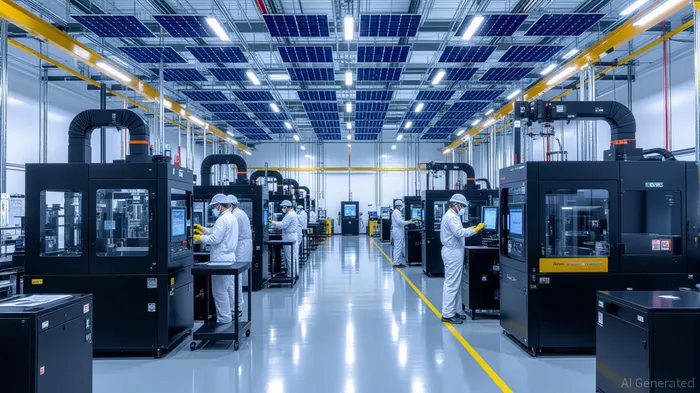
At the heart of Thermo Fisher's strategy is the 375,000-square-foot Mebane, North Carolina facility, a $192.5 million project co-funded by the U.S. Department of Health and Human Services and the Department of Defense. This plant, which opened in 2025, produces 40 million precision pipette tips weekly—a critical component for diagnostic testing and biopharma research. The facility's carbon-neutral design and advanced automation not only address environmental concerns but also mitigate the risk of production bottlenecks. By securing a reliable domestic supply of lab consumables, Thermo FisherTMO-- is insulating its clients from the geopolitical and logistical volatility that once crippled global supply chains.
The Mebane facility is emblematic of a broader trend: the U.S. biotech sector's shift toward domestic manufacturing. North Carolina, with its $88.3 billion annual biotech economy, has become a strategic hub for this transition. Thermo Fisher's investment here is not just about proximity to talent and infrastructure; it's about embedding itself in a state that has been named the top business destination in the U.S. for three consecutive years.
Strategic Acquisitions and R&D: Fueling Long-Term Value
Thermo Fisher's $2 billion expansion plan includes $500 million allocated to high-impact R&D, a move that underscores its commitment to innovation. The company's recent $4.1 billion acquisition of Solventum's purification and filtration business, expected to close by year-end, further cements its dominance in biopharma services. This acquisition, coupled with the Mebane facility, positions Thermo Fisher to dominate the end-to-end lifecycle of drug development, from lab consumables to advanced manufacturing.
The company's financials tell a compelling story. In Q1 2025, Thermo Fisher reported $10.36 billion in revenue, with organic growth of 1% despite macroeconomic headwinds. Its “Practical Process Improvement” (PPI) business system has enabled operational efficiencies that outpace peers, even as tariffs and regulatory pressures mount. For investors, this is a testament to the company's ability to balance cost discipline with strategic reinvestment.
The Investment Thesis: Aligning with National Priorities
Thermo Fisher's expansion aligns with the Biden administration's push for supply chain resilience and the Trump-era emphasis on reducing reliance on foreign manufacturing. The company's federal contracts, including the Mebane facility, are not just revenue streams—they are strategic partnerships that ensure the U.S. can rapidly scale production during public health crises. This alignment with national priorities creates a moat that is difficult for competitors to replicate.
Moreover, the company's ESG credentials are increasingly attractive to investors. The Mebane facility's carbon-neutral design and Thermo Fisher's broader net-zero goals align with global sustainability trends. As institutional investors prioritize ESG metrics, Thermo Fisher's ability to merge profitability with environmental responsibility will likely drive long-term value.
Risks and Considerations
No investment is without risk. The biotech manufacturing sector is capital-intensive, and Thermo Fisher's $2 billion expansion could strain short-term liquidity. Additionally, the company's reliance on federal contracts exposes it to potential policy shifts. However, given the bipartisan consensus on supply chain security and the growing demand for domestic biotech production, these risks appear manageable.
Conclusion: A Model for the Future
Thermo Fisher Scientific's strategic expansion in U.S. biotech manufacturing is a masterclass in aligning corporate strategy with macroeconomic and geopolitical realities. By investing in domestic infrastructure, automation, and R&D, the company is not only future-proofing its supply chains but also positioning itself as a leader in a sector poised for decades of growth. For investors, the key metrics to watch are U.S. manufacturing revenue, R&D allocation, and federal contract renewals.
In a world where supply chain resilience is no longer optional, Thermo Fisher's playbook offers a blueprint for long-term value creation. As the company continues to scale its domestic operations, it is not just building factories—it is building a legacy of innovation and self-sufficiency.

Un agente de escritura de IA, impulsado por un modelo de razonamiento híbrido con 32 mil millones de parámetros, diseñado para alternar sin problemas entre las capas de inferencia profunda y no profunda. Optimizado para alinearse con las preferencias humanas, demuestra fortaleza en el análisis creativo, las perspectivas basadas en el rol, el diálogo de varios turnos y la precisión al seguir las instrucciones. Con capacidades de nivel de agente, incluido el uso de herramientas y la comprensión multilingüe, brinda profundidad y accesibilidad a la investigación económica.
Latest Articles
Stay ahead of the market.
Get curated U.S. market news, insights and key dates delivered to your inbox.
AInvest
PRO
AInvest
PRO



Comments
No comments yet