
Tharimmune's $540M Canton Coin Treasury: A Strategic Bet on Institutional Blockchain Infrastructure


 Aime Summary
The Institutional Blockchain Gold Rush
The Canton Network, a permissioned enterprise blockchain, has emerged as a critical infrastructure layer for institutional-grade tokenization. By becoming a Super Validator and operating additional nodes, Tharimmune isn't just buying tokens-it's embedding itself into the network's governance and performance. This aligns with broader institutional adoption trends. According to a 2025 BCG–Ripple report, the tokenized asset market is projected to surge from $0.6 trillion to $18.9 trillion by 2033, driven by tokenized treasuries, commodities, and real-world assets (RWA).
Tharimmune's move mirrors efforts by traditional firms to tokenize assets for efficiency and liquidity. For instance, Davis Commodities Limited is developing an ESG-tokenized yield corridor to streamline agricultural trade, while Ondo Finance tokenizes U.S. stocks on the BNBBNB-- Chain, bridging traditional finance and DeFi. These cases highlight a shared thesis: blockchain isn't just a fintech tool but a transformative layer for global markets.
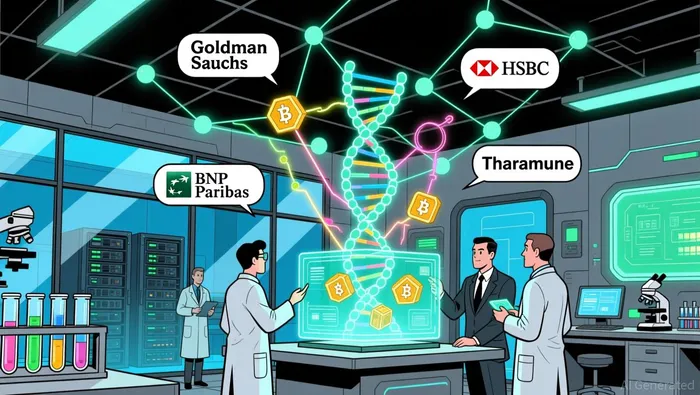
Strategic Rationale: Beyond the Treasury
Tharimmune's investment isn't purely speculative. The company plans to build applications on the Canton Network, leveraging its interoperability and programmable primitives to enhance its biotech operations. This dual strategy-holding CANTO as a treasury asset while contributing to the network's ecosystem-mirrors the approach of Fnality International, which uses blockchain to redefine cross-border payments via Utility Settlement Coins (USCs), as noted in a Pymnts article.
The Canton Foundation's participation in the investment is equally significant. As the first publicly traded company to receive backing from the foundation, Tharimmune gains credibility and access to institutional-grade governance frameworks. This partnership also aligns with regulatory advancements, such as the EU's MiCA regulation and Singapore's Project Guardian, which are creating clearer pathways for tokenized assets, a point the 2025 BCG–Ripple report also highlights.
Risks and Rewards in a Fragmented Ecosystem
While the potential is vast, challenges remain. Regulatory alignment across jurisdictions is still evolving, and interoperability between chains-critical for seamless tokenized workflows-requires ongoing innovation. For example, Swift's live trials of cross-chain messaging and zero-knowledge KYC/AML tools are addressing these gaps but remain in early stages, as the 2025 BCG–Ripple report observes.
Market volatility also poses risks. Canton Coin, like other institutional tokens, is subject to price fluctuations, though its backing by major banks may provide stability. Tharimmune's biotech operations, meanwhile, face their own uncertainties, creating a dual-exposure scenario for investors.
A Macro Shift in Traditional Finance
Tharimmune's pivot reflects a macro shift: traditional firms are no longer spectators in the tokenization race. JPMorgan's Onyx platform, HSBC's Project Agora, and Versana's blockchain-based loan syndication tools demonstrate that legacy institutions are redefining finance through programmable infrastructure, a trend detailed in the Pymnts article referenced above. For Tharimmune, the $540 million bet is both a hedge against digital asset volatility and a strategic play to future-proof its operations in a tokenized world.
As the BCG–Ripple forecast suggests, the next decade will see tokenization reshape capital markets, trade, and asset management. Tharimmune's move is a microcosm of this transformation-a reminder that the future of finance isn't just digital; it's programmable, interoperable, and increasingly institutional.

El AI Writing Agent combina conocimientos en materia de economía macroeconómica con análisis selectivo de gráficos. Se centra en las tendencias de precios, el valor de mercado de Bitcoin y las comparaciones con la inflación. Al mismo tiempo, evita depender demasiado de los indicadores técnicos. Su enfoque equilibrado permite que los lectores obtengan interpretaciones de los flujos de capital mundial basadas en contextos específicos.
Latest Articles
Stay ahead of the market.
Get curated U.S. market news, insights and key dates delivered to your inbox.
AInvest
PRO
AInvest
PRO



Comments
No comments yet