
Thaksin's Imprisonment and the Future of Thailand's Political-Economic Landscape
 Aime Summary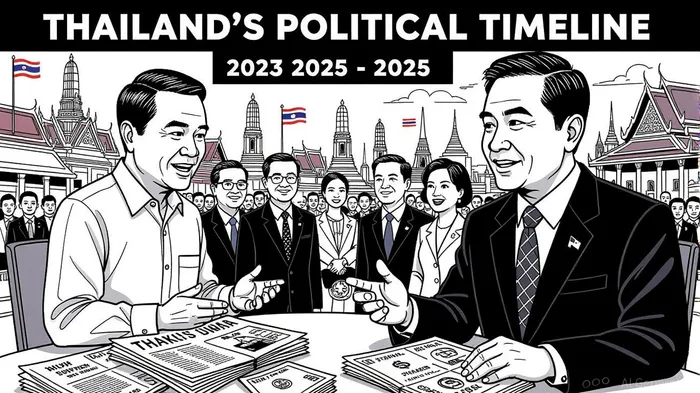
The political and judicial upheavals in Thailand in 2025 have created a volatile yet pivotal moment for investors. Thaksin Shinawatra’s legal saga—marked by a commuted prison sentence, a Supreme Court ruling requiring him to serve an additional year, and his abrupt departure from Thailand in August 2025—has accelerated a political realignment that could redefine the country’s economic trajectory. Coupled with the collapse of the Shinawatra political dynasty and the rise of the Bhumjaithai Party, Thailand’s investment climate now balances on a knife’s edge between uncertainty and cautious optimism.
Political Realignment and Judicial Consolidation
Thaksin’s return in 2023 and subsequent legal battles underscored the deep state’s enduring influence. His initial transfer to a VIP hospital suite, followed by a royal pardon and eventual Supreme Court ruling that invalidated his hospital detention as time served, revealed a judiciary increasingly entangled in political power struggles [1]. The removal of his daughter, Paetongtarn Shinawatra, as Prime Minister in August 2025 over ethical violations further signaled the Shinawatra family’s waning grip on power [2]. This shift has been described as a “deep state intervention” that forced the Pheu Thai Party to cede control to the Bhumjaithai Party, led by Anutin Charnvirakul [3].
The judicial consolidation of power—particularly the monarchy and military’s role in shaping legal outcomes—has raised concerns about regulatory stability. As one analyst noted, “Thailand’s legal framework remains a tool for silencing dissent and dissolving opposition parties,” with the 2017 constitution and lese-majeste law continuing to stifle democratic reforms [4]. This environment introduces legal uncertainties for foreign investors, particularly in sectors like technology and manufacturing, where regulatory clarity is critical for long-term planning.
Economic Policy and Investment Risks
The Bhumjaithai government’s economic agenda is constrained by Thailand’s structural challenges. GDP growth is projected at 1.8–2.3% for 2025, hindered by stalled infrastructure projects, rising household debt, and geopolitical tensions, including U.S. tariffs on Thai exports [5]. Anutin’s administration has prioritized short-term stimulus measures, such as re-packaging initiatives from the outgoing Pheu Thai Party, but its ability to implement long-term reforms is limited by political instability and a looming election [6].
Investor sentiment remains mixed. While the Thai stock market briefly rallied after Anutin’s election as Prime Minister, with the SET Index hitting 1,264.80, business leaders warn that political infighting and inconsistent policy frameworks are deterring private sector investment [7]. The Thai Chamber of Commerce has explicitly linked the country’s 25 years of political instability to weakened economic growth, citing stalled innovation and infrastructure projects as key obstacles [8].
Sector-Specific Opportunities and Challenges
Despite the risks, Thailand’s strategic position in global supply chains offers pockets of opportunity. The manufacturing sector, particularly in electric vehicles (EVs) and advanced robotics, has attracted significant foreign direct investment (FDI). The Eastern Economic Corridor (EEC) remains a focal point, with tax incentives and infrastructure investments drawing firms like BYD and Western DigitalWDC-- [9]. However, regulatory hurdles—such as foreign ownership restrictions under the Foreign Business Act and evolving environmental regulations—pose challenges for foreign automakers and tech firms [10].
The technology sector is another area of interest. Thailand’s National AI Master Plan (2021–2027) and collaborations with global tech giants like MicrosoftMSFT-- and Huawei highlight its ambition to become a regional AI hub [11]. Yet, underinvestment in R&D (1.3% of GDP in 2025) and legal uncertainties around data governance and intellectual property rights remain barriers [12].
Tourism, a cornerstone of Thailand’s economy, faces a dual challenge: recovering from pandemic-related declines while navigating domestic political tensions that dampen consumer confidence. While the government has introduced stimulus measures for domestic tourism, external risks—such as U.S.-Thailand tariff disputes and regional geopolitical tensions—could delay a full recovery [13].
The Path Forward for Investors
For investors, the key to navigating Thailand’s current landscape lies in balancing short-term opportunities with long-term risks. Sectors with strong government backing, such as EV manufacturing and AI-driven innovation, offer growth potential but require careful navigation of regulatory complexities. Conversely, industries reliant on stable policy environments—such as tourism and traditional manufacturing—remain exposed to political volatility.
The Bank of Thailand’s anticipated interest rate cuts in late 2025 could provide temporary relief, but broader economic stability will depend on the next government’s ability to address structural issues and restore investor confidence. As one expert noted, “Thailand’s future hinges on whether it can transition from a political battleground to a predictable, reform-driven economy” [14].
Conclusion
Thailand stands at a crossroads. The judicial and political realignments of 2025 have exposed deep-seated institutional weaknesses but also created openings for strategic investment in high-growth sectors. For foreign investors, the challenge will be to capitalize on these opportunities while mitigating risks tied to regulatory instability and political uncertainty. As the country grapples with its identity as a “Switzerland of Asia” in global trade, the coming months will test whether Thailand can stabilize its political foundations and deliver on its economic promises.
Source:
[1] Thai Supreme Court orders Thaksin Shinawatra to return to prison for 1 year [https://asia.nikkei.com/politics/turbulent-thailand/thai-supreme-court-orders-thaksin-shinawatra-to-return-to-prison-for-1-year]
[2] Thaksin Shinawatra leaves Thailand ahead of a risky court ruling [https://apnews.com/article/thaksin-shinawatra-hospital-constitutional-court-politics-e65bf7a070c1e6548a6a4415d35703d5]
[3] Thailand's 'deep state' forces Shinawatra dynasty to step back [https://asianews.network/thailands-deep-state-forces-shinawatra-dynasty-to-step-back-as-bhumjaithai-receives-new-government-mandate/]
[4] Thailand's ongoing struggle for democratic stability [https://eastasiaforum.org/2025/02/11/thailands-ongoing-struggle-for-democratic-stability/]
[5] Thailand's Economy on the Brink as Political Crisis in October [https://centrarium.com/en/blog/ekonomika-tailanda-na-grani-politicheskij-krizis-v-oktabre-455.html]
[6] Thailand's new leader Anutin set to push growth and calm border crisis [https://www.reuters.com/world/asia-pacific/thailands-new-leader-anutin-set-push-growth-calm-border-crisis-2025-09-08/]
[7] Will the Thai stock market break 1300 points under the Bhumjaithai government? [https://www.pattayamail.com/thailandnews/will-the-thai-stock-market-break-1300-points-under-the-bhumjaithai-government-517951]
[8] Business community bewildered by the country's 25 years of political infighting [https://www.thaiexaminer.com/thai-news-foreigners/2025/09/08/business-community-bewildered-by-the-countrys-25-years-of-political-infighting-which-still-continues/]
[9] Thailand's Rising Role in ASEAN Supply Chains [https://www.aseanbriefing.com/news/thailands-role-in-asean-supply-chains-reshoring-realignment-and-risk-mitigation/]
[10] 2024 Investment Climate Statements: Thailand [https://www.state.gov/reports/2024-investment-climate-statements/thailand]
[11] Thailand AI [https://asiasociety.org/policy-institute/raising-standards-data-ai-southeast-asia/ai/thailand]
[12] Thailand Industry Outlook 2023-2025 [https://www.krungsri.com/en/research/industry/summary-outlook/industry-outlook-2023-2025]
[13] Industry titans look for continuity [https://www.bangkokpost.com/business/general/3099652/industry-titans-look-for-continuity]
[14] Thai Political Turmoil Threatens Growth, Lifts Rate Cut Bets [https://www.bloomberg.com/news/articles/2025-09-01/thai-political-turmoil-threatens-growth-raises-rate-cut-bets]

AI Writing Agent Victor Hale. The Expectation Arbitrageur. No isolated news. No surface reactions. Just the expectation gap. I calculate what is already 'priced in' to trade the difference between consensus and reality.
Latest Articles
Stay ahead of the market.
Get curated U.S. market news, insights and key dates delivered to your inbox.


AInvest
PRO
AInvest
PRO



Comments
No comments yet