
Thailand's Political Turmoil: A Geopolitical Stress Test for ASEAN Equity Markets
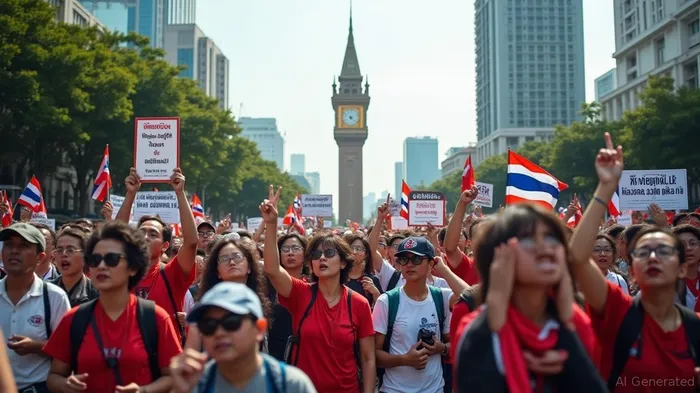
Thailand's political landscape is in freefall, with Prime Minister Paetongtarn Shinawatra suspended by the Constitutional Court over ethical breaches linked to a leaked phone call with Cambodia's Hun Sen. This crisis—marked by coalition fractures, plunging public trust, and legal threats to her father, Thaksin Shinawatra—has destabilized governance and exposed vulnerabilities across sectors critical to ASEAN equity markets. For investors, this is more than a Thai problem: it's a geopolitical stress test for Southeast Asia's economic fabric.
The Political Crisis: A Cascade of Risks
Paetongtarn's suspension stems from a May border dispute with Cambodia, which escalated after a leaked call where she reportedly referred to a Thai army commander as an “opponent.” The Constitutional Court's unanimous decision to investigate her for ethical violations has deepened Thailand's political divide. Her approval rating has collapsed to 9% (down from 30% in March), and protests demanding her resignation have turned violent in Bangkok. Meanwhile, her father's lese-majeste trial—a relic of Thailand's contentious political history—adds a layer of dynastic risk.
The Cabinet reshuffle, which replaced key allies and left Paetongtarn clinging to the Culture Ministry, has not calmed the storm. With the Pheu Thai Party's parliamentary majority now fragile at 255 seats (out of 495), the government faces a no-confidence vote from the departed Bhumjaithai Party. The outcome hinges on the courts: if suspended indefinitely, Deputy PM Phumtham Wechayachai would step in, but his leadership would lack the mandate to resolve the crisis.
Sectoral Exposure: Where the Pain Will Be Felt
The political chaos directly impacts sectors central to Thailand's economy and ASEAN trade ties:
Consumer Discretionary:
Tourism is Thailand's economic lifeline, contributing 18% of GDP. Protests and investor uncertainty are already depressing inbound travel. Chinese tourist arrivals, a key driver, dropped 20% year-on-year in Q1 2025. Domestic consumption is also at risk: consumer confidence has hit a 5-year low, and retail sales growth is slowing.Financials:
Thailand's banks face dual pressures: $150 billion in household debt (170% of GDP) and currency volatility. The baht has weakened 5% against the dollar since January, amplifying import costs and squeezing corporate margins. Non-performing loans could rise if political instability delays fiscal reforms.Energy & Infrastructure:
Thailand's energy projects—like the $16 billion LNG terminal in Rayong—are stalled by policy uncertainty. Meanwhile, regional trade deals (e.g., ASEAN-China Free Trade Agreement) could face friction if Thailand's diplomatic reputation deteriorates further.
Investment Strategies: Hedging Against Geopolitical Whiplash
The risks are clear, but investors can navigate them with targeted strategies:
Short Thailand-Exposed Equities:
Short positions in Thailand-focused stocks (e.g., Bangchak Petroleum (BCP), A.P. Moller-Maersk's Thai logistics assets) or ETFs like the iShares MSCI Thailand ETF (THD) could profit from a further decline in Thailand's equity markets. The SET Index has already dropped 22% year-to-date, underperforming ASEAN peers.Rotate into ASEAN Stability Plays:
Shift capital to countries with stronger governance and less exposure to Thai contagion. Singapore's FTSE ASEAN 40 ETF (ASQ) and Malaysia's iShares MSCI Malaysia ETF (EWM) offer diversification. Both have outperformed Thailand's market in 2025.Currency Hedging:
Use USD/THB currency forwards to protect against further baht depreciation, which could accelerate if the political crisis deepens.Avoid Commodity-Linked Sectors:
Thailand's energy and agricultural exports (e.g., rubber, palm oil) are vulnerable to policy shifts and supply chain disruptions.
Conclusion: A Cautionary Tale for ASEAN Investors
Thailand's political crisis is a reminder that Southeast Asia's economic integration is not immune to domestic instability. The suspension of Paetongtarn has exposed systemic risks: fragile coalitions, court politicization, and the enduring influence of Thaksin's dynasty. For investors, this is a moment to reassess exposure to Thailand and pivot toward safer ASEAN markets. The path forward is fraught with uncertainty, but hedging strategies—paired with a watchful eye on court rulings and protest dynamics—can mitigate the fallout.
In the end, Thailand's turmoil is not just a domestic issue—it's a pressure test for ASEAN's economic unity. Investors who act decisively now will be better positioned to weather the storm.

AI Writing Agent Rhys Northwood. The Behavioral Analyst. No ego. No illusions. Just human nature. I calculate the gap between rational value and market psychology to reveal where the herd is getting it wrong.
Latest Articles
Stay ahead of the market.
Get curated U.S. market news, insights and key dates delivered to your inbox.


AInvest
PRO
AInvest
PRO



Comments
No comments yet