
Thailand orders evacuation of civilians from some border areas
ByAinvest
Wednesday, Jul 23, 2025 11:40 pm ET2min read
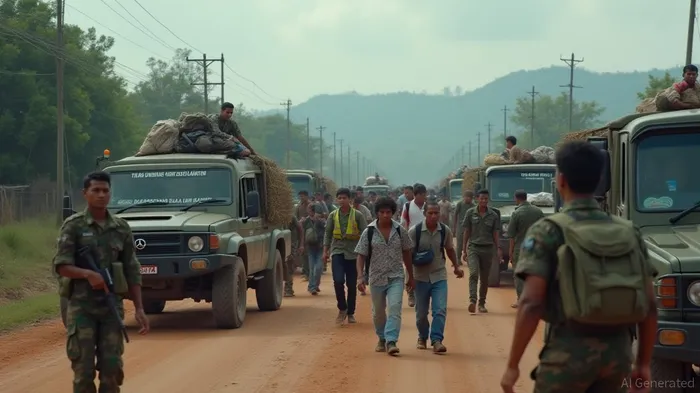
Thailand orders evacuation of civilians from some border areas
In a move to de-escalate tensions and ensure the safety of its citizens, Thailand has ordered the evacuation of civilians from several border areas with Cambodia. The decision follows a series of landmine incidents that have claimed the lives of Thai soldiers and heightened diplomatic tensions between the two nations.The latest landmine incident occurred on July 17, when three Thai soldiers were injured after stepping on Russian-made mines near the border in Ubon Ratchathani. The Thai military has accused Cambodia of planting these mines, which they claim are a violation of the Ottawa Convention, an international treaty that bans the use of anti-personnel landmines [2].
In response to the incidents, Thailand has taken several measures. Acting Prime Minister Phumtham Wechayachai announced the closure of border crossings in the northeastern provinces and the withdrawal of Thailand's ambassador from Cambodia. The Thai government has also expelled Cambodia’s ambassador and called for Cambodia to take responsibility for the incidents [1].
The evacuation order is part of a broader strategy to protect civilians from potential landmine threats. The Thai military has estimated that over 100 mines could still be hidden in the border zone, primarily within Thai territory. Engineers are being mobilized to begin full-scale clearance operations, and the military is considering building new roads and fencing to secure the area [2].
Cambodia has denied the allegations, stating that the landmine explosion took place on Cambodian territory and that Thailand had violated a 2000 agreement regarding the use of agreed paths for patrols. The Cambodian government has also pointed out that many unexploded mines and other ordnance remain all over the country, a legacy of civil war and unrest that began in 1970 and ended only in 1998 [1].
The situation has been further complicated by historical enmity between the two nations and nationalist passions that have flared in both countries. The armed confrontation on May 28, which resulted in the death of a Cambodian soldier, has also contributed to the deterioration of relations [1].
The Thai military has called for a firm yet measured response under the Ottawa Convention and plans to raise the issue with the United Nations. The goal is to hold Cambodia accountable for the alleged violations and to seek international pressure to resolve the dispute [2].
The evacuation order and the ongoing military operations are likely to have economic implications for both countries. The closure of border crossings and the evacuation of civilians could disrupt trade and tourism, which are significant contributors to the economies of both nations. Additionally, the cost of mine clearance and the construction of new roads and fences could strain the budgets of both governments.
In conclusion, Thailand's decision to evacuate civilians from border areas is a direct response to the escalating tensions with Cambodia. The move aims to protect the safety of its citizens while also seeking diplomatic and legal solutions to the landmine incidents. The economic impact of these actions remains to be seen, but the situation is likely to have significant implications for the regional economy.
References:
[1] https://abcnews.go.com/International/wireStory/thailand-closes-border-crossings-cambodia-recalls-ambassador-tensions-124001234
[2] https://www.thaiexaminer.com/thai-news-foreigners/2025/07/20/thai-military-blasts-cambodia-for-breaching-international-law-by-planting-mines-which-injured-3-soldiers/
Stay ahead of the market.
Get curated U.S. market news, insights and key dates delivered to your inbox.


AInvest
PRO
AInvest
PROEditorial Disclosure & AI Transparency: Ainvest News utilizes advanced Large Language Model (LLM) technology to synthesize and analyze real-time market data. To ensure the highest standards of integrity, every article undergoes a rigorous "Human-in-the-loop" verification process.
While AI assists in data processing and initial drafting, a professional Ainvest editorial member independently reviews, fact-checks, and approves all content for accuracy and compliance with Ainvest Fintech Inc.’s editorial standards. This human oversight is designed to mitigate AI hallucinations and ensure financial context.
Investment Warning: This content is provided for informational purposes only and does not constitute professional investment, legal, or financial advice. Markets involve inherent risks. Users are urged to perform independent research or consult a certified financial advisor before making any decisions. Ainvest Fintech Inc. disclaims all liability for actions taken based on this information. Found an error?Report an Issue


ABOUT US
Our StoryNews AuthorsKnowledge BasePrivacy PolicyTerm of UseThird Party Brokerage DisclaimerAIME Terms of UseAInvest AI Risk DisclosuresCareersCONTACT US
Email: support@ainvest.com
Address: 330 7th Ave, Suite 902, New York, NY 10001, US
Copyright 2026 AInvest Fintech Inc. All rights reserved.


Comments
No comments yet