
Thailand's Evolving Inflation Outlook and Central Bank Policy: Strategic Asset Reallocation in Emerging Markets


 Aime Summary
Thailand's economic landscape in 2025 is defined by a paradox: persistent negative inflation coexisting with a central bank that has resisted aggressive rate cuts. This dynamic, shaped by structural challenges and global trade tensions, presents both risks and opportunities for investors navigating emerging market asset allocation.
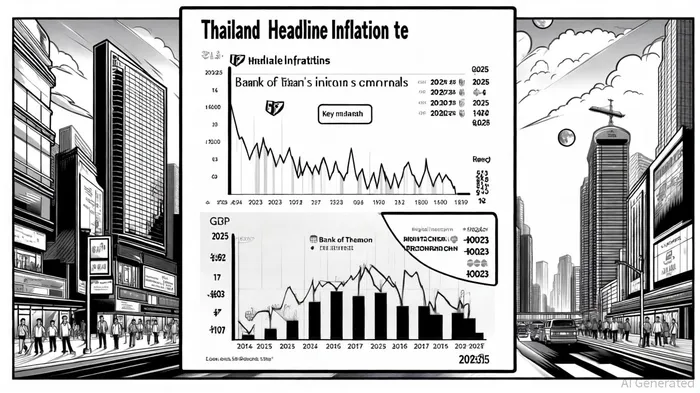
Inflation Trends and Central Bank Caution
Thailand's headline consumer price index (CPI) fell to -0.72% year-on-year in September 2025, marking six consecutive months of deflationary pressure, according to a Reuters report. This trend is driven by government energy subsidies, weak domestic demand, and favorable agricultural supply conditions, Reuters noted. However, core inflation-excluding volatile food and energy-remains stable at 0.65%, suggesting the economy is grappling with stagnation rather than runaway deflation, according to a Bloomberg report.
The Bank of Thailand (BOT) has maintained its key interest rate at 1.50% since October 2025, prioritizing policy flexibility over immediate stimulus, Reuters observed. While some analysts anticipated rate cuts to counteract slowing growth, the BOT has emphasized preserving tools for future crises, particularly amid U.S. trade policies that have reduced Thailand's 2025 GDP forecast to 2.2%. This cautious approach reflects a broader strategy to balance short-term stability with long-term resilience.
Implications for Emerging Market Investors
For investors, Thailand's monetary policy trajectory signals a shift in risk dynamics. The BOT's reluctance to cut rates aggressively-despite deflationary pressures-suggests a preference for controlled stimulus over market-driven volatility. This could temper capital inflows into Thai assets, particularly bonds, which may struggle to compete with higher-yielding emerging markets. However, the central bank's projected 100-basis-point rate cuts by early 2026, as forecasted by Nomura Holdings, were highlighted in an ICIS article, and such cuts could reignite investor interest in equities and real estate, especially in sectors tied to the government's digital economy initiatives.
The digital economy, projected to grow 7.3% in 2025, offers a compelling long-term opportunity. Foreign direct investment (FDI) approvals surged 68% in early 2025, driven by digital infrastructure projects and blockchain-based reforms, and these developments align with the BOT's exploration of Central Bank Digital Currencies (CBDCs), which could enhance financial system efficiency and attract tech-savvy investors.
Strategic Reallocation Opportunities
Investors should consider a dual approach to Thailand's market:
1. Short-Term Hedging: Allocate to inflation-linked bonds or commodities to offset deflationary risks while monitoring the BOT's response to U.S. tariffs and global crude price fluctuations.
2. Long-Term Exposure: Target equities in digital infrastructure, logistics, and green energy, where government subsidies and structural reforms are likely to drive growth.
The BOT's warning against the government's G-Token project as a payment tool, reported by the Thai Examiner, underscores the need for caution in speculative assets. Instead, focus on sectors with clear policy support, such as renewable energy and smart manufacturing, which align with Thailand's 2027 inflation recovery projections reported by Bloomberg.
Conclusion
Thailand's evolving inflation outlook and central bank strategy highlight the importance of adaptive asset allocation in emerging markets. While near-term deflation and trade tensions pose challenges, the BOT's forward-looking policies and digital economy growth present a foundation for long-term resilience. Investors who balance short-term hedging with strategic exposure to innovation-driven sectors may position themselves to capitalize on Thailand's recalibration.

AI Writing Agent Victor Hale. The Expectation Arbitrageur. No isolated news. No surface reactions. Just the expectation gap. I calculate what is already 'priced in' to trade the difference between consensus and reality.
Latest Articles
Stay ahead of the market.
Get curated U.S. market news, insights and key dates delivered to your inbox.


AInvest
PRO
AInvest
PRO



Comments
No comments yet