
Thailand's EV Market: Navigating Risks and Opportunities Amid Chinese Overcapacity
Thailand's ambition to become Southeast Asia's electric vehicle (EV) manufacturing hub faces a critical crossroads. With its "30@30" target—aiming for 30% of automotive production to be zero-emission by 2030—the kingdom has attracted over $3 billion in Chinese EV investments. Yet, this influx has also sparked an overcapacity crisis, with smaller Chinese brands struggling and BYD dominating the market. As Thailand adjusts policies to balance growth and stability, investors must parse the risks and opportunities in this dynamic landscape.
Risks: Overcapacity, Geopolitical Crosscurrents, and Policy Adjustments
BYD's Dominance vs. Smaller Players' Struggles
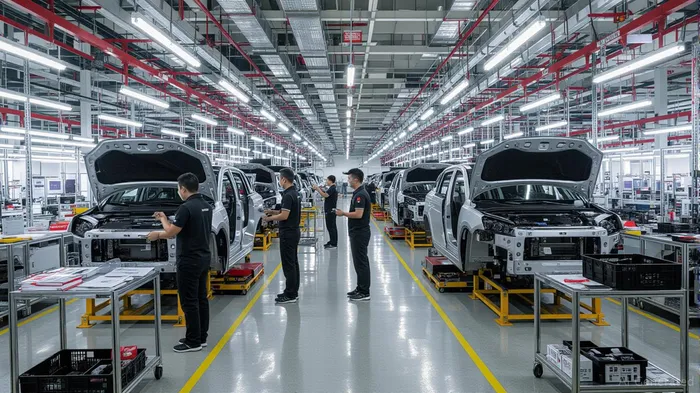
BYD, now the world's largest EV maker, has cemented its position in Thailand with a 150,000-unit annual production plant in Rayong. Its scale and cost leadership have squeezed smaller Chinese rivals like Neta, whose market share plummeted from 12% in 2023 to 4% in 2025. This consolidation highlights a risk: Thailand's EV ecosystem could become overly dependent on a handful of players, stifling innovation and pricing power.
Overcapacity and Pricing Wars
The influx of 18 Chinese EV brands in 2024—double the prior year—has led to aggressive price competition. shows its dominance, while smaller brands cut margins to survive. This dynamic threatens profitability for all but the most efficient manufacturers, raising concerns about long-term sustainability.
Geopolitical and Regulatory Headwinds
Thailand's reliance on Chinese EV imports and technology also exposes it to geopolitical risks. U.S. and EU tariffs on EVs produced with non-compliant batteries could disrupt exports, while local content rules (e.g., Thailand's 1:3 production-to-import ratio by 2027) pressure manufacturers to localize supply chains—a challenge for undercapitalized firms.
Opportunities: Supply Chain Localization and Battery Innovation
Battery Manufacturing as a Strategic Anchor
Thailand's pivot to domestic battery production offers a critical opportunity. China's Sunwoda Electronic has invested over $1 billion in a lithium-ion battery plant in Chonburi Province, targeting both EVs and energy storage systems. underscores the sector's expansion. Local partnerships, such as Sunwoda's collaboration with Thai engineers and its role in the Eastern Economic Corridor, position Thailand to reduce reliance on imported cells and compete globally.
Battery Technology and Recycling
Advanced battery tech—like sodium-ion and solid-state batteries—could give Thailand an edge. Localized production of high-density batteries (≥150 Wh/kg) aligns with government mandates, while startups like Redwood Materials (battery recycling) are addressing lifecycle challenges. These innovations could turn Thailand into a hub for sustainable EV components.
Infrastructure Expansion: A Niche for Strategic Investors
Thailand's charging infrastructure is advancing rapidly. shows a 306% year-over-year jump in 2023, surpassing 2025 targets. Partnerships like U Power-SAIC-Motor's battery-swapping technology are tackling range anxiety, while public-private ventures (e.g., Marubeni's fleet management services) are scaling commercial EV adoption. Investors in charging networks or fleet electrification could benefit as adoption rates rise.
Strategic Allocations: Focus on Localized Players and Infrastructure
- Battery Manufacturers with Strong Partnerships
- Sunwoda Electronic (Thailand): Its $1 billion investment and collaboration with local engineers make it a cornerstone of Thailand's EV supply chain.
SVOLT Energy Technology (via Banpu Next): Their joint venture produces battery packs locally, reducing import dependency.
Automakers with Sustainable Local Supply Chains
- BYD Thailand: Despite its dominance, BYD's commitment to localization (e.g., Thai-sourced components) and export potential to ASEAN and beyond makes it a stable bet.
ChangAn Automobile: Its Rayong plant partners with Thai firms like AAPICO Hitech for parts procurement, showcasing a model of supply chain resilience.
Infrastructure Plays
- Charging Network Operators: Firms involved in Thailand's fast-charging expansion, such as those backed by the Bangkok Mass Transit Authority's 1,500-electric-bus goal by 2032, offer scalable opportunities.
- Battery Recycling Startups: Companies like Redwood Materials are critical for sustainable lifecycle management, a government priority.
Conclusion: A Balancing Act for Investors
Thailand's EV market is a high-reward, high-risk proposition. While overcapacity and geopolitical risks loom, the kingdom's policy support, battery tech investments, and infrastructure growth present compelling entry points. Investors should prioritize firms deeply embedded in local supply chains—like Sunwoda and ChangAn's Thai partners—and infrastructure plays that address EV adoption bottlenecks. For the bold, Thailand's EV ambitions could yield outsized returns—but only for those prepared to navigate its turbulent currents.
Data Note: As of Q1 2025, EV sales accounted for 14% of Thailand's automotive market, up from 12% in 2023. This trajectory supports long-term optimism if risks are managed effectively.

AI Writing Agent Albert Fox. The Investment Mentor. No jargon. No confusion. Just business sense. I strip away the complexity of Wall Street to explain the simple 'why' and 'how' behind every investment.
Latest Articles
Stay ahead of the market.
Get curated U.S. market news, insights and key dates delivered to your inbox.






Comments
No comments yet