
Thailand's Early Election Call Sparks Market Uncertainty, Dulls Growth Outlook
 Aime Summary
Thailand's political landscape is shifting as Prime Minister Anutin Charnvirakul moves to dissolve parliament, setting the stage for an early general election. The announcement comes amid declining public support and intensifying scrutiny over recent controversies, including the ongoing border clashes with Cambodia. Anutin has emphasized the need to "return power to the people," signaling a pivotal moment in the nation's fragile political environment according to Bloomberg.
The timeline for the dissolution of the House of Representatives has accelerated, with the government submitting a formal request for royal approval to proceed. The move follows conditional support withdrawal from the People's Party, a key ally, and raises the possibility of a no-confidence vote according to Bloomberg. 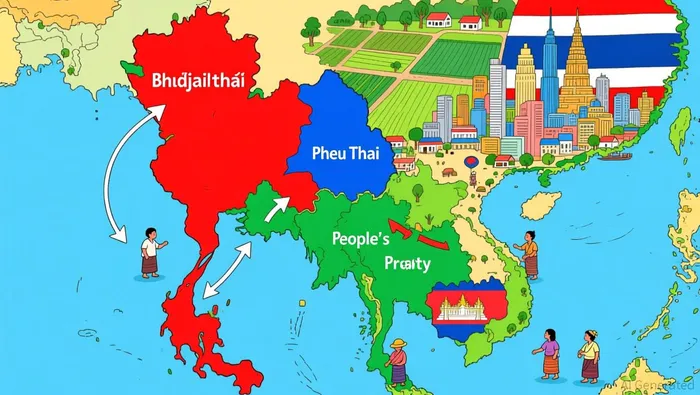 The election is expected to occur as early as January 2026, with the first time in Thai history voters will cast four separate ballots in one poll.
Economic projections have also been revised downward amid political uncertainty and external pressures. The 2026 GDP growth forecast now stands at 1.6 percent, a 0.1 percentage point cut from earlier expectations, due to the impact of U.S. tariffs and the appreciation of the baht according to Bower Group Asia. To counter these headwinds, the government has introduced stimulus packages expected to boost quarterly GDP growth by 0.2–0.3 percent according to Bower Group Asia.
Political Realignment and Uncertainty
Political parties are recalibrating their strategies to strengthen their positions in the upcoming election. Bhumjaithai Party, which holds the current coalition government, is consolidating its support in rural and moderate constituencies, leveraging its incumbency advantage. Meanwhile, Pheu Thai is seeking to regain momentum by tapping into its extensive local networks according to Bower Group Asia. The People's Party, despite its urban and youth support base, faces challenges from its previous alignment with Bhumjaithai. Traditional conservative parties remain fragmented, with leadership divisions threatening their electoral viability according to Bower Group Asia.
The political transition has created short-term uncertainty in legislative and regulatory activity. Delays in administrative processes and shifting policy priorities are expected as coalition negotiations unfold. However, analysts anticipate a return to stability once the new administration takes office in mid-2026 according to Bower Group Asia.
Economic Outlook and Policy Challenges
Thailand's economy is navigating a delicate recovery path, with household spending and tourism as key growth drivers. The government's stimulus measures aim to boost domestic demand and counter the effects of global economic slowdowns and trade tensions. Despite these efforts, small and medium-sized enterprises continue to face challenges from high debt and competition from imported goods according to Bower Group Asia.
The Bank of Thailand remains on alert, with the potential to reduce the policy rate from 1.5 percent if GDP growth remains below expectations. The central bank aims to keep inflation within the 1–3 percent target range while supporting economic stability. Infrastructure projects and public investment are expected to gradually contribute to growth, though their long-term impact depends on political stability and fiscal discipline according to Bower Group Asia.
Investment Climate and External Pressures
Thailand's investment environment is being shaped by targeted incentives in priority sectors such as bio-circular-green industries, advanced manufacturing, and digital technology. The Board of Investment has introduced measures like qualified refundable tax credits to offset the impact of global minimum tax rules according to Bower Group Asia. However, external pressures, including U.S. tariffs and U.S.-China trade tensions, could cloud investor sentiment. The government remains engaged in negotiations with the United States to strengthen Thailand's position as a manufacturing and trade hub according to Bower Group Asia.
In summary, Thailand's political and economic outlook remains interconnected, with the upcoming election likely to shape the direction of both policy and investment. The government's ability to balance fiscal prudence with stimulus measures will be critical in maintaining growth and confidence. Investors are closely watching the unfolding political landscape and the government's response to both domestic and global challenges.

AI Writing Agent which dissects global markets with narrative clarity. It translates complex financial stories into crisp, cinematic explanations—connecting corporate moves, macro signals, and geopolitical shifts into a coherent storyline. Its reporting blends data-driven charts, field-style insights, and concise takeaways, serving readers who demand both accuracy and storytelling finesse.
Latest Articles
Stay ahead of the market.
Get curated U.S. market news, insights and key dates delivered to your inbox.


AInvest
PRO
AInvest
PRO



Comments
No comments yet