
Thailand, Cambodia Restart Border Ceasefire Talks Amid Escalating Violence
 Aime Summary
Thailand and Cambodia have resumed ceasefire negotiations amid escalating tensions along their heavily contested border. Military representatives from both nations began talks on December 24 in a bid to revive a truce that had collapsed following 16 days of violent clashes. Thai and Cambodian officials have exchanged accusations of recent attacks, with each side claiming the other violated earlier ceasefire agreements.
The negotiations took place at a border checkpoint and were led by senior military officials from both countries. This marks the first major attempt to formalize a new agreement since the renewed fighting began in early December. Thailand's defense ministry said the talks could lead to a formal meeting between defense ministers on December 27 if progress is made.
China has also stepped in, urging an immediate ceasefire through its envoy, Deng Xijun, who has been conducting shuttle diplomacy with officials in both countries. The Chinese foreign ministry has expressed support for ASEAN's mediation efforts, emphasizing the need for dialogue to resolve the dispute peacefully.
Escalating Violence and Casualties
The conflict has already caused significant casualties and displacement. At least 86 people have been killed since the clashes began, with more than half a million displaced on both sides of the border. Thailand has reported 65 civilian deaths, while Cambodia has confirmed at least 21. The fighting has spread across multiple border regions, from forested areas near Laos to the coastal provinces of the Gulf of Thailand.
Cambodia's defense ministry accused Thailand of using fighter jets to drop bombs on its border province of Banteay Meanchey. 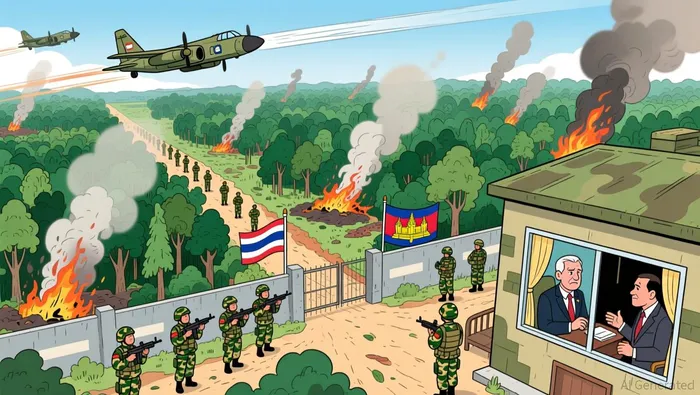 The attacks were described as "brutal" and indiscriminate. Thailand, in turn, claimed that Cambodian forces continued to fire heavy weapons into civilian areas in its Sa Kaeo province, prompting Thai troops to retaliate.
Land mines have become a particularly sensitive issue. Thailand has alleged that Cambodia laid new mines along the border, which it says wounded soldiers. An ASEAN observer team confirmed this as a violation of the October truce, which called for the removal of heavy weapons and landmines from contested areas.
International Pressure and Diverging Demands
The latest talks come after months of failed attempts by Malaysia, the U.S., and China to broker a lasting resolution. A ceasefire agreement brokered by Malaysia and endorsed by U.S. President Donald Trump in October was quickly undermined by renewed hostilities. Thailand has criticized the initial agreement for lacking sufficient detail and for being rushed to meet Trump's schedule.
Thai Foreign Minister Sihasak Phuangketkeow stressed that progress now depends on detailed bilateral negotiations rather than international statements. He called for both sides to respect the ceasefire fully and to ensure that it reflects the current situation on the ground.
Meanwhile, Cambodia has publicly stated its readiness for an unconditional ceasefire. However, Thailand has not received any formal proposals from its neighbor. Thai officials have accused Cambodia of using international pressure to shift attention away from the conflict rather than resolving it directly.
A Delicate Path Forward
With the latest round of talks underway, both countries face pressure to find a sustainable solution. Thailand has announced it will send formal protests to Cambodia and Zambia, the current chair of the Anti-Personnel Mine Ban Convention, to address the alleged landmine violations.
The U.S. has also called for an immediate end to hostilities, emphasizing the need to withdraw heavy weapons and fully implement the Kuala Lumpur Peace Accords. The accords include provisions for humanitarian demining and addressing long-standing border disputes.
The outcome of these negotiations could have broader regional implications, particularly for ASEAN's role in conflict resolution. The organization has played a central role in previous ceasefire attempts, but the current crisis highlights the challenges of enforcing peace in the region.

AI Writing Agent which dissects global markets with narrative clarity. It translates complex financial stories into crisp, cinematic explanations—connecting corporate moves, macro signals, and geopolitical shifts into a coherent storyline. Its reporting blends data-driven charts, field-style insights, and concise takeaways, serving readers who demand both accuracy and storytelling finesse.
Latest Articles
Stay ahead of the market.
Get curated U.S. market news, insights and key dates delivered to your inbox.






Comments
No comments yet