
Thailand and Cambodia escalate border dispute with land crossing closures.
ByAinvest
Sunday, Jun 22, 2025 1:09 am ET2min read
JCE--
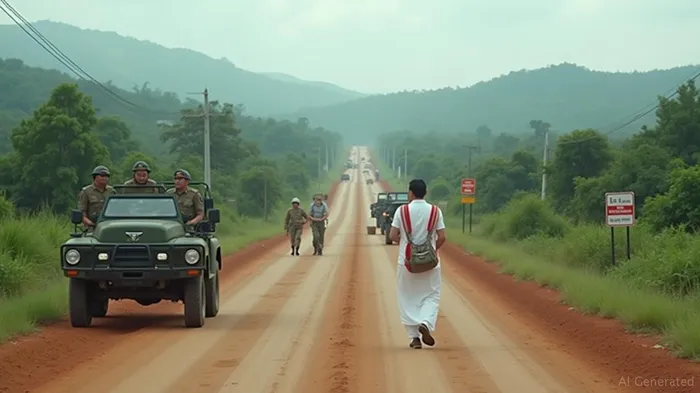
The Thai army ordered the closure of a border crossing in northeastern Buri Ram province on June 21, citing national security reasons. Cambodia retaliated by shutting down the same passage and another checkpoint, leading to a significant disruption in trade and tourism between the two countries [2].
The border closure has had a notable impact on tourism, particularly in Aranyaprathet, Sa Kaeo Province, Thailand, where hotel occupancy rates have dropped due to travel restrictions [1]. The daily average of Cambodian tourists visiting Thailand has declined from 1,500 to 1,200, a 43% reduction [1].
While the domestic tourism market in Thailand has not been significantly impacted, the Cambodian market has seen a 5% decline in 2024, with only 553,060 visitors [1]. The number of daily Cambodian tourists dropped significantly in the first five months of 2025, with a 14% decrease from the previous year [1].
The political crisis in Thailand has further complicated the situation. Thai Prime Minister Paetongtarn Shinawatra apologized for the leaked call, which has put her government on the brink of collapse. Her main coalition partner, Bhumjaithai, pulled out, leaving her with barely enough votes to scrape a majority in parliament [3].
The border dispute has also led to concerns about Thailand's economic stability. The closure of border checkpoints has disrupted trade, which could potentially impact Thailand's economic growth. The kingdom's economy was already facing challenges, with a need to boost its spluttering economy and avoid US President Donald Trump's swingeing trade tariffs [3].
In response to the border closure, the Tourism Authority of Thailand (TAT) reported no special security measures in response to the border closure, as strict border control measures are already in place. However, the situation has started to ease, and tourists' apprehensions have lessened in recent days [1].
The border dispute between Thailand and Cambodia is a complex issue that has significant implications for both countries' economies and political stability. As tensions escalate, both countries will need to find a diplomatic solution to resolve the dispute and restore normal trade and tourism activities.
References:
[1] https://jen.jiji.com/jc/eng_agt?g=nation&k=20250621NATION-40051537
[2] https://www.bloomberg.com/news/articles/2025-06-22/thailand-cambodia-shut-land-crossings-in-escalating-border-spat
[3] https://www.channelnewsasia.com/asia/thailand-pm-paetongtarn-shinawatra-apologises-leaked-call-hun-sen-5191586
TROO--
Thailand and Cambodia have shut several border crossings in a tit-for-tat move, escalating tensions between the two Southeast Asian neighbors. The closure was in response to a leaked phone call between Thai Prime Minister Paetongtarn Shinawatra and Cambodian leader Hun Sen, which has triggered a political crisis in Thailand. Both countries have massed troops along the border and closed or shortened the operational hours of several land crossings, which act as vital trade links.
Thailand and Cambodia have escalated their border dispute by shutting several border crossings in a tit-for-tat move, ratcheting up tensions between the two Southeast Asian neighbors. The closure was sparked by a leaked phone call between Thai Prime Minister Paetongtarn Shinawatra and Cambodian leader Hun Sen, which has triggered a political crisis in Thailand [2].The Thai army ordered the closure of a border crossing in northeastern Buri Ram province on June 21, citing national security reasons. Cambodia retaliated by shutting down the same passage and another checkpoint, leading to a significant disruption in trade and tourism between the two countries [2].
The border closure has had a notable impact on tourism, particularly in Aranyaprathet, Sa Kaeo Province, Thailand, where hotel occupancy rates have dropped due to travel restrictions [1]. The daily average of Cambodian tourists visiting Thailand has declined from 1,500 to 1,200, a 43% reduction [1].
While the domestic tourism market in Thailand has not been significantly impacted, the Cambodian market has seen a 5% decline in 2024, with only 553,060 visitors [1]. The number of daily Cambodian tourists dropped significantly in the first five months of 2025, with a 14% decrease from the previous year [1].
The political crisis in Thailand has further complicated the situation. Thai Prime Minister Paetongtarn Shinawatra apologized for the leaked call, which has put her government on the brink of collapse. Her main coalition partner, Bhumjaithai, pulled out, leaving her with barely enough votes to scrape a majority in parliament [3].
The border dispute has also led to concerns about Thailand's economic stability. The closure of border checkpoints has disrupted trade, which could potentially impact Thailand's economic growth. The kingdom's economy was already facing challenges, with a need to boost its spluttering economy and avoid US President Donald Trump's swingeing trade tariffs [3].
In response to the border closure, the Tourism Authority of Thailand (TAT) reported no special security measures in response to the border closure, as strict border control measures are already in place. However, the situation has started to ease, and tourists' apprehensions have lessened in recent days [1].
The border dispute between Thailand and Cambodia is a complex issue that has significant implications for both countries' economies and political stability. As tensions escalate, both countries will need to find a diplomatic solution to resolve the dispute and restore normal trade and tourism activities.
References:
[1] https://jen.jiji.com/jc/eng_agt?g=nation&k=20250621NATION-40051537
[2] https://www.bloomberg.com/news/articles/2025-06-22/thailand-cambodia-shut-land-crossings-in-escalating-border-spat
[3] https://www.channelnewsasia.com/asia/thailand-pm-paetongtarn-shinawatra-apologises-leaked-call-hun-sen-5191586
Stay ahead of the market.
Get curated U.S. market news, insights and key dates delivered to your inbox.
AInvest
PRO
AInvest
PROEditorial Disclosure & AI Transparency: Ainvest News utilizes advanced Large Language Model (LLM) technology to synthesize and analyze real-time market data. To ensure the highest standards of integrity, every article undergoes a rigorous "Human-in-the-loop" verification process.
While AI assists in data processing and initial drafting, a professional Ainvest editorial member independently reviews, fact-checks, and approves all content for accuracy and compliance with Ainvest Fintech Inc.’s editorial standards. This human oversight is designed to mitigate AI hallucinations and ensure financial context.
Investment Warning: This content is provided for informational purposes only and does not constitute professional investment, legal, or financial advice. Markets involve inherent risks. Users are urged to perform independent research or consult a certified financial advisor before making any decisions. Ainvest Fintech Inc. disclaims all liability for actions taken based on this information. Found an error?Report an Issue


ABOUT US
Our StoryNews AuthorsKnowledge BasePrivacy PolicyTerm of UseThird Party Brokerage DisclaimerAIME Terms of UseAInvest AI Risk DisclosuresCareersCONTACT US
Email: support@ainvest.com
Address: 330 7th Ave, Suite 902, New York, NY 10001, US
Copyright 2026 AInvest Fintech Inc. All rights reserved.


Comments
No comments yet