
Thailand-Cambodia Border Conflict: Geopolitical Turmoil and Investment Opportunities in Defense and Infrastructure
 Aime Summary
The Thailand-Cambodia border conflict of 2025 has reignited a century-old territorial dispute, escalating into one of the most severe military confrontations in the region in over a decade. With artillery exchanges, air strikes, and rocketRCKT-- fire dominating headlines, the conflict has not only strained diplomatic relations but also reshaped investment dynamics in Southeast Asia. For investors, the fallout from this crisis presents a dual-edged sword: opportunities in defense and infrastructure stocks, tempered by the risks of prolonged instability.
Geopolitical Context and Immediate Impacts
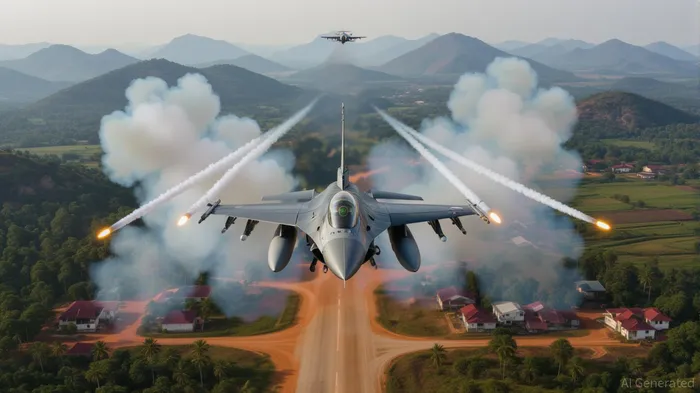
The conflict, triggered by a July 23 landmine explosion that injured Thai soldiers, has seen Thailand deploy F-16s to strike Cambodian positions, while Cambodia has retaliated with BM-21 rockets. Thailand's defense budget of $5.89 billion (vs. Cambodia's $860 million) underscores its military superiority, yet Cambodia's 463 multiple launch rocket systems (MLRS) have enabled asymmetric warfare. The closure of seven cross-border trade corridors has disrupted $1.2 billion in annual bilateral commerce, with logistics firms rerouting goods through Laos and Vietnam at 30% higher costs.
Defense Contractors: Benefiting from Escalation
The surge in military activity has directly boosted demand for defense technology. Thai Aerospace Industries (TAA) and Siam Defense Systems (SDS) have outperformed the SET Index by 15% since May 2025, driven by contracts for drones, surveillance systems, and cybersecurity solutions. TAA's Q3 2025 performance reflects this trend, with a 15% stock gain as it supplies Thailand's Royal Air Force with reconnaissance drones.
Cambodia's reliance on Chinese-supplied systems—such as the QW-3 Vanguard missiles and PHL-03 rocket launchers—has also spurred regional arms competition. Thai Advanced Armament Company (TAAC) has seen increased orders for armored vehicles and small arms, capitalizing on the imbalance in military capabilities.
Logistics and Infrastructure: Rerouted Trade and Resilient Players
The closure of key border crossings like Sa Kaeo has forced logistics firms to adapt. Pan-Asia Freight and Maylong Logistics have gained traction by facilitating rerouted shipments through third-party routes, with operational costs rising but demand surging. Thai Post and Westports Holdings, however, face challenges due to disrupted supply chains.
Infrastructure projects with diversified financing are proving more resilient. Singapore's Sembcorp Energy and Thailand's PTT Group are expanding regional energy partnerships to meet rising demand for grid infrastructure, as Cambodia pivots away from Thai oil imports. Special economic zones and renewable energy projects are also gaining traction, with solar and wind investments rising by 12% in Q3 2025.
Investment Opportunities and Risks
Defense Sector:
- Short-term gains: Companies like TAATATT-- and SDS are well-positioned for continued military spending. Thailand's $1.7 billion acquisition budget by 2029 and Cambodia's modernization efforts (e.g., Chinese corvettes) will drive demand.
- Long-term risks: A diplomatic breakthrough at the September 2025 Joint Boundary Commission (JBC) meeting could dampen demand for military tech, leading to profit-taking in defense stocks.
Logistics and Infrastructure:
- Resilient plays: Firms with diversified regional networks, such as Pan-Asia Freight and Sembcorp Energy, are better insulated against trade disruptions.
- Economic risks: Prolonged conflict could depress Cambodia's stock market (down 12% since July) and strain ASEAN's trade framework, with ripple effects on Southeast Asian growth.
Strategic Considerations for Investors
- Hedge Volatility: Investors should balance exposure to defense stocks with hedging strategies, such as short-term positions in copper and lithium to capitalize on infrastructure spending.
- Monitor Diplomatic Developments: The JBC meeting in September and ASEAN's role in mediation will be critical inflection points. A failure to de-escalate could extend the conflict into 2026.
- Currency Exposure: The Thai baht's 0.3% depreciation against the USD highlights the need to hedge currency risks, particularly for firms reliant on cross-border trade.
Conclusion
The Thailand-Cambodia border conflict is a microcosm of Southeast Asia's geopolitical fragility, with immediate benefits for defense and logistics firms but long-term risks to economic stability. While Thai Aerospace Industries and Sembcorp Energy represent compelling short-term opportunities, investors must remain vigilant about the potential for a regional arms race and the erosion of ASEAN's diplomatic influence. For those willing to navigate the volatility, the crisis underscores the importance of agility and strategic foresight in emerging markets.

Stay ahead of the market.
Get curated U.S. market news, insights and key dates delivered to your inbox.
AInvest
PRO
AInvest
PRO



Comments
No comments yet