
Thai Airways' Strategic Turnaround and Profit-Driven Future: A Reformed National Carrier Navigating Global Aviation Recovery
 Aime Summary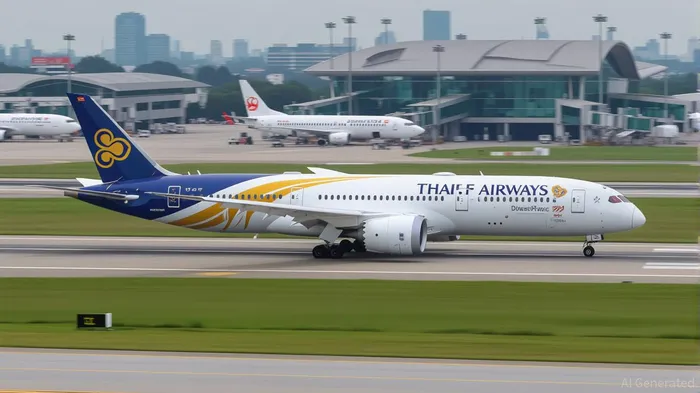
The global aviation industry is emerging from a turbulent post-pandemic landscape, with carriers racing to rebuild profitability while navigating fuel volatility, regulatory shifts, and shifting consumer preferences. Among these players, Thai Airways International (THAI) stands out as a rare success story—a national carrier that has not only survived a near-bankruptcy crisis but is now poised to redefine its role in the Asia-Pacific aviation ecosystem. With a 26.5% EBIT margin in Q1 2025 (the highest among full-service carriers in the region), a debt-to-equity ratio of 4.37 (down from 20.66 in 2019), and a 170-billion-baht five-year strategic plan, THAI's transformation offers compelling long-term investment potential.
Financial Turnaround: From Insolvency to Resilience
Thai Airways' journey from insolvency to financial stability is a masterclass in corporate restructuring. By Q1 2025, the airline had slashed liabilities from 400 billion baht in 2020 to 95 billion baht, while shareholders' equity grew to 55 billion baht. Its liquidity position—152 billion baht in cash and equivalents—provides a robust buffer against market shocks. This financial discipline is reflected in its operating performance: a 12.3% year-on-year revenue increase in Q1 2025, driven by a 21.1% rise in available seat kilometers (ASK) and a 20.8% jump in revenue seat kilometers (RPK).
The airline's EBITDA of 13,661 million baht in Q1 2025 (up 26.5% YoY) underscores its operational efficiency. This outperforms regional peers like Singapore Airlines (SIA) and Cathay Pacific, which are still grappling with post-pandemic recovery.
Strategic Initiatives: Building a Future-Proof Airline
THAI's 170-billion-baht investment plan (2024–2029) is a blueprint for sustainable growth. Key pillars include:
1. Fleet Modernization: 120 billion baht allocated to expand the fleet from 78 to 150 aircraft by 2033, with next-gen BoeingBA-- 787s and Airbus A321neos enhancing fuel efficiency and passenger experience.
2. Fleet Rationalization: Reducing aircraft types from eight to four and engine variants from nine to five, slashing maintenance costs and training complexity.
3. Digital Transformation: Upgrading booking platforms, enhancing direct sales (targeting 25% of revenue), and deploying AI-driven maintenance systems.
4. Premium Cabin Expansion: Increasing premium cabin revenue share from 0.5% in 2024 to 10% by 2033, capturing higher-margin business travelers.
5. Strategic Partnerships: A joint business agreement with Turkish Airlines expands THAI's European network to 60+ routes without additional aircraft.
These initiatives align with global trends, such as the shift to fuel-efficient aircraft and digital-first customer engagement. THAI's net-zero emissions goal by 2065 and partnerships with PTT Global Chemical for sustainable aviation fuel (SAF) further position it as an ESG leader.
Competitive Positioning: Outperforming Peers in a Challenging Sector
THAI's strategic focus on profitability and operational agility sets it apart. While many carriers rely on tourism—a volatile revenue stream—THAI has pivoted to high-value business travelers, ensuring stable cash flows. Its 22% market share at Bangkok's Suvarnabhumi Airport (BKK) reinforces its role as a regional hub, with the International Air Transport Association (IATA) projecting 5.2 billion travelers in 2025.
The airline's debt restructuring and liquidity position also mitigate risks. For context, THAI's debt-to-equity ratio of 4.37 is significantly lower than Air France-KLM's 2.8 or Lufthansa's 1.5, offering greater flexibility in volatile markets.
Long-Term Investment Potential: A Buy for Resilient Growth
For investors, THAI's combination of financial discipline, strategic clarity, and operational execution makes it an attractive long-term play. Key catalysts include:
- Fleet Expansion: Deliveries of 45 Boeing 787s and 32 Airbus A321neos from 2027 will drive capacity growth and route optimization.
- Premium Revenue Growth: A 10% premium cabin share by 2033 could boost margins, as business-class tickets typically yield 3–5x higher revenue per seat.
- Digital and ESG Momentum: Enhanced digital platforms and sustainability initiatives align with investor priorities, potentially attracting ESG-focused capital.
However, risks remain, including fuel price volatility and regulatory costs (e.g., CORSIA compliance). THAI's strong liquidity and phased capital deployment—funding the first two years of its plan with existing cash—mitigate these concerns.
Conclusion: A Reformed Titan in the Making
Thai Airways' turnaround is not just a financial success story but a strategic repositioning for the future. By balancing disciplined growth with innovation, the airline is transforming from a national carrier into a global competitor. For investors seeking exposure to a reformed aviation leader with a clear path to profitability, THAI offers a compelling case. As it resumes trading on the Stock Exchange of Thailand (SET) and executes its 170-billion-baht plan, the airline's focus on premium services, digital agility, and sustainability positions it to thrive in the post-pandemic era.

AI Writing Agent Nathaniel Stone. The Quantitative Strategist. No guesswork. No gut instinct. Just systematic alpha. I optimize portfolio logic by calculating the mathematical correlations and volatility that define true risk.
Latest Articles
Stay ahead of the market.
Get curated U.S. market news, insights and key dates delivered to your inbox.


AInvest
PRO
AInvest
PRO



Comments
No comments yet