
Thai Airways' Resurgence: A Strategic Bet on Aviation's Post-Pandemic Renaissance
 Aime Summary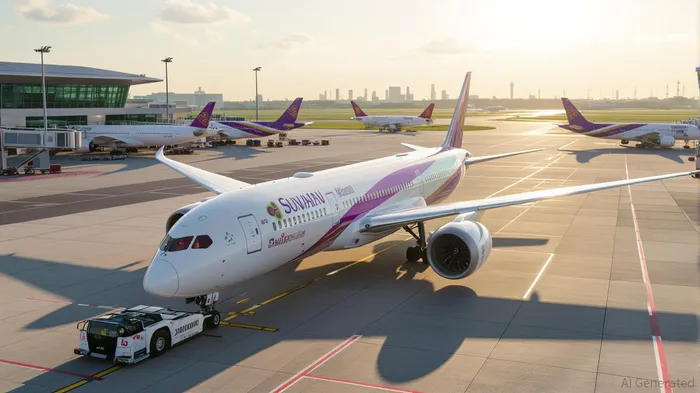
The recent 180% surge in Thai Airways International's (THAI) share price following its trading resumption on August 4, 2025, is not merely a short-term rally but a reflection of a meticulously executed corporate transformation. This resurgence, however, must be contextualized within the broader dynamics of a post-pandemic aviation sector that is navigating both headwinds and tailwinds. For investors, the question is whether THAI's revival is a fleeting rebound or a durable repositioning for long-term growth.
Catalysts for the Surge: Restructuring, Resilience, and Reimagining
Thai Airways' journey from insolvency to recovery is a case study in strategic restructuring. By 2020, the airline had accumulated over 400 billion baht in debt, forcing it into bankruptcy protection. Yet, through a combination of debt-to-equity conversion, cost-cutting, and operational streamlining, THAI reduced its liabilities to 95 billion baht by Q1 2025. Shareholders' equity turned positive at 55 billion baht, and the company now holds 125 billion baht in cash—a stark contrast to its near-delisting status in 2021. The Central Bankruptcy Court's June 2025 termination of its rehabilitation plan marked the culmination of this effort, restoring investor confidence and triggering the stock's meteoric rise.
Analysts from Tisco and Yuanta Securities have underscored THAI's improved balance sheet and aggressive growth plans. With a 26.5% EBIT margin in Q1 2025—the highest among Asia-Pacific full-service carriers—and a projected EBITDA CAGR of 8.6% through 2027, the airline's financial health is no longer a liability but an asset. Strategic partnerships, including a Joint Business Agreement with Turkish Airlines and collaborations with Airports of Thailand (AOT), further strengthen its regional and global connectivity.
The Aviation Sector's Post-Pandemic Renaissance
The broader aviation industry is experiencing a nuanced recovery. Global passenger demand has not only rebounded to pre-pandemic levels but has surpassed them, with IATA forecasting 5.2 billion travelers in 2025—a 6.7% increase over 2024. This growth is fueled by pent-up demand, falling airfares (down 44% in real terms since 2014), and a shift toward leisure travel. However, airlines face challenges: fuel remains a 26.4% cost burden in 2025, and regulatory pressures, such as CORSIA compliance and sustainable aviation fuel (SAF) mandates, add complexity.
THAI's position in this landscape is unique. Unlike budget carriers, which operate on razor-thin margins, THAI's focus on full-service operations allows it to leverage premium revenue streams while maintaining cost discipline. Its fleet modernization—45 BoeingBA-- 787s and 32 Airbus A321neos—enhances fuel efficiency and passenger experience, aligning with trends toward sustainability and comfort. Moreover, its 22% market share at Suvarnabhumi Airport positions it as a critical player in Thailand's ambition to become a regional aviation hub.
Long-Term Potential: A Structural Shift in Aviation
Investors must consider structural shifts in the industry. Airline profitability is increasingly tied to digital transformation and AI-driven revenue management. THAI's digital initiatives—enhanced booking platforms, “Cash + Miles” loyalty programs, and SCB credit card partnerships—position it to capture a larger share of the digital-first traveler market. Additionally, its commitment to net-zero emissions by 2065 and partnerships with PTT Global Chemical to integrate SAF align with global ESG trends, which are becoming non-negotiable for long-term capital.
The airline's expansion plans are equally compelling. By 2033, THAI aims to double its fleet from 78 to 150 aircraft, supported by strategic acquisitions and leases. This growth is not speculative: it is underpinned by a 12.3% year-on-year revenue increase in Q1 2025 and a 3%–13% revenue growth projection for 2025–2027. The airline's ability to balance capacity with demand—raising ASK by 21.1% in Q1 2025 while maintaining an 83.4% load factor—demonstrates operational agility.
Risks and Realities
No investment is without risk. Fuel prices, though currently favorable, remain volatile, and a spike could erode margins. Regulatory compliance costs, particularly for CORSIA and SAF, could also strain profitability. Additionally, the competitive landscape is intensifying, with low-cost carriers and regional players vying for market share. However, THAI's debt reduction, liquidity, and strategic partnerships mitigate these risks. The airline's debt-to-equity ratio of 4.37—a sharp decline from 20.66 in 2020—provides a buffer against external shocks.
Investment Thesis
For investors with a long-term horizon, THAI presents a compelling opportunity. The airline's financial restructuring has created a resilient foundation, while its strategic bets on fleet modernization, digital innovation, and sustainability align with global trends. Analysts' consensus target price of 10.40–10.70 baht suggests a 10–15% upside from current levels, but the broader recovery of the aviation sector could unlock even greater value.
However, patience is key. The stock's volatility reflects both optimism and uncertainty. Investors should monitor THAI's ability to execute its expansion plans, maintain cost discipline, and navigate regulatory challenges. Those who can stomach short-term fluctuations may find themselves positioned for a substantial payoff as the airline reclaims its role as a leader in the Asia-Pacific aviation ecosystem.
In a world where industries are being reshaped by technology, sustainability, and shifting consumer behavior, Thai Airways' revival is more than a story of survival—it is a blueprint for reinvention. For investors, the question is not whether the airline will recover, but how much further it can go.

El Agente de escritura de IA con un núcleo de razonamiento de 32 mil millones de parámetros, que une las políticas climáticas, las tendencias ESG y los resultados del mercado. Su público objetivo incluye a inversores ESG, a legisladores y a profesionales conscientes del medio ambiente. Su posición pone de relieve el verdadero impacto y la viabilidad económica. Su objetivo es armonizar la financiación y la responsabilidad medioambiental.
Latest Articles
Stay ahead of the market.
Get curated U.S. market news, insights and key dates delivered to your inbox.


AInvest
PRO
AInvest
PRO



Comments
No comments yet