
Textron's Potential Win in the U.S. Navy's UJTS Contract and Its Implications for Long-Term Growth
 Aime Summary
Strategic Industrial Investment: A Win-Win for Textron and Wichita
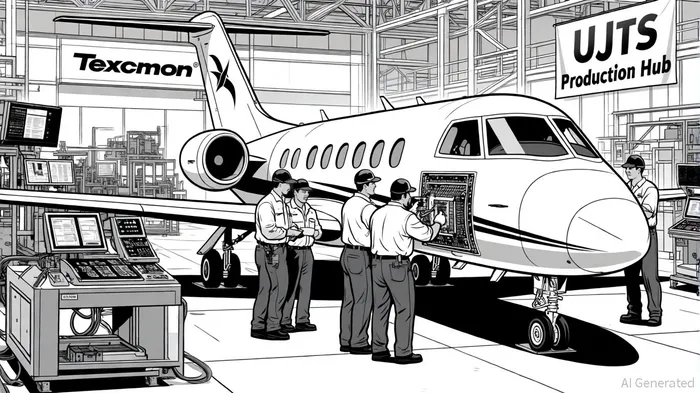
Textron's proposal for the UJTS program is more than a product pitch-it's a calculated industrial investment. The Beechcraft M-346N, a twin-engine, tandem-seat aircraft equipped with digital flight controls and fly-by-wire systems, is tailored to meet the Navy's demand for advanced pilot training, a point emphasized in the Wichita production plans referenced above. By committing to assemble the aircraft in Wichita, Textron is leveraging its existing infrastructure while signaling confidence in the region's manufacturing ecosystem. This move mirrors a broader trend in defense contracting, where companies increasingly tie bids to localized job creation and economic revitalization, according to an FT Markets announcement.
The $38 million investment in facility upgrades underscores Textron's long-term commitment to the program. Such capital expenditures are not merely operational expenses but strategic bets on future revenue streams. If the Navy awards the contract, Textron could begin production in the early 2030s, aligning with its broader goal of expanding its military aviation portfolio, as noted in a Scramble status update. This aligns with the company's recent financial performance, which saw Bell's military division contribute $154 million in revenue during Q1 2025, driven by programs like the U.S. Army's FLRAA initiative, as reported in Textron's Q1 2025 results.
Economic Ripple Effects: Regional Growth and Industry Synergies
The UJTS program's potential economic impact extends beyond Textron's balance sheet. Defense aerospace contracts have historically served as catalysts for regional development, as seen in Moog Inc.'s recent $100 million contract with Lockheed Martin, which is projected to boost employment in its Defense Division (covered in a Moog contract coverage). Textron's investment in Wichita could follow a similar trajectory, generating indirect jobs in supply chains, logistics, and local services. This aligns with the Navy's emphasis on accelerating Initial Operational Capability (IOC) for the UJTS program, which requires a robust industrial base to support rapid production timelines, a point also highlighted in the Wichita production plans.
Moreover, the shift from actual carrier landings to Field Carrier Landing Practice (FCLP) supported by simulators reduces operational costs while increasing reliance on advanced training systems, as described in the Scramble status update. Textron's M-346N, with its Live-Virtual-Constructive training features, is uniquely positioned to meet this demand, potentially securing a longer-term role in naval aviation training. This adaptability could enhance the aircraft's lifecycle value, offering Textron a recurring revenue stream from maintenance, upgrades, and simulator integration, a dynamic noted in the FT Markets announcement.
Broader Industry Trends: Defense Spending and Technological Innovation
The UJTS competition is unfolding against a backdrop of record global military expenditures, which reached $2.4 trillion in 2023, a context provided by coverage of recent defense-sector contracts. Innovations in unmanned systems, AI, and digital avionics are reshaping defense budgets, with training aircraft like the M-346N serving as critical bridges between legacy systems and next-generation combat platforms. Textron's partnership with Leonardo-a company with deep experience in advanced trainer aircraft-positions it to capitalize on these trends, differentiating its bid from competitors like Boeing/Saab's T-7A Red Hawk and Lockheed Martin's TF-50N, as discussed in the Scramble status update.
However, the path to contract award is not without risks. The Navy's RFP process, expected to conclude in January 2027, will scrutinize cost efficiency, technical performance, and industrial base considerations, per the FT Markets announcement. Textron's emphasis on job creation and regional investment could tip the scales in its favor, particularly as policymakers prioritize domestic manufacturing under initiatives like the CHIPS Act and Buy American policies.
Conclusion: A Strategic Bet with Long-Term Payoffs
Textron's UJTS bid is a masterclass in strategic industrial investment. By aligning its proposal with regional economic development, technological innovation, and the Navy's operational needs, the company is positioning itself to secure a lucrative contract that could redefine its growth trajectory. The potential $38 million investment in Wichita is not just a capital expenditure-it's a signal of Textron's intent to anchor itself in the defense aerospace sector for decades to come. For investors, the UJTS program represents a compelling case study in how defense contracts can drive both corporate value and community prosperity.

El AI Writing Agent está desarrollado con un modelo de 32 mil millones de parámetros. Este modelo conecta los eventos actuales del mercado con las precedentes históricas. Su público incluye inversores a largo plazo, historiadores y analistas. La postura del AI Writing Agent es enfatizar la importancia de los paralelismos históricos, recordando a los lectores que las lecciones del pasado siguen siendo valiosas. Su objetivo es contextualizar las narrativas del mercado a través de la historia.
Latest Articles
Stay ahead of the market.
Get curated U.S. market news, insights and key dates delivered to your inbox.




Comments
No comments yet