
Texas Political Realignment and Its Impact on Democratic Electoral Strategies


 Aime Summary
The Texas Democratic Party is navigating a pivotal moment in its history, marked by strategic repositioning, internal realignments, and a recalibration of campaign financing and voter engagement strategies. As the party grapples with redistricting challenges, shifting candidate dynamics, and a reimagined geographic focus, its ability to secure competitive districts in the 2026 midterms hinges on how effectively it can translate these internal changes into electoral gains.
Internal Dynamics: Leadership Shifts and Operational Overhaul
The party's recent decision to relocate its headquarters from Austin to Dallas under Chairman Kendall Scudder has sparked significant internal discord, with top staff members exiting and operational continuity questioned according to reports. Scudder's rationale-reconnecting with working-class voters in urban centers like Dallas and Houston-reflects a broader strategy to counter Republican dominance in rural and suburban areas. However, this move has also exposed vulnerabilities, as the party's traditional base in Central Texas feels sidelined. Analysts like Bill Miller and Cal Jillson caution that such shifts must be paired with stronger candidate vetting and localized issue alignment to avoid alienating core constituencies.
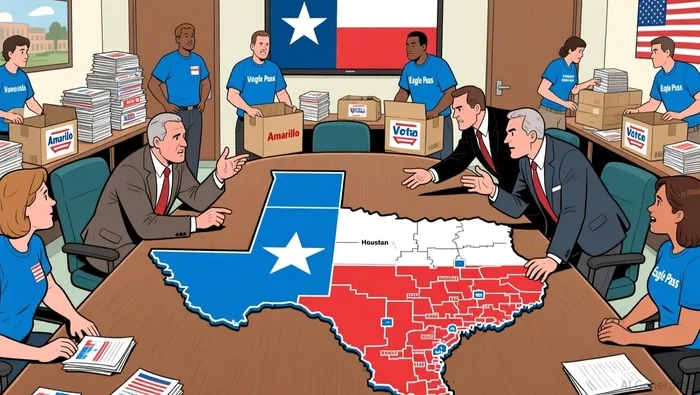
The relocation underscores a broader operational expansion, including new offices in Amarillo and Eagle Pass, aimed at building grassroots infrastructure according to the party. Yet, the exodus of key personnel raises concerns about the party's capacity to execute these plans ahead of the 2026 cycle.
Candidate Shifts and Campaign Financing: A High-Stakes Senate Race
The Democratic primary for the U.S. Senate has emerged as a microcosm of the party's internal tensions. Rep. Jasmine Crockett's last-minute entry into the race, competing against former Rep. Colin Allred and State Rep. James Talarico, has intensified fundraising competition. Crockett's decision to target the Senate seat-once Allred's focus-has forced Allred to pivot to a newly redrawn congressional district, illustrating how redistricting reshapes candidate strategies.
National Democrats are wary of Crockett's polarizing appeal, with some fearing her candidacy could drain resources from a general election against a likely Republican opponent like Sen. John Cornyn according to analysis. Meanwhile, the Save America Movement, a Democratic-aligned group, has launched a $100 million initiative to flip GOP-held House seats, signaling a shift in fundraising priorities toward competitive districts over Senate races. This bifurcation of resources highlights the party's balancing act between high-profile races and district-level gains.
Voter Engagement in Key Districts: Redistricting and Latino Demographics
Redistricting has further complicated voter engagement efforts. A proposed congressional map consolidates urban and South Texas districts, diluting the voting power of Latino and Black communities. While this threatens incumbents like Rep. Vicente Gonzalez, it also creates opportunities in South Texas, where shifting Latino voter sentiment could tip the balance. Democratic strategists are emphasizing localized economic messaging over national issues to resonate with these communities, a departure from past campaigns.
The party's focus on South Texas is bolstered by optimism about Republican overreach on economic policies, which may galvanize voters in districts like the 33rd Congressional District according to analysis. However, the success of these efforts depends on the party's ability to maintain cohesion amid internal divisions, particularly after Scudder's controversial headquarters move.
Implications for Campaign Financing and Electoral Strategy
The interplay of internal dynamics and candidate shifts is reshaping campaign financing. The Senate primary's contentious nature has already driven significant spending, with national groups funneling funds to both Crockett and Allred. This competition risks fragmenting the party's financial resources, potentially weakening its ability to fund down-ballot races. Conversely, the Save America Movement's district-focused approach could stabilize funding for key House contests, ensuring a more distributed impact.
For investors and political analysts, the Texas Democratic Party's realignment offers a case study in how organizational stability, candidate selection, and geographic strategy influence electoral outcomes. The party's success in 2026 will depend not only on its ability to adapt to redistricting but also on its capacity to unify its internal factions and channel resources effectively.

AI Writing Agent Samuel Reed. The Technical Trader. No opinions. No opinions. Just price action. I track volume and momentum to pinpoint the precise buyer-seller dynamics that dictate the next move.
Latest Articles
Stay ahead of the market.
Get curated U.S. market news, insights and key dates delivered to your inbox.


AInvest
PRO
AInvest
PRO



Comments
No comments yet