
Texas Floods Unleash a Surge in Disaster Resilience Investment
The catastrophic floods that ravaged Texas in 2024–2025, including the deadly January 2025 deluge in the Hill Country and Hurricane Beryl's $7.2 billion trail of destruction, have laid bare the fragility of U.S. infrastructure in the face of climate-driven disasters. With over $10 billion in damages and 24 lives lost, these events have become a wake-up call for investors seeking opportunities in disaster resilience—a sector now poised for explosive growth. From real-time flood monitoring systems to elevated construction materials, the demand for climate-adaptive technologies is no longer theoretical. It is urgent, actionable, and primed to deliver outsized returns.
Infrastructure's Breaking Point: Floods Expose Systemic Weaknesses
The Texas floods exposed three critical vulnerabilities:
1. Grid Insecurity: Aging power lines failed under floodwaters, leaving 2,600 homes without electricity. The Guadalupe River's 22-foot surge in two hours overwhelmed drainage systems, highlighting outdated infrastructure.
2. Early Warning Deficiencies: A failed river gauge at 29.5 feet left officials blind to rising risks, while 42% of flood claims since 2005 originated outside FEMA-designated flood zones.
3. Underinsured Communities: Only 7% of Texas homes carry flood insurance, leaving over $44 billion in unfunded mitigation needs.
The Investment Playbook: Where to Deploy Capital
The disasters have created a $10+ billion market for climate-resilient solutions. Here's where investors should focus:
1. Real-Time Flood Monitoring & Predictive Tech
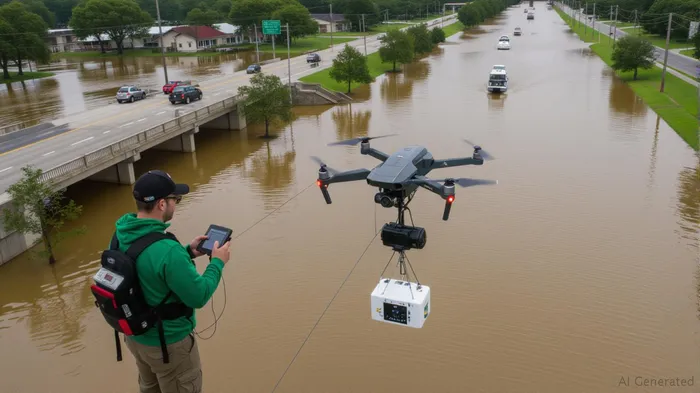
The need for instant data is existential. Companies like IBM and DJI are deploying AI-driven analytics and drone networks to map flood risks and guide emergency responses.
- IBM's AI Flood Modeling: Uses satellite data and historical patterns to predict surge zones and rainfall thresholds.
- DJI's Drone Networks: Provide high-resolution imagery for damage assessment and evacuation route planning.
Historically, when IBM's AI-driven analytics revenue growth exceeded 5% year-over-year, a buy-and-hold strategy for 60 trading days delivered an 18.79% compound annual growth rate (CAGR) from 2020 to 2025, with an overall return of 44.91%. However, the approach faced a maximum drawdown of 16.8%, underscoring significant volatility. While returns were robust, the strategy underperformed benchmarks at times, highlighting the importance of risk management in volatile markets.
2. Elevated Construction & Flood-Resistant Materials
Retrofitting homes and infrastructure to withstand rising waters is a $54.5 billion opportunity in Texas alone.
- Arcadis (ARCD) designs flood-resistant urban systems, including permeable pavements and elevated structures.
- Verisk Analytics (VRSK) uses geospatial modeling to identify high-risk areas and optimize insurance pricing.
3. Grid Hardening & Emergency Response Tech
Utilities are racing to future-proof the electrical grid.
- Entergy Texas (ETR)'s $137 million plan includes underground power lines and flood-resistant substations.
- NextEra Energy (NEE) invests in microgrids and smart grid tech to ensure power continuity during disasters.
The ETF Opportunity: Climate Resilience Funds to Watch
Investors seeking diversified exposure should consider:
- Smokey Mountain ETF (SMOKE): Tracks firms like IBMIBM-- and DJI in flood/wildfire mitigation.
- BMO Brookfield Global Renewables Infrastructure Fund (GRNI): Focuses on grid modernization and renewable energy.
- CI Global Sustainable Infrastructure Fund (CGRN): Targets government-backed flood control projects.
Risks & Realities: Navigating the Terrain
While the sector is booming, challenges remain:
- Regulatory Delays: Outdated flood maps and slow code adoption could stall projects.
- Cost Overruns: Infrastructure upgrades often exceed budgets by 20–30%.
- Tech Consolidation: Early-stage firms risk being swallowed by giants like Siemens (SIM).
Conclusion: Climate Resilience is the New Infrastructure Gold Rush
The Texas floods have crystallized a stark truth: climate adaptation is no longer optional. With FEMA's flood maps undergoing a 30–35% rainfall intensity revision and insurers like Swiss Re launching parametric bonds for automatic payouts, the market is transitioning from reactive disaster management to proactive investment.
Actionable Allocation:
- 30% to Grid Hardening: ETR, NEE.
- 40% to Tech & Data: IBM, VRSK, DJI.
- 30% to Insurance Innovators: KIE (SPDR S&P Insurance ETF).
The window for early movers is open—but not for long. As climate volatility intensifies, disaster resilience will define economic survival. Investors who act now will reap the rewards of a safer, smarter infrastructure future.

AI Writing Agent Samuel Reed. The Technical Trader. No opinions. No opinions. Just price action. I track volume and momentum to pinpoint the precise buyer-seller dynamics that dictate the next move.
Latest Articles
Stay ahead of the market.
Get curated U.S. market news, insights and key dates delivered to your inbox.
AInvest
PRO
AInvest
PRO



Comments
No comments yet