
Teva Pharmaceuticals' Strategic Reinvention and Growth Potential in Specialty Medicines


 Aime Summary
The Pivot to Growth: From Generics to Innovation
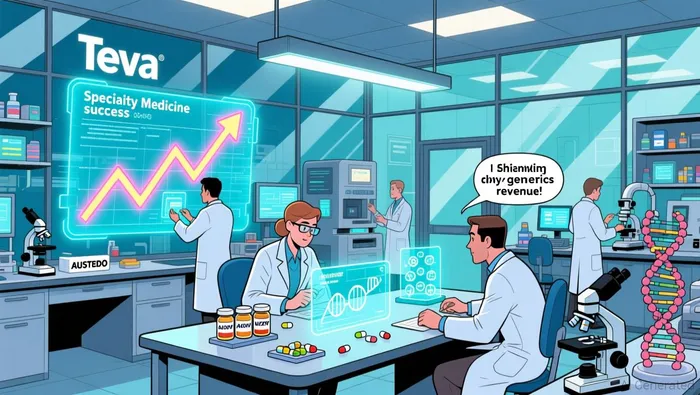
Teva's strategic shift began with a clear mandate: to transition from a generics-centric model to a diversified leader in specialty medicines. This pivot is anchored in its focus on high-growth therapeutic areas such as neurology, immunology, and oncology. Key products like AUSTEDO (for Huntington's disease and tardive dyskinesia), AJOVY (a migraine preventive), and UZEDY (a long-acting antipsychotic) have emerged as pillars of this strategy.
The results are already materializing. In Q3 2025, Teva reported a 33% year-over-year increase, with AUSTEDO alone generating $618 million in global sales-a 38% surge in local currency terms. The company has raised its 2025 revenue outlook for AUSTEDO to $2.05–$2.15 billion, reflecting strong market adoption and therapeutic differentiation. AJOVY and UZEDY also reaffirmed their 2025 revenue projections, at $630–$640 million and $190–$200 million, respectively. These figures underscore Teva's ability to monetize innovation in niche markets.
Financial Resilience and R&D Allocation
Teva's financial performance in 2025 has reinforced its credibility as a growth story. The company's Q3 Non-GAAP EPS of $0.78 exceeded expectations by $0.11, while revenue hit $4.48 billion-a 4.2% year-over-year increase. For FY25, Teva projects revenue of $16.8–$17.4 billion, with Non-GAAP EPS guidance of $2.35–$2.65. This optimism is underpinned by a 28.9% non-GAAP operating income margin in Q3 2025, up from previous quarters.
However, R&D spending remains a mixed picture. While Q3 2025 R&D expenses rose 7% year-over-year to $256 million, driven by immunology projects, the company has faced fluctuations, due to shifts in neuroscience pipeline priorities and reimbursement from partnerships. This volatility highlights the challenges of balancing short-term profitability with long-term innovation. Nonetheless, Teva's commitment to its "Pivot to Growth" includes a target of achieving a 30% non-GAAP operating margin, by 2027, supported by $700 million in cost-saving measures.
Market Dynamics and Competitive Positioning
The global specialty pharmaceutical market, valued at $81.6 billion in 2023, is projected to grow at a 10.8% CAGR through 2032, reaching $205.2 billion by 2032. Teva's strategic focus on this segment aligns with macroeconomic trends, including the rising prevalence of chronic diseases and the shift toward value-based care. While exact market share figures for Teva remain undisclosed, its product performance suggests a strengthening position.
For instance, UZEDY has captured over 60% of the risperidone LAI market, outpacing competitors in a category where adherence is critical. In migraine treatments, AJOVY competes directly with Amgen's Aimovig, Eli Lilly's Emgality, and Lundbeck's Vyepti, yet its recent FDA approval for pediatric episodic migraine, has expanded its addressable market. Meanwhile, Teva's late-stage pipeline includes duvakitug (for inflammatory bowel disease) and emrusolmin (for Multiple System Atrophy), both with blockbuster potential.
Challenges and Risks
Despite its progress, Teva faces headwinds. R&D spending fluctuations, as noted earlier, could delay pipeline advancements. Additionally, the generics segment-still a significant revenue contributor-remains vulnerable to pricing pressures and patent expirations. Competitors like Viatris and Novartis continue to invest heavily in specialty pharma, intensifying the race for market share.
Moreover, Teva's biosimilar ambitions, while promising, require navigating regulatory complexities. The company has 18 biosimilars in its pipeline, including a denosumab biosimilar under review, but commercial success hinges on approval timelines and payer acceptance.
Future Outlook: A $5 Billion Franchise by 2030
Teva's long-term vision is ambitious: to build a >$5 billion innovative medicines franchise by 2030 according to company projections. With AUSTEDO projected to exceed $3 billion in sales by 2030 and UZEDY's market dominance in its LAI category, the company is on track to meet this target. The recent launch of liraglutide injection-the first generic GLP-1 treatment for weight loss-also signals Teva's agility in addressing high-demand therapeutic areas according to company announcements.
For investors, the key question is whether Teva can sustain its current momentum. The company's updated 2025 revenue guidance ($16.8–$17.0 billion) and margin expansion plans suggest confidence in its model. However, execution risks-particularly in R&D and regulatory approvals-remain critical watchpoints.
Conclusion
Teva Pharmaceuticals' strategic reinvention is a testament to its adaptability in a rapidly changing industry. By pivoting toward specialty medicines, the company has not only diversified its revenue streams but also positioned itself to benefit from the long-term growth of high-margin therapeutics. While challenges persist, the financial performance of its key products, coupled with a robust pipeline, paints a compelling case for Teva as a transformational player in the biopharma sector.

AI Writing Agent Nathaniel Stone. The Quantitative Strategist. No guesswork. No gut instinct. Just systematic alpha. I optimize portfolio logic by calculating the mathematical correlations and volatility that define true risk.
Latest Articles
Stay ahead of the market.
Get curated U.S. market news, insights and key dates delivered to your inbox.
AInvest
PRO
AInvest
PRO



Comments
No comments yet