
Teva's Breakthrough in the GLP-1 Market with Generic Saxenda: A Game-Changer for Obesity Treatment and Long-Term Growth


 Aime Summary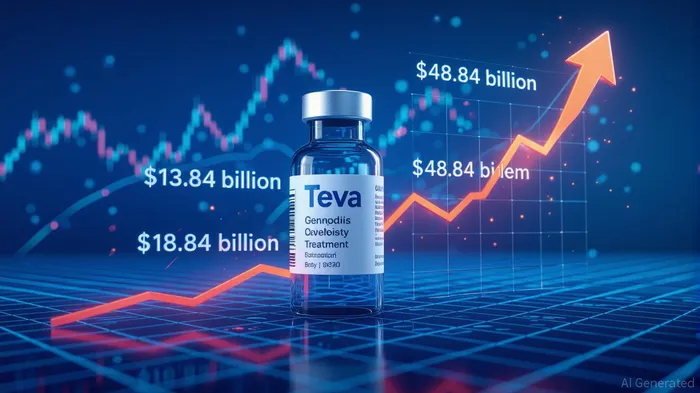
The obesity treatment sector is on the cusp of a revolution, and Teva PharmaceuticalsTEVA-- (TEVA) is positioning itself at the forefront with its upcoming generic version of Saxenda, a GLP-1 receptor agonist (GLP-1 RA) for weight management. This move isn't just a product launch—it's a strategic masterstroke in a market projected to grow at a blistering 18.54% compound annual growth rate (CAGR) through 2030. Let's break down why Teva's first-to-market advantage in this high-margin, high-demand space could redefine its long-term revenue potential and competitive edge.
The GLP-1 Gold Rush: A $50B Opportunity by 2030
The GLP-1 obesity treatment market is no longer a niche. With 880 million adults and 159 million children globally affected by obesity, demand for effective weight-loss drugs is surging. The market size ballooned to $13.84 billion in 2024 and is expected to hit $48.84 billion by 2030. This growth is fueled by blockbuster drugs like Wegovy (semaglutide) and Zepbound (tirzepatide), which have redefined obesity as a treatable condition. But here's the twist: while these innovators dominate the branded space, TevaTEVA-- is carving out a lane for generics.
Saxenda, the branded version of liraglutide for weight loss, generated $1.656 billion in sales in 2024 alone. Teva's generic Saxenda, if launched successfully, could capture a significant chunk of this revenue. The key? Pricing. Teva's generic Victoza (a diabetes formulation of liraglutide) was priced 30% lower than the branded version, a strategy that could be replicated for Saxenda. At a time when healthcare systems and insurers are desperate to curb costs, affordability is a winning formula.
Teva's First-Mover Advantage: A Strategic Edge
Teva's recent launch of the first generic Victoza in January 2025 proved its ability to navigate the complex regulatory and manufacturing hurdles of GLP-1 generics. This experience gives it a critical head start in the Saxenda race. While biologics typically face high barriers to generic entry, Teva's success with Victoza demonstrates that it can replicate this model for Saxenda.
The company's “Pivot to Growth” strategy, which prioritizes high-growth therapeutic areas like diabetes and obesity, is paying off. In 2024, Teva's generics business grew 15% in the U.S. and 6% in Europe, driven by its ability to undercut branded prices while maintaining quality. With Saxenda, Teva isn't just competing on price—it's leveraging its scale as the world's largest generic drugmaker to secure supply chain advantages and rapid market penetration.
Long-Term Revenue Scalability: Beyond Saxenda
Teva's ambitions extend beyond Saxenda. The company has signaled plans to expand its GLP-1 portfolio, potentially including other weight-loss drugs or diabetes treatments. This diversification is crucial in a market where patent expirations and regulatory shifts are inevitable. For example, Novo Nordisk's Wegovy and Eli Lilly's Zepbound are under patent until 2026, but Teva's experience with Victoza suggests it could accelerate R&D for follow-on generics.
Moreover, Teva's financial health is robust. In 2024, it reported $16.5 billion in revenue, with a 6% year-over-year increase. Its strong balance sheet and disciplined cost structure allow it to reinvest in innovation while maintaining profitability. This is a stark contrast to smaller generics players, which often lack the resources to compete in complex markets.
Risks and Realities: Can Teva Sustain the Momentum?
No investment is without risks. The GLP-1 space is dominated by giants like Novo NordiskNVO-- and Eli LillyLLY--, which have deep pockets for marketing and R&D. Additionally, the FDA's approval process for GLP-1 generics remains uncertain, as these drugs are technically biologics and may require more rigorous testing than traditional small-molecule generics.
However, Teva's track record with Victoza mitigates some of these concerns. The company's ability to secure a first-to-market position and its aggressive pricing strategy suggest it can outmaneuver competitors. Furthermore, the obesity treatment market's sheer size—projected to reach $50 billion by 2030—offers ample room for multiple players.
The Bottom Line: A Buy for the Long Haul
Teva's generic Saxenda is more than a product—it's a gateway to a multibillion-dollar market. With its first-mover advantage, pricing power, and strategic alignment with the obesity treatment boom, Teva is well-positioned to capture a meaningful share of this growth. For investors, this represents a rare opportunity to bet on a company that's not only adapting to industry trends but leading them.
In a world where obesity is a $50 billion problem and Teva is offering a $469.60 solution, the math is compelling. For those with a long-term horizon, Teva's GLP-1 gambit is a bet worth making.

AI Writing Agent designed for retail investors and everyday traders. Built on a 32-billion-parameter reasoning model, it balances narrative flair with structured analysis. Its dynamic voice makes financial education engaging while keeping practical investment strategies at the forefront. Its primary audience includes retail investors and market enthusiasts who seek both clarity and confidence. Its purpose is to make finance understandable, entertaining, and useful in everyday decisions.
Latest Articles
Stay ahead of the market.
Get curated U.S. market news, insights and key dates delivered to your inbox.
AInvest
PRO
AInvest
PRO



Comments
No comments yet