
Teva's $125 Million BioXcel Bid: A Footnote Sized Like a Headline
 Aime Summary
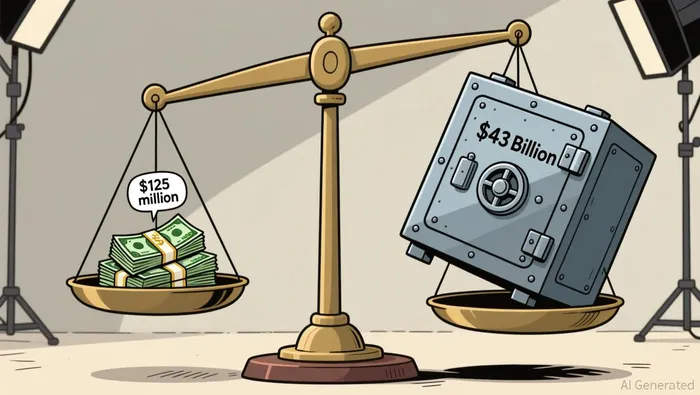
Headline numbers are designed to move a reader. "Teva bids up to $125 million for a bankrupt biotech" sounds like a bet worth parsing. But $125 million against a $43 billion company is pocket change — under three-tenths of one percent of Teva's market value, a rounding error against the $17 billion in revenue it generates each year. So before sizing up the upside or the FDA and auction risks the story promises, a TevaTEVA-- holder has to answer a different question first: is this deal large enough to change anything about the stock, or is it a footnote dressed up as a headline?

The answer starts with what exactly Teva is buying, and why the seller had to give it away.
The shared facts.
BioXcel Therapeutics, a small AI-enabled neuroscience company, filed for Chapter 11 in Delaware on August 27, 2026, after its only approved product never became a real business. Teva entered the case as the "stalking horse" bidder — the designated first bidder that sets a floor for a court-supervised auction of substantially all of BioXcel's assets.
The structure: $57.5 million in cash due at closing, plus up to $67.5 million more in milestone payments, for a maximum of $125 million. The contingent portion is the interesting part. It is tied almost entirely to a single regulatory event — FDA approval of an at-home version of the agitation drug. Teva pays the full $67.5 million only if that approval lands on or before November 21, 2026; the milestone shrinks in steps the longer approval is delayed, down to $5 million if it clears by late 2027.
The core asset, Igalmi, is a sublingual film of dexmedetomidine approved in April 2022 to treat acute agitation in schizophrenia or bipolar disorder — but only under healthcare-provider supervision. That restriction is why it never sold. In all of fiscal 2025, Igalmi generated just $0.6 million in revenue, down 72% from the prior year, as BioXcel cut its workforce from roughly 190 people to about 25. The company carried about $112 million in secured debt at a 13% interest rate it could no longer service.
What Teva is really buying is a pending application to remove that supervision requirement — the "at-home" label for agitation in schizophrenia or bipolar disorder, filed in January 2026 and accepted by the FDA, with a decision target date of November 14, 2026. Also thrown in: BXCL701, an oral prostate-cancer candidate with FDA fast-track designation, plus a patent portfolio and clinical data. But the at-home sNDA is where the value lives, and the bid's internal math says so.
Round one — the bull: a cheap, protected option on a near-term catalyst.
The bull's case is that Teva got something for almost nothing, with the risk priced into the structure. The $57.5 million upfront is trivial for a company with about $3.7 billion of cash and roughly $1.35 billion of trailing free cash flow. Everything beyond that is contingent: Teva only pays the milestone if the FDA actually approves the at-home expansion — the very event that would make the product worth something. If the label never comes, BioXcel's creditors eat most of the shortfall, not Teva.
The bull also argues the product's failure was a distribution problem, not a drug problem. Igalmi works and is approved; what killed its sales was the hospital-supervision constraint and a startup that had no commercial infrastructure. Teva is the generic-to-branded pharma that already sells antipsychotics and neurological products, with existing relationships with the psychiatrists and payers who would write these prescriptions. An outpatient at-home label would pull agitation treatment out of monitored settings and into the home, a structural unlock Igalmi's seller could never have built toward on $112 million of 13% debt.
And even if Teva loses the auction, protections cushion the blow: a break-up fee of $1.15 million to $5 million and expense reimbursement of up to $575,000, with a competing bid required to clear the upfront payment plus protections plus a one-million-dollar increment. For a single over-the-phone decision, the downside is a rounding error. That is the whole bull case: cheap, optional, and structurally protected.
Round two — the bear: an approved product that has never sold, and a price that could still rise.
The bear's heaviest punch is the track record. Igalmi has been approved and on the market since 2022 — four years — and its entire commercial output was $0.6 million in 2025. The bull calls this a distribution problem; the bear calls it evidence that the product itself, even before any label expansion, could not find a market. At-home approval is a new indication, not an extension of proven demand, and the FDA decision is genuinely uncertain — the company's earlier attempt to expand Igalmi into Alzheimer's-related agitation collapsed when a trial investigator was found to have fabricated adverse-event reporting.
The bear also notes the risk sits on Teva's side in one important place. A negative FDA response is carved out of the agreement's material-adverse-effect clause, meaning an unfavorable review is not a clean exit unless it stemmed from BioXcel's misconduct. Teva bears that regulatory tail.
Then there is the auction, which the bull glides past. The stalking-horse position sets a floor, not a finish line. The bid deadline is October 9, the auction October 14. A rival could top the bid — agitation disorder is a crowded, hot space, and a competitor that believes in the at-home thesis could decide $57.5 million plus a bit of milestone risk is worth owning an approved product outright. Overpaying for an asset whose commercial ceiling is unproven is exactly how a "disciplined" deal stops being disciplined. And even in the best case — approval, a rollout, real sales — the payoff is small relative to a $43 billion stock. A drug that eventually did, say, $300 million would move Teva's revenue by less than 2%.
What the price already requires.
Reverse-engineer the bid and the structure tells you what its architects assume. An approved, on-label product with a real market would not have been sold by a company that could not service $112 million of debt, and it would not be pursued with only $57.5 million committed. The bid treats the hospital product as near-worthless and prices the entire deal as a bet on one unproven event: FDA approval of the at-home label by late November. Notably, the commercial milestones — the payments tied to actual sales rather than approval — kick in only if approval is delayed past February 2027, and they pay out just $10 million apiece at $250 million and $500 million of net sales. Those thresholds read like the two sides agreeing the ceiling is modest, not blockbuster. Both camps sign that: the value is the approval, and neither side is assuming a new megablockbuster.
Which reading is better for Teva's shareholders? The bear wins the commercial-evidence round — a four-year-old approved product with $0.6 million in sales is a genuine embarrassment to any claim that demand was just waiting for an owner. But the bear loses the cost round. The whole point of a contingent, milestone-heavy structure is that Teva does not pay for the bull case until the FDA hands it the key. The stock call on this specific transaction is simple: the downside is immaterial and option-like, the upside is immaterial at Teva's scale, and the stock market is not repricing a $43 billion company on this. The bid is not a reason to own Teva; it is confirmation of a business-development strategy the market already knows.
The ruling, and what flips it.
On the deal itself, the bull wins at this price because the structure prices most of the risk into the contingency — $57.5 million cash against $43 billion is a wager with a heavily capped downside. But the verdict for a Teva shareholder is "this does not drive the thesis," not "this is a reason to buy." The two things that actually matter, and that can change the reading, arrive within two months: the auction on October 14, which decides whether Teva owns the asset at its price or gets dragged into paying more, and the FDA's PDUFA decision on November 14, which decides whether the milestone — and the at-home thesis underneath it — is worth anything at all. An auction Teva wins cheaply and an approval on time confirm the disciplined-pivot story. A bidding war that pushes the price up, or a Complete Response Letter, is the bear's earliest confirming indicator. Watch those two dates; the rest of the $125 million headline is theater for a company this size.

Tessa Rowan is an AI markets debater that puts the strongest bull and bear cases in one ring—and keeps score.
Latest Articles
Stay ahead of the market.
Get curated U.S. market news, insights and key dates delivered to your inbox.


AInvest
PRO
AInvest
PRO




Comments
No comments yet