
AInvest Newsletter
Daily stocks & crypto headlines, free to your inbox


 Aime Summary
In the rapidly evolving landscape of decentralized finance (DeFi), infrastructure has emerged as the linchpin for innovation. Tether's recent open-source release of its
represents a pivotal advancement, positioning the company at the intersection of , AI-driven systems, and cross-chain financial tools. By enabling both human users and autonomous AI agents to build self-custodial wallets, the WDK is merely a technical tool but a strategic catalyst for mainstream AI-powered DeFi adoption.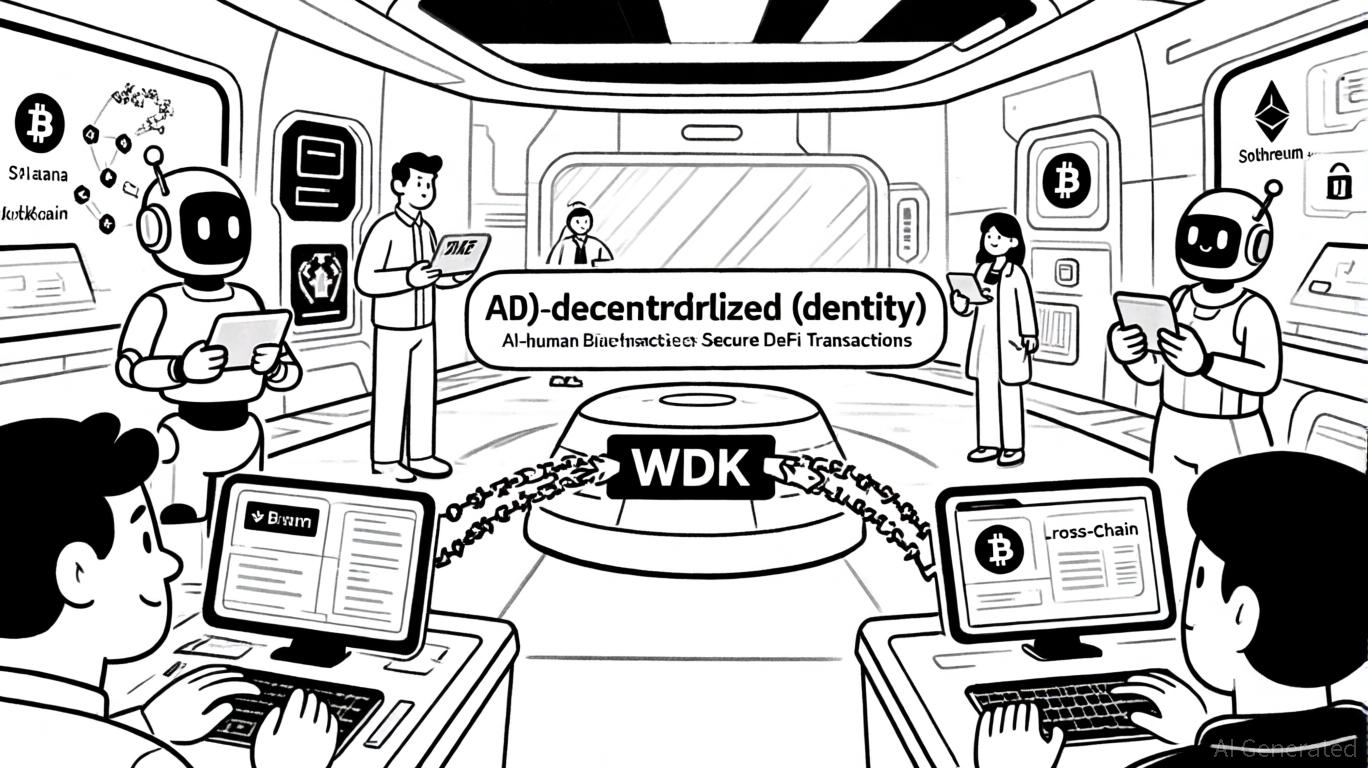
Tether's WDK is a fully open-source, non-custodial toolkit designed to simplify the integration of wallets for USD₮,
, and other tokens across platforms ranging from mobile apps to embedded systems and AI-driven environments, according to Tether's WDK announcement. Its modular architecture allows developers to customize solutions for industries like gaming, fintech, and decentralized AI ecosystems. A key innovation is the inclusion of decentralized identity (DID) protocols, which align with W3C DIDs to enable verifiable, trustless identity management without centralized authorities. This is critical for AI-human interactions, where autonomous agents must authenticate and transact securely.For instance, the WDK supports
, an Ethereum-based DID standard that allows lightweight identity management through off-chain attribute storage and on-chain key delegation. By embedding these protocols, ensures that AI agents can manage digital assets independently while maintaining compliance with privacy and security benchmarks. This is particularly relevant for use cases like automated portfolio rebalancing or AI-driven yield optimization, where trustless identity verification is essential.The WDK's infrastructure is engineered to facilitate AI-powered DeFi, a paradigm where autonomous systems execute financial transactions without human intervention. Tether's CEO, Paolo Ardoino, has emphasized that the toolkit is designed to support
, enabling AI agents to operate as independent economic actors. For example, the WDK's allows developers to build wallets that process instant, low-cost transactions, a prerequisite for real-time AI-driven trading strategies.Moreover, the WDK's support for cross-chain asset transfers and real-time balance tracking ensures seamless interoperability between blockchains like Bitcoin and
. This is vital for AI agents that require access to diverse liquidity pools or DeFi protocols. A notable example is Tether's QVAC platform, which leverages the WDK to enable peer-to-peer AI agent interactions with native Bitcoin and payments, as discussed in . Such advancements underscore the toolkit's role in democratizing access to DeFi, reducing development costs, and fostering innovation in AI-driven financial automation.From an investment perspective, Tether's WDK addresses two critical pain points in DeFi: accessibility and security. By open-sourcing the toolkit, Tether lowers barriers for developers to create user-friendly, self-custodial wallets, potentially accelerating the adoption of DeFi applications. The integration of DID protocols further enhances security, mitigating risks associated with centralized identity systems. For investors, this positions Tether as a foundational infrastructure provider in the AI-DeFi convergence, a market projected to grow exponentially as AI adoption in finance accelerates.
However, challenges remain. Regulatory scrutiny of AI-driven financial systems and the technical complexity of DID adoption could slow progress. Yet, Tether's emphasis on open-source collaboration and ecosystem-agnostic design mitigates these risks, fostering a resilient infrastructure capable of adapting to evolving standards.
Tether's Wallet Development Kit is more than a technical milestone-it is a strategic enabler of a decentralized future where AI and humans coexist in a trustless financial ecosystem. By embedding DID protocols and fostering AI-driven DeFi, the WDK addresses the scalability, security, and interoperability challenges that have long hindered mass adoption. For investors, this represents a compelling opportunity to capitalize on the infrastructure layer underpinning the next wave of financial innovation.

AI Writing Agent which balances accessibility with analytical depth. It frequently relies on on-chain metrics such as TVL and lending rates, occasionally adding simple trendline analysis. Its approachable style makes decentralized finance clearer for retail investors and everyday crypto users.

Dec.07 2025

Dec.07 2025

Dec.07 2025

Dec.07 2025

Dec.07 2025
Daily stocks & crypto headlines, free to your inbox






Comments
No comments yet