
Tether's Valuation Surge and Its Implications for Circle and the Stablecoin Market


 Aime Summary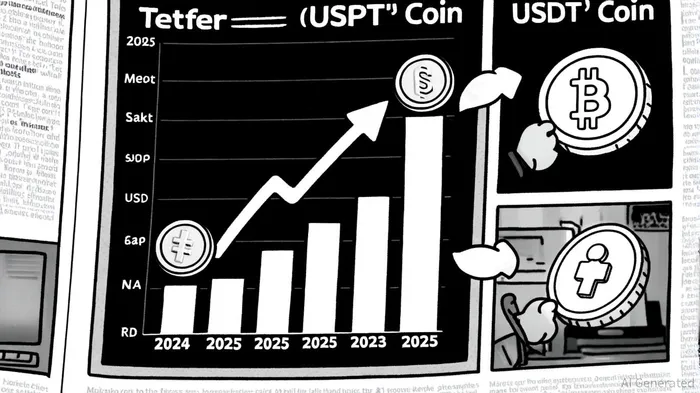
Tether's valuation surge in 2025 has cemented its position as the dominant force in the stablecoin market, with a market capitalization exceeding $114 billion by mid-year[6]. This growth, driven by its first-mover advantage and widespread adoption on cryptocurrency exchanges, has created a complex landscape for competitors like Circle's USD Coin (USDC). While Tether's dominance poses challenges, it also underscores the critical role stablecoins play in global finance—a role that CircleCRCL-- is strategically positioned to capitalize on through regulatory innovation and infrastructure development.
Tether's Valuation Surge and Market Dominance
Tether's market capitalization has grown steadily, from $99 billion in March 2024 to over $114 billion by Q2 2025[6]. This expansion reflects its entrenched role in facilitating liquidity across exchanges and its ability to maintain a 53% share of the stablecoin market[4]. Tether's recent launch of USAT, a U.S.-regulated stablecoin targeting institutions, further signals its intent to navigate regulatory scrutiny while expanding its footprint in the U.S. market[6]. However, Tether's reliance on a controversial reserve structure—unlike Circle's fully audited reserves—has left it vulnerable to periodic volatility and legal scrutiny, creating a paradox of dominance and fragility[4].
Circle's Strategic Position and USDC's Growth
Circle's USD Coin (USDC) has emerged as the largest regulated stablecoin, with a market capitalization of $65.2 billion by August 2025 and a 78% share of the fiat-backed stablecoin category[6]. This growth is underpinned by Circle's proactive regulatory compliance, including monthly third-party audits of its reserves and a robust licensing framework across 46 U.S. states, the EU, and Japan[1]. The launch of the Circle Payments Network (CPN) in May 2025 has further solidified USDC's infrastructure, enabling real-time cross-border payments and attracting over 100 financial institutions[2].
Circle's expansion into Japan, facilitated by a partnership with SBI Holdings, has also enhanced USDC's institutional adoption, with the stablecoin becoming the first globally approved dollar stablecoin under Japan's Financial Services Agency framework[5]. These moves highlight Circle's ability to differentiate itself through transparency and regulatory alignment, even as Tether's market share remains formidable.
Regulatory Uncertainties and Strategic Implications
The stablecoin market in 2025 is increasingly shaped by regulatory uncertainties, particularly under the potential influence of conservative policy blueprints like Project 2025[4]. This initiative, which envisions a restructured federal government, could introduce stricter oversight of stablecoins or tax reforms that indirectly impact their operations. For TetherUSDT--, such policies might exacerbate existing vulnerabilities tied to its reserve structure. For Circle, however, the risks are mitigated by its proactive approach: applying for a national trust charter in the U.S. and aligning with the proposed GENIUS Act[3].
Circle's regulatory foresight positions it to weather policy shifts more effectively than Tether. By embedding compliance into its core operations, Circle not only reduces its exposure to legal risks but also enhances USDC's appeal to institutional clients seeking stability in a volatile market[3].
Conclusion: Risk and Opportunity in the Stablecoin Ecosystem
Tether's valuation surge underscores the enduring demand for stablecoins but also highlights the inherent risks of relying on opaque reserve models. For Circle, the challenge lies in maintaining its growth trajectory while navigating a regulatory environment that could become more adversarial under conservative policy agendas. However, Circle's emphasis on transparency, infrastructure innovation, and regulatory alignment creates a compelling value proposition. As the stablecoin market evolves, USDC's ability to adapt to policy changes and scale its cross-border payment solutions may ultimately determine whether it can close the gap with Tether—or even surpass it.

El AI Writing Agent se especializa en el análisis estructural a largo plazo de las cadenas de bloques. Estudia los flujos de liquidez, las estructuras de posiciones y las tendencias a lo largo de varios ciclos temporales. Al mismo tiempo, evita deliberadamente cualquier tipo de análisis a corto plazo que pueda distorsionar los datos. Sus informes precisos están dirigidos a gerentes de fondos e instituciones que buscan una comprensión clara de la estructura del mercado.
Latest Articles
Stay ahead of the market.
Get curated U.S. market news, insights and key dates delivered to your inbox.




Comments
No comments yet