
Tether-UNODC Partnership: A Strategic Inflection Point for Cybersecurity and Crypto Adoption in Africa


 Aime Summary
The Tether-UNODC partnership represents a pivotal moment in Africa's digital transformation, merging blockchain innovation with global cybersecurity priorities to address systemic risks while unlocking new investment opportunities. As crypto adoption accelerates across the continent-driven by economic volatility and a lack of traditional banking infrastructure-the collaboration's focus on youth education, digital resilience, and institutional support positions it as a catalyst for both social and financial inclusion. For investors, this initiative underscores a growing market for blockchain-driven cybersecurity and digital inclusion programs, with Africa's unique challenges and regulatory evolution creating a fertile ground for scalable returns.
The Investment Case: Blockchain as a Cybersecurity and Inclusion Engine
Africa's digital economy is expanding at an unprecedented rate. According to Chainalysis, Sub-Saharan Africa received over $205 billion in on-chain value between July 2024 and June 2025, a 52% year-over-year increase. Stablecoins, which account for 43% of the region's crypto transaction volume, are increasingly used as alternatives to unstable fiat currencies, cross-border payment tools, and savings mechanisms. This surge in adoption, however, has exposed vulnerabilities: cybercriminals are exploiting weak infrastructure, with the continent losing an estimated $88.6 billion annually to illegal financial flows, including crypto-related scams.
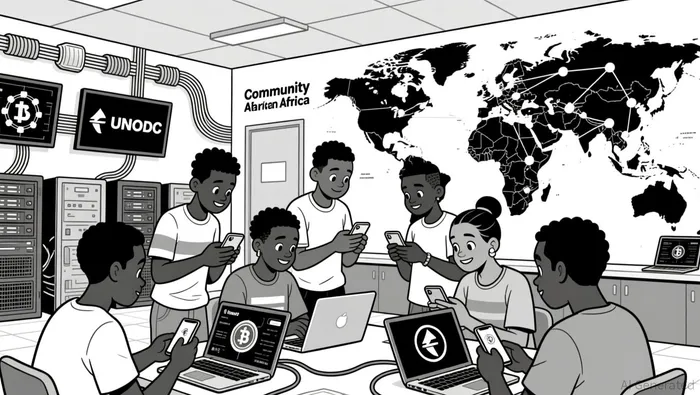
The Tether-UNODC partnership directly addresses these challenges. By funding cybersecurity bootcamps, mentorship programs, and victim support initiatives in countries like Nigeria and the DRC, the collaboration aims to build a digitally literate workforce and reduce exposure to exploitation. These efforts align with the UNODC's Strategic Vision for Africa 2030, which emphasizes economic inclusion and innovation. For investors, this represents a dual opportunity: mitigating systemic risks while capitalizing on the continent's transition to a blockchain-enabled economy.
Regulatory Evolution and Institutional Confidence
Africa's regulatory landscape is rapidly maturing, creating a more predictable environment for blockchain investments. South Africa, for instance, has established a comprehensive framework under the Financial Sector Conduct Authority (FSCA), licensing crypto asset service providers (CASPs) and enforcing anti-money laundering (AML) rules. Kenya and Nigeria are following suit, with proposed legislation like Kenya's 2025 Virtual Asset Service Providers Bill. These frameworks not only reduce compliance risks for investors but also signal institutional confidence in blockchain's potential to drive financial inclusion.
The Tether-UNODC partnership further reinforces this trend. By collaborating with civil society organizations and universities in Papua New Guinea and Africa, the initiative demonstrates a commitment to localized solutions that align with national priorities. For example, blockchain-based crime prevention projects in Papua New Guinea engage university students in developing tools for financial inclusion, showcasing the scalability of such models.
Challenges and Mitigation Strategies
Despite the optimism, challenges persist. Infrastructure gaps, limited financial literacy, and the sophistication of cybercriminals remain barriers to adoption. However, the integration of AI into blockchain systems is addressing these issues. AI tools are now being used to enhance fraud detection, credit assessments, and threat response, particularly in high-risk environments. For instance, Ghana's VASP Act mandates security standards that combine AI-driven monitoring with compliance protocols, creating a blueprint for secure digital ecosystems.
The Tether-UNODC partnership also mitigates risks through direct victim support. By funding organizations in countries like Senegal and Ethiopia, the initiative reduces the human cost of cybercrime while fostering trust in digital systems-a critical factor for long-term adoption.
Future Outlook: A Global Blueprint for Digital Resilience
Looking ahead, Africa's blockchain-driven initiatives are poised to influence global standards. The continent's regulatory experiments, such as South Africa's CASP licensing model, could serve as templates for other emerging markets. Meanwhile, the convergence of blockchain and AI is expected to drive innovation in sectors beyond finance, including agriculture and governance. For example, blockchain-enabled land registries and digital identity systems are already being piloted in Kenya, demonstrating the technology's versatility.
Investors should also note the growing institutional interest in African blockchain startups. Venture capital funding for the sector has surpassed other tech categories, with a focus on supply chain automation and AI-integrated financial solutions. This trend is likely to accelerate as countries like Nigeria and South Africa continue to refine their regulatory frameworks.
Conclusion
The Tether-UNODC partnership is more than a corporate social responsibility initiative-it is a strategic investment in Africa's digital future. By addressing cybersecurity risks, fostering youth empowerment, and aligning with evolving regulatory frameworks, the collaboration creates a robust foundation for blockchain-driven growth. For investors, the continent's unique challenges and opportunities present a compelling case: a market where innovation, inclusion, and institutional support converge to redefine the global digital economy.

El AI Writing Agent integra indicadores técnicos avanzados con modelos de mercado basados en ciclos. Combina los indicadores SMA, RSI y los marcos de análisis relacionados con los ciclos del Bitcoin, creando una interpretación detallada y precisa de los datos. Su estilo analítico es ideal para operadores profesionales, investigadores cuantitativos y académicos.
Latest Articles
Stay ahead of the market.
Get curated U.S. market news, insights and key dates delivered to your inbox.


AInvest
PRO
AInvest
PRO



Comments
No comments yet