
Tether's Strategic Shift: Implications for Stablecoin Liquidity and Blockchain Ecosystems


 Aime Summary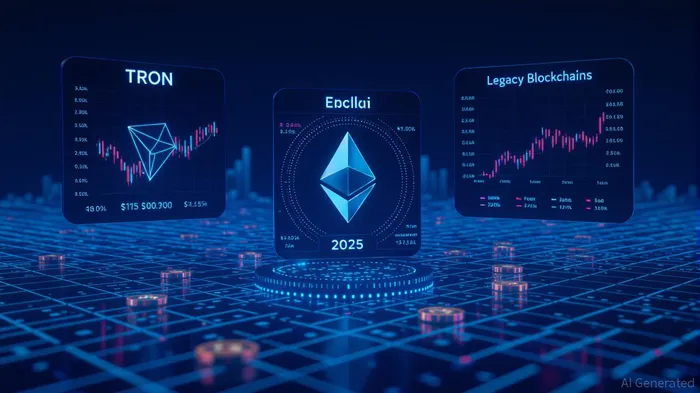
Tether’s 2025 decision to abandon USDTUSDC-- freezes on legacy blockchains—Omni Layer, Bitcoin CashBCH-- SLP, Kusama, EOS, and Algorand—reflects a broader recalibration of capital allocation and operational efficiency in the stablecoin market. By maintaining transferability of existing tokens while ceasing new issuance and redemption, Tether has prioritized user retention and reputational stability over abrupt disruptions [1]. This strategic pivot underscores a market-wide shift toward blockchain networks with robust developer activity, scalability, and high user demand, such as EthereumETH-- and TronTRON-- [2].
The implications for investors are profound. Tron, for instance, has emerged as a dominant force in USDT liquidity, with its supply surpassing Ethereum’s in Q2 2025. Tron’s $73 billion in USDT—accounting for 51% of global circulation—highlights its cost efficiency and fast transaction speeds, which have attracted institutional and retail capital [3]. Meanwhile, Ethereum’s recent $1 billion USDT mint underscores its role as a foundational layer for DeFi, leveraging upgrades like Pectra and Dencun to enhance scalability [4]. These developments signal a structural realignment: investors must now weigh the trade-offs between Tron’s low-cost, high-volume model and Ethereum’s deflationary supply dynamics and institutional adoption.
Bitcoin’s integration of USDT via the RGB protocol further complicates the landscape. By enabling fast, private, and scalable transactions on Bitcoin’s infrastructure, Tether has positioned the network as a global payments layer, with $167 billion in liquidity potentially boosting cross-border remittances and DeFi applications [5]. This innovation challenges Bitcoin’s traditional store-of-value narrative, aligning it with capital-efficient use cases that could attract institutional participation [6].
For investors, the long-term value shift toward supported, scalable chains is clear. Tether’s Q2 2025 profits of $4.9 billion and 68% stablecoin market share demonstrate its ability to sustain dominance while adapting to regulatory and technological pressures [7]. However, challenges remain: regulatory scrutiny, particularly under the U.S. GENIUS Act and Europe’s MiCAR, could disrupt liquidity flows [8]. Investors should also monitor Tron’s Kant mainnet upgrade and Ethereum’s staking yields (3.8%) as indicators of sustained capital allocation [9].
In conclusion, Tether’s strategic shift reflects a market prioritizing operational efficiency and scalability. While Tron and Ethereum are currently the beneficiaries, Bitcoin’s RGB-enabled USDT integration signals a potential third pillar in the stablecoin ecosystem. Investors must remain agile, balancing short-term gains with long-term risks in a rapidly evolving landscape.
Source:
[1] Tether scraps plan to freeze USDT on five blockchains [https://cointelegraph.com/news/tether-drops-plan-to-end-usdt-on-five-chains]
[2] Tether abandons plan to freeze USDT on legacy crypto ... [https://cryptoslate.com/tether-abandons-plan-to-freeze-usdt-on-legacy-crypto-networks-classifies-them-unsupported/]
[3] Tron (TRX) Sees Significant Growth in H1 2025 [https://www.ainvest.com/news/ethereum-news-today-tron-surpasses-ethereum-top-usdt-platform-h1-2025-2508/]
[4] Tether's $1 Billion USDT Mint: A Strategic Catalyst for ... [https://www.ainvest.com/news/tether-1-billion-usdt-mint-strategic-catalyst-crypto-market-momentum-2508/]
[5] Tether's USDT on BitcoinBTC-- via RGB: A Game Changer for ... [https://www.bitget.com/news/detail/12560604939472]
[6] The Bitcoin-to-Ethereum Capital Rotation: A Strategic Shift ... [https://www.ainvest.com/news/bitcoin-ethereum-capital-rotation-strategic-shift-crypto-asset-allocation-2508/]
[7] Tether’s Q2 2025 Profit and Market Capitalization [https://www.bitget.com/news/detail/12560604939472]
[8] Ethereum News Today: Regulation Challenges Tether's ... [https://www.ainvest.com/news/ethereum-news-today-regulation-challenges-tether-dominance-rising-competition-2508/]
[9] TRON's Outperformance Over ETH, SOL, and XRPXRP-- [https://www.ainvest.com/news/tron-outperformance-eth-sol-xrp-sustainable-growth-story-fading-momentum-2508/]

Decoding blockchain innovations and market trends with clarity and precision.
Latest Articles
Stay ahead of the market.
Get curated U.S. market news, insights and key dates delivered to your inbox.




Comments
No comments yet