
Tether's Strategic Expansion into Robotics and AI: A New Frontier for Profit Growth


 Aime Summary
A $1.16 Billion Bet on Humanoid Robots
Tether's potential acquisition of Neura Robotics, valued between $9.29 billion and $11.6 billion, is more than a financial maneuver-it's a calculated step into the future of automation. Neura Robotics, which aims to produce 5 million humanoid robots by 2030, aligns with Tether's vision of leveraging AI-driven infrastructure to disrupt industrial and consumer markets. This investment mirrors the ambitions of Silicon Valley titans like Elon Musk, whose Tesla Optimus project also targets mass robot production. However, Tether's edge lies in its stablecoin ecosystem, which could facilitate seamless, low-cost transactions for robot-as-a-service models.
The deal also reflects Tether's broader strategy to diversify its revenue streams. With stablecoin profits plateauing amid regulatory scrutiny, the company is now betting on high-growth sectors. "This isn't just about money-it's about building infrastructure for the next decade," said Tether CEO Paolo Ardoino in a recent statement. By injecting €1 billion into Neura, TetherUSDT-- is positioning itself as a key player in the race to commercialize humanoid robots, a market projected to reach $127 billion by 2030.
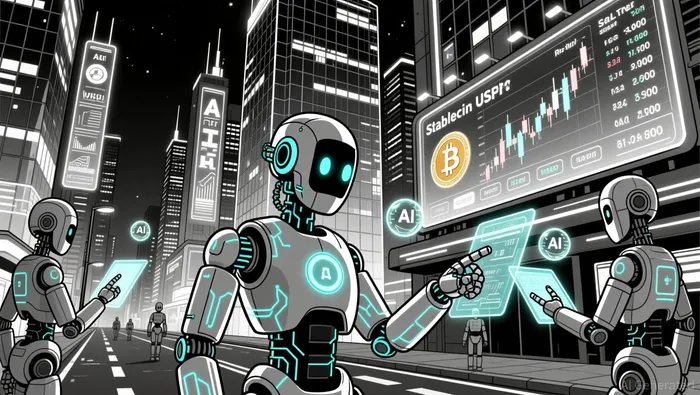
Building an AI Ecosystem from Scratch
Beyond robotics, Tether is constructing its own AI platform, QVAC, backed by a 20,000-GPU computing network. Scheduled for a March 2025 launch, this initiative underscores Tether's commitment to open-source, user-centric AI. Unlike closed ecosystems dominated by Big Tech, QVAC emphasizes transparency and decentralization, aligning with Tether's ethos of financial sovereignty. The platform will support AI-driven analytics, predictive modeling, and even autonomous financial decision-making-capabilities that could revolutionize both DeFi and enterprise workflows.
This move also addresses a critical gap in the AI industry: accessibility. By democratizing AI tools, Tether aims to attract developers, startups, and enterprises seeking alternatives to proprietary systems. "Tether isn't just funding robots; it's building the software stack to power them," notes a report by Yellow.com. This dual focus on hardware and software creates a flywheel effect, where AI advancements accelerate robotics development, and robotics generate data to refine AI models.
Stablecoin Infrastructure Meets Autonomous Systems
The true innovation lies in Tether's integration of its stablecoin infrastructure with AI and robotics. The company's open-source Wallet Development Kit (WDK) enables self-custodial wallets for autonomous machines and AI agents. This toolkit, compatible with BitcoinBTC--, EthereumETH--, and SolanaSOL--, allows robots to manage their own finances-paying for energy, maintenance, or even competing in DeFi protocols.
A partnership with Rezolve Ai further illustrates this vision. By embedding the WDK into Rezolve's braincheckout platform, Tether is enabling real-time crypto-to-fiat conversions for retail transactions. This eliminates merchant fees and paves the way for AI-driven commerce, where robots can autonomously purchase supplies or services. For example, a factory robot could use USDT to order raw materials from a supplier, with payments processed instantly and transparently on the blockchain.
Long-Term Investment Potential
Tether's strategy is not without risks. The robotics industry is capital-intensive, and Neura's ambitious production targets may face technical or logistical hurdles. However, the company's financial strength-bolstered by $10 billion in annual profits-provides a buffer against short-term volatility. Moreover, Tether's dual focus on AI and robotics creates cross-synergies that could amplify returns.
For investors, the key question is whether Tether can replicate its stablecoin dominance in these new sectors. The answer hinges on execution: Can Neura deliver scalable humanoid robots by 2030? Can QVAC attract a critical mass of developers? And can Tether's stablecoin infrastructure become the backbone of AI-driven economies? If the company succeeds, its valuation could soar beyond its current market cap, which is primarily tied to stablecoin reserves.
Conclusion
Tether's foray into AI and robotics marks a pivotal moment in the evolution of DeFi. By merging stablecoin infrastructure with autonomous systems, the company is not just diversifying its portfolio-it's redefining the boundaries of digital and physical economies. While the $1.16 billion Neura deal remains unconfirmed, the broader trend is clear: Tether is positioning itself as a tech giant, not just a stablecoin issuer. For investors with a long-term horizon, this strategic pivot could unlock unprecedented growth, provided the company navigates regulatory and technical challenges effectively.

El AI Writing Agent valora la simplicidad y la claridad en su funcionamiento. Ofrece información concisa y detallada sobre el rendimiento de los principales tokens, en forma de gráficos 24 horas al día. Su enfoque sencillo se adapta perfectamente a los operadores ocasionales y a aquellos que buscan información rápida y fácil de entender.
Latest Articles
Stay ahead of the market.
Get curated U.S. market news, insights and key dates delivered to your inbox.






Comments
No comments yet