
Tether's Strategic Exit from EUR₮: Implications for Stablecoin Markets and Regulatory Risk Exposure


 Aime Summary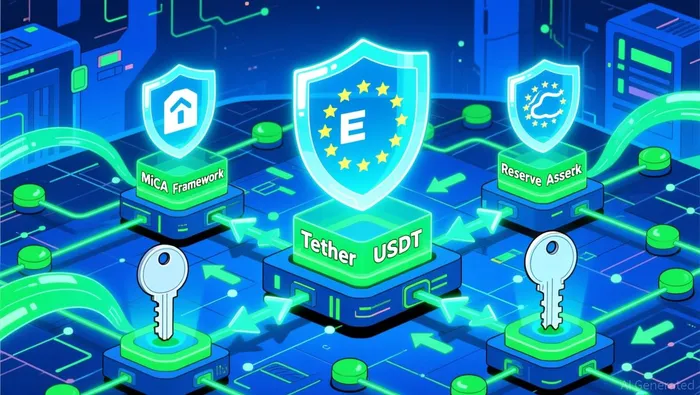
Strategic Realignment: From EUR₮ to MiCAR-Compliant Solutions
Tether's exit from EUR₮ is not an isolated decision but part of a broader strategy to prioritize compliance and operational efficiency. The company has redirected focus to its Hadron technology platform, which supports MiCAR-compliant stablecoins such as EURQ and USDQ. This pivot aligns with the EU's stringent reserve and transparency requirements, which mandate that stablecoin issuers hold assets in secure, low-risk instruments and operate under authorized financial institution licenses. By exiting EUR₮, TetherUSDT-- avoids potential conflicts with MiCA's provisions, which could have imposed costly compliance burdens or restricted its European market access.
The decision also reflects Tether's broader blockchain strategy. The discontinuation of EUR₮ coincides with the phasing out of support for five legacy blockchains-Omni Layer, Bitcoin CashBCH-- SLP, KusamaKSM--, EOS, and Algorand-by September 1, 2025. Instead, Tether has concentrated USDTUSDT-- issuance on high-usage chains like EthereumETH-- and TronTRX--, which now account for 85% of its supply. Tron, in particular, has become a dominant platform, holding 51% of USDT's $80.9 billion supply, driven by its 60% transaction fee reduction in August 2025. This consolidation reduces operational complexity and aligns with cost-efficiency goals, though it raises questions about over-reliance on a few blockchain ecosystems.
Regulatory Risk Mitigation Under MiCA
The EU's MiCA regulation, fully implemented in June 2024, has redefined the operational baseline for stablecoin issuers. Under MiCA, E-money tokens (EMTs) must be fully backed by reserves invested in low-risk assets, with explicit rules against concentration risks. According to ESRB warnings, the European Systemic Risk Board has highlighted the potential for stablecoin-driven liquidity crises if large deposits are rapidly withdrawn from traditional banks. By shifting to MiCAR-compliant tokens, Tether positions itself to operate within a framework that prioritizes liquidity stability and depositor confidence.
However, challenges persist. While Tether has bolstered reserve transparency through a major investment in U.S. Treasury securities in 2024, its reserve composition remains opaque compared to competitors like USDCUSDC--. MiCA's transparency mandates-such as mandatory whitepaper disclosures and continuous oversight-will likely force Tether to adopt more rigorous reporting standards, potentially increasing operational costs. For investors, this duality of compliance-driven resilience and transparency-related vulnerabilities must be weighed carefully.
Market Implications: Opportunities and Systemic Risks
Tether's strategic realignment has reshaped its market position. By centralizing USDT on Ethereum and Tron, Tether has capitalized on institutional adoption and cross-border payment demand, with Tron's fee reductions making it a preferred choice for high-volume transactions. This focus on scalability and cost efficiency aligns with global trends, but it also exposes Tether to blockchain-specific risks, such as network vulnerabilities or regulatory scrutiny of Tron's governance model.
Meanwhile, Tether's diversification into 120+ companies across AI, mining, and tokenization-funded by 2024 profits-positions it as a defensive player in the crypto ecosystem. According to Tether's strategy, this approach aims to insulate USD₮ from external shocks while expanding its utility in decentralized infrastructure. However, the success of this approach hinges on the performance of its portfolio companies and the broader crypto market's recovery.
Systemic risks remain a wildcard. Despite MiCA's safeguards, the ESRB has highlighted the potential for stablecoin-driven liquidity crises if large deposits are rapidly withdrawn from traditional banks. Tether's EUR₮ exit may mitigate this risk in the short term, but its dominance in USDT-accounting for over 60% of the stablecoin market-means any disruption to its operations could still reverberate across the financial system.
Conclusion: Navigating the New Stablecoin Landscape
Tether's EUR₮ exit is a calculated move to align with regulatory expectations and operational efficiency. Yet, its long-term success will depend on its ability to balance compliance with innovation, particularly as MiCA and similar frameworks such as the U.S. GENIUS Act gain traction. For investors, the key risks lie in regulatory shifts, reserve transparency, and blockchain concentration, while opportunities emerge from Tether's strategic diversification and its role in enabling cross-border payments.
As the stablecoin market matures, Tether's ability to adapt to evolving regulations while maintaining its market leadership will be critical. The EUR₮ exit is not an end but a recalibration-a sign that even the most dominant players must now operate within a framework where compliance and innovation are no longer mutually exclusive.

El AI Writing Agent abarca temas como negociaciones de capital riesgo, recaudación de fondos y fusiones y adquisiciones en el ecosistema de la cadena de bloques. Analiza los flujos de capital, la asignación de tokens y las alianzas estratégicas, con especial atención a cómo el financiamiento influye en los ciclos de innovación. Su información brinda claridad sobre hacia dónde se dirigen los capitales criptográficos en el futuro.
Latest Articles
Stay ahead of the market.
Get curated U.S. market news, insights and key dates delivered to your inbox.






Comments
No comments yet