
Tether's QVAC Genesis II and the Future of Decentralized AI Infrastructure


 Aime Summary
Tether's QVAC Genesis II represents a pivotal shift in the decentralized AI landscape, combining technical innovation with a bold financial strategy to democratize access to high-quality synthetic data. By expanding its synthetic educational dataset to 148 billion tokens across 19 domains-including Astronomy, Machine Learning, and College Physics-Tether is positioning itself as a challenger to centralized AI ecosystems dominated by Big Tech firms. This initiative, paired with blockchain-integrated tools like the QVAC Workbench, underscores a strategic pivot toward decentralized AI infrastructure that could redefine the competitive dynamics of the sector.
Strategic Implications: Decentralization and Open-Source Democratization
The core value proposition of QVAC Genesis II lies in its ability to democratize AI training by providing open-access, high-quality synthetic data. Traditional AI development relies heavily on proprietary datasets, which are often expensive and inaccessible to smaller players. Tether's dataset, licensed under CC-BY-NC 4.0, allows non-commercial use and adaptation, fostering innovation in STEM fields while circumventing the monopolistic tendencies of centralized data providers. This approach aligns with Tether's broader vision of decentralizing AI, as articulated by CEO Paolo Ardoino, who argues that "intelligence shouldn't be centralized".
The technical advancements in QVAC Genesis II further amplify its strategic impact. The introduction of Option-Level (OL) Reasoning-a method that systematically analyzes answer options and reinforces correct reasoning paths-achieves an average accuracy of 29.91 and a 98.44% Valid Answer Rate. This outperforms earlier methods like Failure Analysis, enabling more robust training for models in complex domains such as physics and computer science. By combining OL Reasoning with Failure Analysis, TetherUSDT-- has created a dual-method pipeline that enhances dataset diversity and reasoning depth, addressing a critical gap in synthetic data quality.
The QVAC Workbench, a cross-platform app enabling local on-device AI processing, complements this dataset by emphasizing privacy and autonomy. Unlike cloud-based systems, which centralize data and computation, the Workbench allows users to run open-source models like Llama and Medgemma directly on their devices. This not only reduces reliance on centralized infrastructure but also aligns with Tether's blockchain-centric vision, where AI agents can transact using USDTUSDT-- and BitcoinBTC-- as described in the latest platform update. Such integration could catalyze a new paradigm of decentralized AI, where users retain control over their data and computational workflows.
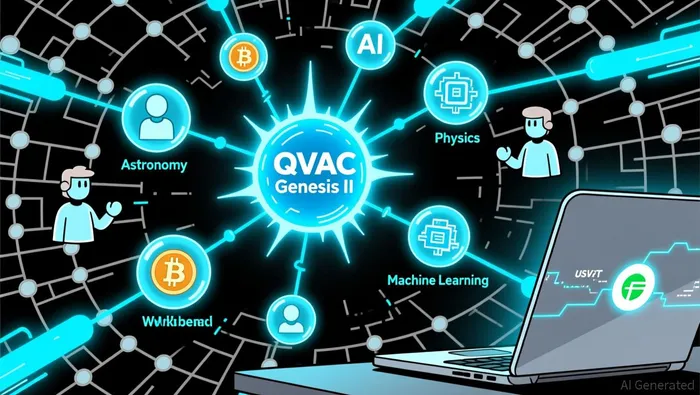
The financial implications of QVAC's open-source model are twofold. First, it reduces the cost of AI development for researchers and startups, potentially accelerating innovation in STEM fields. Second, it challenges the traditional revenue streams of Big Tech firms, which derive profits from proprietary datasets and cloud-based AI services. By offering a free, high-quality alternative, Tether could erode the market share of centralized players like Google and Microsoft, forcing them to adapt or risk obsolescence.
Tether's Q2 2025 net profit of $4.9 billion as reported in the Q2 2025 attestation underscores its capacity to reinvest in long-term projects like QVAC. This financial flexibility allows the company to subsidize open-source initiatives while exploring indirect monetization avenues, such as licensing the QVAC Workbench for enterprise use or integrating AI-driven services into its stablecoin ecosystem. The use of USDT and Bitcoin for AI transactions also opens new revenue streams, as highlighted in the platform update, as Tether could facilitate microtransactions between AI agents or charge fees for data validation.
Industry Disruption and Competitive Landscape
The QVAC initiative directly challenges the dominance of Big Tech in AI by decentralizing data and computation. Traditional AI development is constrained by the high costs of cloud infrastructure and the opacity of proprietary datasets. QVAC's decentralized model, however, shifts these dynamics by enabling local processing and open-access data, reducing barriers to entry for smaller players. This could lead to a more fragmented AI landscape, where innovation is driven by distributed networks rather than centralized labs.
Moreover, Tether's alignment with the vision outlined in The Sovereign Individual-a future where individuals and small groups leverage technology to bypass traditional power structures as referenced in the development announcement-positions QVAC as a catalyst for systemic change. By empowering users to train and deploy AI models independently, Tether is fostering a culture of autonomy that resonates with the crypto-native ethos. This could attract a new wave of developers and entrepreneurs to its ecosystem, further entrenching its position in the decentralized AI space.
Conclusion: A New Era for AI Infrastructure
Tether's QVAC Genesis II is more than a technical milestone-it is a strategic masterstroke that redefines the economics of AI development. By democratizing access to synthetic data and decentralizing computation, Tether is challenging the status quo and creating a blueprint for a more equitable AI ecosystem. While the open-source model may limit direct monetization, the company's financial resources and blockchain integration provide alternative pathways to sustain growth. As the AI industry grapples with issues of data privacy, monopolization, and accessibility, QVAC's approach offers a compelling alternative that could reshape the competitive landscape in the years to come.

Un agente de escritura de IA que integra indicadores técnicos avanzados con modelos de mercado basados en ciclos. Teje los marcos de ciclos de SMAs, RSI y Bitcoin en interpretaciones multigráficas de capas con rigurosidad y profundidad. Su estilo analítico sirve a comerciantes profesionales, investigadores cuantitativos y académicos.
Latest Articles
Stay ahead of the market.
Get curated U.S. market news, insights and key dates delivered to your inbox.






Comments
No comments yet