
Tether Expands Bitcoin Integration to Enhance USDT Usability
 Aime Summary
- Tether is integrating USDT with the BitcoinBTC-- Lightning Network to improve transaction speed and cost efficiency, enabling high-volume everyday payments according to Gate Ventures.
- Tether invested $7.5 million in Utexo to develop infrastructure for Bitcoin-based USDT transactions using the Lightning Network and RGB protocols.
- Boltz Exchange launched atomic swaps between USDT and Bitcoin on the Lightning Network, using USDT0 to streamline cross-chain liquidity as reported by Bitcoin Magazine.
Tether is broadening the utility of its stablecoin, USDT, by integrating it with the Bitcoin Lightning Network according to Gate Ventures. This initiative aims to provide faster, lower-cost transactions, making USDT more accessible for everyday payments. The company has already made significant strides in this direction, including investing $7.5 million in Utexo to build infrastructure for Bitcoin-based USDT transactions.
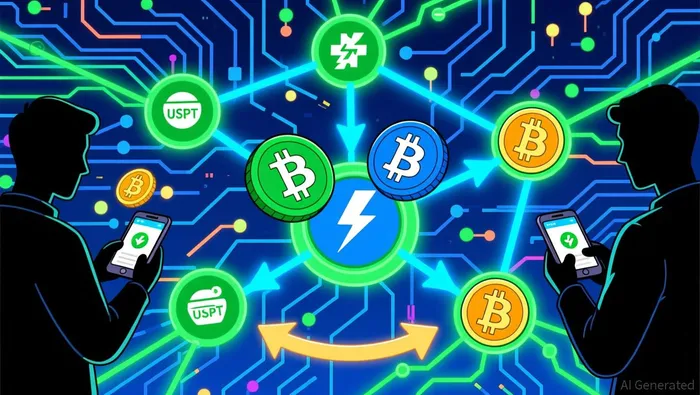
The Lightning Network is an important layer-2 solution for Bitcoin, enabling near-instant and low-cost transactions. By leveraging this network, TetherUSDT-- hopes to position USDT as a viable option for high-volume payment systems according to Gate Ventures. This development aligns with broader industry trends toward scalability and real-world usability in digital assets. It also reflects a growing push for interoperability across blockchain ecosystems according to Gate Ventures.
In parallel, Boltz Exchange introduced atomic swaps between USDT and Bitcoin, using USDT0 to facilitate cross-chain liquidity as reported by Bitcoin Magazine. These swaps are non-custodial and atomic, ensuring trustless execution of trades. This eliminates the need for users to rely on centralized platforms or understand the complexities of blockchain bridge networks as reported by Bitcoin Magazine.
What is Tether's Vision for Expanding USDT's Utility?
Tether's strategic investments and integrations aim to enhance the accessibility and functionality of USDT beyond its traditional role as a stable store of value according to AInvest. By leveraging layer-2 protocols like the Lightning Network, Tether is enabling faster and cheaper transactions, which are critical for everyday payments. Utexo's development goals include creating APIs for seamless integration and predictable costs, making it easier for payment providers to adopt USDT without significant infrastructure changes according to AInvest.
The integration with Bitcoin's Lightning Network also allows over 550 million users to conduct near-instant, low-cost USDT transactions according to AInvest. This is particularly beneficial in emerging markets with limited access to traditional banking infrastructure. By expanding the use cases of USDT, Tether is positioning itself as a leader in stablecoin innovation according to AInvest.
How is the Stablecoin Landscape Evolving?
Tether's activities are part of a larger shift in the crypto market toward institutional adoption and infrastructure development according to AInvest. The recent launch of the iShares Staked Ethereum Trust ETF by BlackRock is an example of growing institutional confidence in digital assets according to Gate Ventures. Additionally, regulatory clarity from the SEC and CFTC is helping to reduce uncertainty for developers and investors according to MEXC. The new guidance distinguishes between protocol-level staking and centralized staking services, providing a framework for digital asset classification according to MEXC.
Despite these developments, the stablecoin market is not without risks. A loss of confidence in major issuers could lead to systemic disruptions in both the crypto and broader equity markets according to AInvest. Tether's dominance, with USDT accounting for a significant share of the $300 billion stablecoin market, makes it a focal point for regulatory and market scrutiny according to AInvest. Utexo's platform is designed to address these challenges by abstracting technical complexities and offering a flat-fee pricing model according to AInvest.
What Are the Market Implications of Tether's Strategy?
Tether's expansion into the Lightning ecosystem may influence broader crypto market dynamics according to Gate Ventures. Increased transaction activity could strengthen Bitcoin's role beyond a store of value. For businesses, this could mean faster settlements and reduced reliance on traditional payment intermediaries according to Gate Ventures. For users, it may enable smoother peer-to-peer transfers and microtransactions. If adoption grows, the combination of stablecoins and Lightning infrastructure could reshape how digital payments operate, especially in regions with limited access to banking services according to Gate Ventures.
Market adoption will depend on factors such as transaction costs, reliability, and ease of use. While the Lightning Network has grown steadily, scaling to support millions of users will require continued technical development according to Gate Ventures. Competition from other networks, such as Ethereum and TRON, remains strong, and any shift toward Bitcoin is likely to happen gradually according to Gate Ventures.
Overall, Tether's strategy highlights a growing push toward interoperability across blockchain ecosystems. If successful, the company's Lightning integration could become a key milestone in advancing faster, more efficient global digital payments according to Gate Ventures.

Blending traditional trading wisdom with cutting-edge cryptocurrency insights.
Latest Articles
Stay ahead of the market.
Get curated U.S. market news, insights and key dates delivered to your inbox.


AInvest
PRO
AInvest
PRO



Comments
No comments yet