
Tether’s Decline in Market Share and Its Implications for Stablecoin Investors


 Aime Summary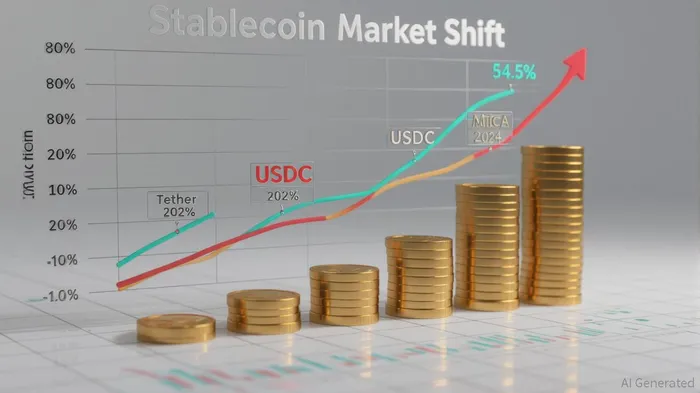
The stablecoin market has entered a transformative phase, marked by Tether’s (USDT) historic decline in market share and the rise of compliant alternatives like USDCUSDC-- and USDeUSDC--. By August 2025, Tether’s dominance had fallen to 59.5%, its lowest level since March 2023, as regulatory scrutiny and institutional trust gaps eroded its once-unassailable position [1]. This shift reflects broader dynamics reshaping the digital asset landscape, where compliance, transparency, and systemic risk mitigation are now central to investor decision-making.
Regulatory Pressures and Tether’s Strategic Challenges
Tether’s decline is inextricably linked to evolving regulatory frameworks. The U.S. GENIUS Act (July 2025) and the EU’s MiCA Regulation (December 2024) have redefined stablecoin issuance, mandating 1:1 reserve backing, monthly audits, and stricter anti-money laundering (AML) protocols [2]. Tether’s refusal to comply with MiCA led to its delisting in the EU, ceding ground to USDC and other compliant stablecoins [3]. Meanwhile, the GENIUS Act’s requirement for monthly reserve disclosures put Tether at a disadvantage compared to USDC’s quarterly reporting, which aligns with institutional expectations for transparency [4].
Tether’s strategic pivot to EthereumETH-- and TronTRON-- blockchains, now hosting 72% of its supply, has boosted scalability but raised systemic risks. Critics argue this concentration amplifies vulnerability to network outages or regulatory actions, particularly as Tether’s reserve composition—65.7% U.S. Treasury bills—remains opaque compared to USDC’s fully cash-backed model [5].
Institutional Adoption and Trust in Compliant Stablecoins
The rise of USDC and USDe underscores a growing preference for regulatory alignment. USDC, backed by CircleCRCL-- and CoinbaseCOIN--, has captured 30% of the market by adhering to both the GENIUS Act and MiCA, with monthly audits and a reserve structure of 90% cash and short-term Treasuries [6]. Institutions like JPMorganJPM-- and PayPalPYPL-- have integrated USDC into cross-border payments and treasury management, with JPM Coin facilitating $1 billion in daily settlements and PYUSD contributing 15% of PayPal’s revenue [7].
New entrants like Ethena’s USDe (4.3% market share) further diversify the ecosystem by offering yield-bearing features, attracting investors seeking passive income without sacrificing compliance [8]. This innovation has spurred capital reallocation, with BlackRockBLK-- and CitigroupC-- expanding stablecoin-based yield products and custody services [9].
Risks and Opportunities for Investors
While Tether’s decline signals a maturing market, it also highlights systemic risks. The concentration of 90% of the $250 billion stablecoin market in Tether and USDC raises concerns about single-point failures, as seen during the 2023 regional banking crisis when USDC briefly depegged due to exposure to Silicon Valley Bank [10]. Investors must balance compliance with diversification, avoiding overexposure to any single stablecoin.
Actionable strategies include:
1. Prioritizing Compliant Issuers: Allocate capital to stablecoins with transparent reserve structures and regulatory alignment, such as USDC or USDe.
2. Diversifying Across Protocols: Spread investments across Ethereum, Tron, and Bitcoin-based RGB protocols to mitigate blockchain-specific risks.
3. Monitoring Yield Opportunities: Leverage yield-bearing stablecoins like USDe while assessing counterparty risks from underlying collateral.
The Future of Stablecoin Investing
The stablecoin market is projected to grow to $10 trillion by 2028, driven by institutional adoption and regulatory clarity [11]. However, success will depend on navigating dual pressures: maintaining compliance with evolving frameworks and innovating to meet demand for yield and utility. For investors, the key lies in balancing trust in established players like USDC with agility to capitalize on emerging opportunities in hybrid ecosystems.
As the industry evolves, Tether’s decline serves as a cautionary tale and a catalyst for a more resilient, diversified stablecoin landscape. Investors who adapt to this new paradigm will be well-positioned to harness the transformative potential of digital assets.
Source:
[1] Tether's Market Share Dwindles as Stablecoin Dynamics [https://www.onesafe.io/blog/tether-market-share-decline-stablecoin-dynamics]
[2] The GENIUS Act of 2025 Stablecoin Legislation Adopted in ... [https://www.lw.com/en/insights/the-genius-act-of-2025-stablecoin-legislation-adopted-in-the-us]
[3] Regulators and Rivals Reshape Tether's Stablecoin Reign [https://www.ainvest.com/news/regulators-rivals-reshape-tether-stablecoin-reign-2508/]
[4] Tether's U.S. Market Expansion and the Strategic Value of Stablecoins in the Post-GENIUS Act Era [https://www.ainvest.com/news/tether-market-expansion-strategic-stablecoins-post-genius-act-era-2508/]
[5] Tether's Blockchain Strategy Shift: Implications for Stablecoin Investors [https://www.ainvest.com/news/tether-blockchain-strategy-shift-implications-stablecoin-investors-2508/]
[6] America's Embrace of Stablecoins: What Investors Should Know [https://hashdex.com/en-KY/insights/america-s-embrace-of-stablecoins-what-investors-should-know]
[7] Stablecoin Stocks: How Regulatory Clarity and Institutional Adoption are Reshaping Risk and Demand [https://www.ainvest.com/news/stablecoin-stocks-regulatory-clarity-institutional-adoption-reshaping-risk-demand-2508/]
[8] Tether's Strategic Shift and Its Implications for Stablecoin Ecosystems [https://www.bitget.com/news/detail/12560604941715]
[9] Stablecoin Adoption in 2025: Global Market Trends [https://www.getivy.io/stablecoins/stablecoin-adoption-trends]
[10] Tether (USDT) and USDC Dominate the Stablecoin Market, but Is This Concentration a Risk for Investors? [https://www.mitrade.com/insights/news/live-news/article-8-1001287-20250731]
[11] Stablecoin Stocks: A New Era of Regulatory Clarity and Institutional Adoption [https://www.ainvest.com/news/stablecoin-stocks-era-regulatory-clarity-institutional-adoption-2025-2508-82/]

Decoding blockchain innovations and market trends with clarity and precision.
Latest Articles
Stay ahead of the market.
Get curated U.S. market news, insights and key dates delivered to your inbox.
AInvest
PRO
AInvest
PRO



Comments
No comments yet