
Tether's Blockchain Strategy Shift: Implications for Stablecoin Investors


 Aime Summary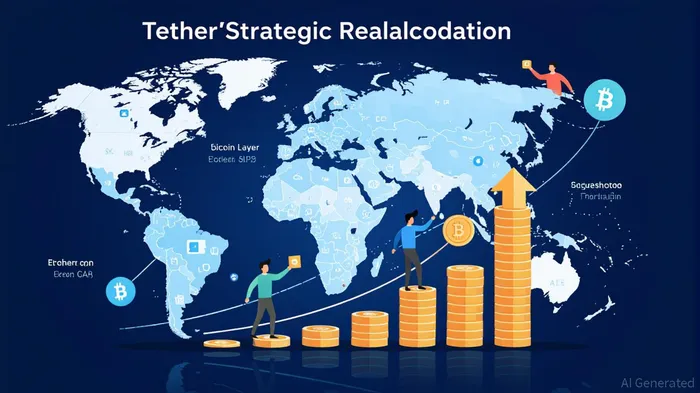
Tether’s 2025 Q3 strategic reallocation of blockchain resources marks a pivotal shift in the stablecoin landscape, with profound implications for market concentration and investment opportunities. By phasing out support for legacy blockchains like Omni Layer, Bitcoin CashBCH-- SLP, Kusama, EOS, and AlgorandALGO--, Tether is consolidating liquidity into high-utility ecosystems such as EthereumETH--, TronTRON--, and Bitcoin-based protocols like RGB [1]. This move reflects a calculated alignment with market demand, regulatory clarity, and scalability, but it also raises critical questions for investors navigating a rapidly evolving blockchain ecosystem.
Strategic Reallocation: From Legacy Chains to Scalable Ecosystems
Tether’s decision to halt USDTUSDC-- minting and redemption on underutilized blockchains is driven by operational efficiency and user demand. These legacy chains now account for less than 2% of USDT’s transaction volume, with Ethereum and Tron hosting 72% of the stablecoin’s total supply [1]. The shift to Ethereum and Tron is not merely a technical adjustment but a strategic pivot to ecosystems with robust developer activity and institutional adoption. Ethereum’s DeFi infrastructure and Tron’s cost efficiency have become central to the stablecoin-driven financial landscape, with Tron alone hosting 51% of USDT’s $80.9 billion supply [2].
Simultaneously, Tether is leveraging Bitcoin’s security and global reach through the RGB protocol, enabling private, scalable transactions on the BitcoinBTC-- network [3]. This integration positions Bitcoin as a dual-purpose asset—both a store of value and a medium for everyday transactions—while expanding its role in decentralized finance (DeFi) and cross-border remittances [4]. The RGB protocol’s client-side validation and Lightning Network compatibility further reduce reliance on third-party chains, enhancing Bitcoin’s utility as a payments layer [5].
Market Concentration and Systemic Risks
The reallocation of USDT to Ethereum and Tron has intensified market concentration, with these two blockchains now dominating stablecoin activity. Ethereum’s 78.22% share of stablecoin lending and Tron’s 51% circulation of USDT underscore their entrenched positions [6]. However, this consolidation amplifies systemic risks, particularly for projects dependent on legacy blockchains. Kusama and Algorand, for instance, face liquidity erosion and declining developer incentives, highlighting vulnerabilities in underdeveloped ecosystems [7].
The rise of USDCUSDC-- as a compliance-focused alternative further complicates the landscape. With 20% market share and adherence to frameworks like the U.S. Stablecoin Act and MiCA, USDC is gaining traction among institutional investors [8]. This competition challenges Tether’s dominance, emphasizing the growing importance of transparency and regulatory alignment in institutional adoption.
Investment Opportunities in a Shifting Ecosystem
For investors, the key lies in balancing scalability, institutional credibility, and innovation. Ethereum’s institutional-grade DeFi infrastructure and Tron’s cost efficiency remain attractive, but both face regulatory scrutiny under the U.S. Stablecoin Act and MiCA [9]. Meanwhile, Bitcoin’s RGB integration opens new avenues for DeFi applications and institutional-grade financial tools, supported by Tether’s $4.9 billion Q2 2025 profits and 68% stablecoin market share [10].
Niche opportunities also emerge in tokenized assets and AI-driven infrastructure. The tokenization of illiquid assets like high-performance GPUs and the integration of AI in managing crypto treasuries are reshaping investment strategies [11]. Additionally, platforms like Caliber are leveraging blockchain-based solutions to automate asset management, signaling broader adoption in traditional finance [12].
Regulatory Challenges and the Path Forward
Regulatory frameworks like the U.S. GENIUS Act and EU MiCA will continue to shape the stablecoin ecosystem. Tether’s compliance efforts, including quarterly audits and reserve enhancements (e.g., 100,000 Bitcoins and $120 billion in U.S. Treasuries), aim to address transparency concerns [13]. However, the 3.9% annual run risk for USDT compared to 3.3% for USDC underscores lingering uncertainties [14].
The broader blockchain industry is also witnessing a shift toward compliance-driven infrastructure. Initiatives like the Beacon Network, supported by CoinbaseCOIN-- and Binance, are redefining fraud detection and money laundering prevention, creating long-term moats for security-first firms [15]. This trend aligns with institutional adoption, as companies increasingly prioritize scalable, compliant solutions for cross-border transactions and asset management [16].
Conclusion
Tether’s blockchain strategy shift reflects a broader industry trend toward consolidation, regulatory readiness, and scalable innovation. While Ethereum and Tron remain dominant, Bitcoin’s RGB integration and USDC’s compliance-driven growth present compelling opportunities for investors. The key to navigating this landscape lies in monitoring regulatory developments, balancing cost efficiency with institutional credibility, and capitalizing on emerging technologies like RGB and tokenized assets. As the stablecoin ecosystem evolves, investors must remain agile, leveraging insights from both technical innovation and regulatory alignment to secure long-term value.
Source:
[1] Tether's Strategic Shift and Its Implications for Blockchain [https://www.ainvest.com/news/tether-strategic-shift-implications-blockchain-ecosystems-stablecoin-dominance-2508/]
[2] Tether's Strategic Shift and the Future of Stablecoin Ecosystems [https://www.bitget.com/news/detail/12560604941715]
[3] Tether's USDT on Bitcoin via RGB: A Game Changer for [https://www.bitget.com/news/detail/12560604939472]
[4] Tether's Blockchain Reconfiguration: A Catalyst for ..., [https://www.ainvest.com/news/tether-blockchain-reconfiguration-catalyst-stablecoin-stability-institutional-adoption-2508/]
[5] Tether's Strategic Expansion of USDT on Bitcoin and RGB [https://www.bitget.com/news/detail/12560604937525]
[6] Tether's Strategic Shift and the Future of Niche Blockchain Networks [https://www.ainvest.com/news/tether-strategic-shift-future-niche-blockchain-networks-2508]
[7] Tether's Strategic Shift and Its Implications for Blockchain [https://www.ainvest.com/news/tether-strategic-shift-implications-blockchain-ecosystems-stablecoin-dominance-2508]
[8] USDT, USDC, and Beyond: Stablecoin Adoption and Regulation Across the Globe in 2025 [https://yellow.com/research/usdt-usdc-and-beyond-stablecoin-adoption-and-regulation-across-the-globe-in-2025]
[9] Tether's Strategic Shift and the Future of Stablecoin Ecosystems [https://www.bitget.com/news/detail/12560604941715]
[10] Tether’s Q2 2025 Profit and Market Capitalization [https://www.tradingview.com/news/cryptonews:bb05882ce094b:0-breaking-tether-stablecoin-usdt-coming-to-bitcoin-blockchain/]
[11] How Blockchain and AI are Reshaping Investment | INN [https://investingnews.com/blockchain-ai-investment-landscape/]
[12] Caliber Establishes LINK Token Digital Asset Treasury [https://www.morningstarMORN--.com/news/globe-newswire/9519764/caliber-establishes-link-token-digital-asset-treasury]
[13] Tether’s Reserves and Transparency Measures [https://www.hollaex.com/blog/is-usdt-safe-understanding-tethers-reserves-and-transparency]
[14] Stablecoin Run Risk and Institutional Adoption Trends [https://www.investopedia.com/hidden-risks-of-widespread-adoption-of-stablecoin-11747043]
[15] Blockchain Infrastructure and Regulatory Compliance [https://www.ainvest.com/news/blockchain-infrastructure-regulatory-compliance-era-security-investment-opportunities-2508/]
[16] North American CFOs Anticipate Significant Uptick in Corporate Cryptocurrency Adoption [https://www.deloitte.com/us/en/about/press-room/cfo-signals-survey-north-american-cfos-anticipate-significant-uptick-in-corporate-cryptocurrency-adoption-2027.html]

Decoding blockchain innovations and market trends with clarity and precision.
Latest Articles
Stay ahead of the market.
Get curated U.S. market news, insights and key dates delivered to your inbox.




Comments
No comments yet