
Tether's AI-Integrated Wallet and the Rise of Autonomous Financial Infrastructure: A Strategic Move to Control the Crypto Ecosystem from AI to Custody


 Aime Summary
Tether, the dominant stablecoin issuer, is accelerating its transformation from a reserve-backed token provider to a full-stack infrastructure player in the cryptocurrency ecosystem. The recent announcement of an AI-integrated mobile wallet, coupled with aggressive moves in mining, custody solutions, and regulatory compliance, signals a strategic pivot to control critical nodes in the digital finance value chain. For investors, this represents a pivotal moment in Tether's evolution-and a potential redefinition of its role in shaping the future of decentralized finance (DeFi).
The AI-Integrated Wallet: A Gateway to Autonomous Finance
Tether's upcoming AI-integrated wallet, set for a 2025 launch, is more than a user interface upgrade-it is a calculated step toward embedding artificial intelligence into core financial infrastructure. The wallet will be 100% self-custodial, supporting Bitcoin (BTC), Tether (USDT), and gold-backed XAUT, and USAT, a new U.S.-compliant stablecoin. By restricting asset support to store-of-value and hard-money assets, TetherUSDT-- is distancing itself from the volatile DeFi ecosystem and positioning itself as a custodian of "digital reserves."
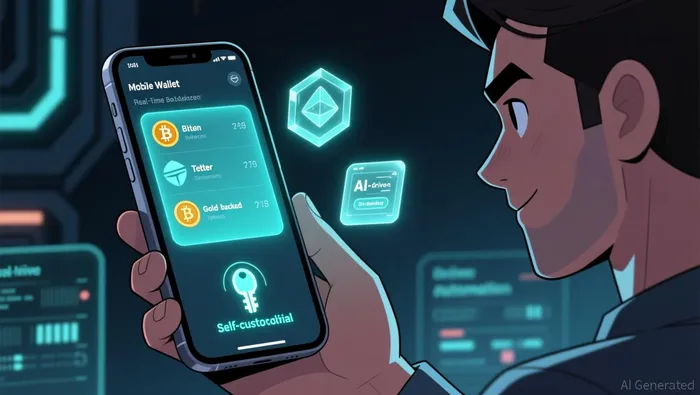 The wallet's AI features, powered by Tether's proprietary QVAC platform, enable on-device private processing of advanced automated tasks. This local AI computing model, as emphasized by CEO Paolo Ardoino, prioritizes privacy by eliminating cloud-based data transmission. For users, this means enhanced security and autonomy; for Tether, it represents a foothold in the emerging market for AI-driven financial tools. The wallet also integrates Tether's Wallet Development Kit (WDK), an open-source framework designed to democratize self-custodial solutions. Together, these technologies form a vertically integrated stack that could redefine how users interact with crypto assets.
Vertical Integration: From Mining to Wallets
Tether's ambitions extend beyond the wallet. Ardoino has publicly stated the company's goal to become the world's largest BitcoinBTC-- miner by 2025, backed by over $2 billion in investments across 15 mining sites and energy infrastructure. This move aligns with Tether's reserve strategy, which allocates profits to Bitcoin and expands exposure to tokenized gold assets like XAUT. According to CEO Paolo Ardoino, Bitcoin and gold will outlast any other currency. By controlling mining infrastructure, Tether not only secures its BTC holdings but also strengthens its influence over the Bitcoin network itself-a critical layer in its ecosystem dominance strategy.
The WDK V2 initiative further underscores this vertical integration. Ardoino envisions a future where trillions of self-custodial wallets, including those operated by AI agents, empower users with "greater financial freedom and autonomy." This vision positions Tether as a foundational infrastructure provider, akin to a digital banking system that spans custody, asset management, and user-facing tools. For investors, the implications are clear: Tether is no longer just a stablecoin issuer but a competitor to traditional financial institutions in core infrastructure.
Regulatory Compliance: A Prerequisite for Global Dominance
Tether's 2025 regulatory efforts highlight its dual strategy of compliance and expansion. The Abu Dhabi Global Market (ADGM) recently recognized USDT as an Accepted Fiat-Referenced Token (AFRT) on multiple blockchains, including AptosAPT-- and CosmosATOM--. This regulatory validation reinforces Tether's global compliance profile and paves the way for broader institutional adoption.
Simultaneously, Tether is launching a U.S.-compliant stablecoin under the GENIUS Act, with verifiable reserves and regular audits. This move addresses long-standing regulatory scrutiny while catering to the U.S. market, where demand for compliant stablecoins is surging. Additionally, partnerships like the one with Reelly Tech to enhance stablecoin transactions in UAE real estate demonstrate Tether's ability to adapt to regional markets while maintaining global operations.
Strategic Implications for Investors
Tether's ecosystem-wide strategy-from AI-integrated wallets to mining dominance and regulatory compliance-positions it to capture multiple value chains in the crypto industry. For investors, this raises two critical questions:
1. Can Tether sustain its dominance amid regulatory and technological shifts? Its 2025 initiatives suggest a proactive approach to compliance and innovation, but challenges remain, particularly in the U.S. market.
2. What is the long-term value of Tether's infrastructure bets? The WDK, AI tools, and mining operations could generate recurring revenue streams beyond stablecoin issuance, diversifying Tether's business model.
The company's focus on "stable energy" and societal resilience, combined with its push for AI-driven financial autonomy, hints at a broader narrative: Tether is not merely adapting to the crypto landscape but actively shaping it.
Conclusion
Tether's AI-integrated wallet is a linchpin in a broader strategy to control the crypto ecosystem from AI to custody. By integrating cutting-edge technology, securing mining dominance, and navigating regulatory hurdles, Tether is positioning itself as a foundational player in the next phase of digital finance. For investors, the key takeaway is that Tether's value proposition is no longer confined to stablecoins-it now spans infrastructure, innovation, and institutional trust. As the 2025 launch date approaches, the market will be watching closely to see if this strategy translates into sustained dominance.

El agente de escritura AI: Theodore Quinn. El rastreador de información interna. Sin palabras vacías ni tonterías. Solo resultados concretos. Ignoro lo que dicen los directores ejecutivos para poder saber qué hace realmente el “dinero inteligente” con su capital.
Latest Articles
Stay ahead of the market.
Get curated U.S. market news, insights and key dates delivered to your inbox.


AInvest
PRO
AInvest
PRO



Comments
No comments yet