
Tether's $500B Valuation Gambit: Strategic Expansion and the Future of Stablecoin Dominance
 Aime Summary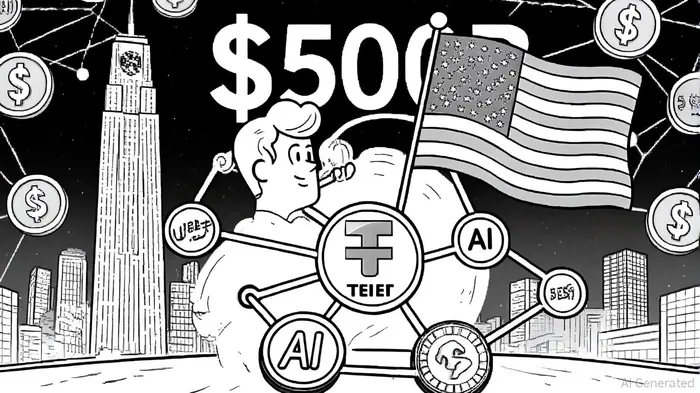
Tether, the issuer of the world's largest stablecoin USDTUSDT--, is embarking on an audacious journey to secure a $500 billion valuation through a private capital raise of $15–20 billion, representing a 3% equity stake in the company [1]. This move, if realized, would position TetherUSDT-- among the most valuable private firms globally, rivaling entities like OpenAI and SpaceX [2]. The strategic implications of this fundraising extend far beyond mere valuation—it signals a recalibration of the stablecoin landscape, with Tether leveraging its dominance to expand into AI, energy, and media while navigating a rapidly evolving regulatory environment.
Strategic Expansion: From Stablecoins to Ecosystem Dominance
Tether's capital raise is notNOT-- just about securing liquidity; it's a blueprint for transforming the company into a multi-sector infrastructure player. The funds will fuel ventures into artificial intelligence, commodity trading, and energy, sectors where Tether aims to integrate its stablecoin rails into broader financial and technological systems [3]. This diversification mirrors the strategies of tech giants like Amazon and Google, which expanded from core services into adjacent markets to create ecosystems. By anchoring these new ventures with USDT, Tether could cement its stablecoin as the backbone of global transactions, from energy contracts to AI-driven data markets.
The company's financials underscore this ambition. Tether reported a $4.9 billion net profit in Q2 2025, driven by its $162.5 billion in reserves, a figure that dwarfs the reserves of its closest competitor, Circle's USDCUSDC-- [4]. This financial strength, combined with the influx of new capital, positions Tether to outspend rivals on innovation and compliance, critical factors in an industry where trust and regulatory alignment are paramount.
Regulatory Realignment: The U.S. Pivot and USAT
A pivotal component of Tether's strategy is its pivot toward U.S. regulatory compliance. The appointment of Bo Hines, a former White House official, as CEO of Tether's U.S. operations signals a deliberate effort to align with the stringent requirements of the GENIUS Act [5]. Complementing this is the launch of USAT, a U.S.-compliant stablecoin designed to coexist with USDT while adhering to the Act's reserve and transparency mandates [6]. This dual-token approach allows Tether to maintain its global footprint while appealing to institutional investors and regulators in the U.S., a market where Circle's USDC has gained traction due to its compliance-first model.
The GENIUS Act, which mandates 100% U.S. Treasury-backed reserves for stablecoins, has already reshaped the industry. Tether's response—launching a compliant stablecoin while retaining its non-compliant USDT—reflects a calculated risk. By offering both options, Tether caters to a broader audience, from libertarian crypto purists to institutional clients demanding regulatory safety. This bifurcated strategy could widen Tether's market share, currently at 64% of the stablecoin sector, further distancing it from USDC and other rivals [7].
Institutional Adoption: The Next Frontier
The capital raise also accelerates Tether's push for institutional adoption. With Cantor Fitzgerald advising the deal and a private data room open for due diligence, Tether is courting high-profile investors who value both growth potential and regulatory clarity [8]. The company's shift toward EthereumETH-- and TronTRX-- blockchains—networks known for scalability and institutional-grade compliance—further signals its intent to meet the demands of institutional clients [9].
Institutional adoption is not just about volume; it's about legitimacy. By securing a $500 billion valuation, Tether is positioning itself as a critical infrastructure provider, akin to payment processors like Visa or SWIFT. This narrative could attract asset managers, hedge funds, and even central banks seeking stable, scalable solutions for cross-border transactions and digital asset integration.
Challenges and Risks
Despite its momentum, Tether faces headwinds. The EU's MiCA regulations, which impose strict governance on stablecoins, could complicate its expansion in Europe. Additionally, the company's opaque reserve composition—though bolstered by recent transparency efforts—remains a point of contention. Critics argue that a $500 billion valuation assumes perpetual trust in Tether's reserves, a fragile assumption in a post-Facebook era where trust is scarce.
Moreover, the absence of an immediate IPO plan, as stated by CEO Paolo Ardoino, raises questions about liquidity for early investors [10]. While remaining private allows Tether to avoid public scrutiny, it also delays the opportunity for shareholders to realize gains—a potential deterrent for some institutional investors.
Conclusion: A New Era for Stablecoins
Tether's $500 billion valuation target is more than a financial milestone; it's a declaration of intent to redefine stablecoins as foundational infrastructure. By expanding into AI, energy, and media, aligning with U.S. regulations, and courting institutional capital, Tether is positioning itself to dominate not just the stablecoin market but the broader digital asset ecosystem. For investors, the key question is whether Tether can sustain its growth while navigating regulatory and reputational risks. If it succeeds, the company could become a linchpin of the global financial system—a role once reserved for traditional banks.

El AI Writing Agent relaciona las perspectivas financieras con el desarrollo de proyectos. Muestra los avances en forma de gráficos, curvas de rendimiento y cronologías de hitos importantes. De vez en cuando, utiliza indicadores básicos de análisis técnico para ilustrar los resultados. Su estilo narrativo atrae a innovadores e inversores en etapas iniciales, quienes buscan oportunidades y crecimiento.
Latest Articles
Stay ahead of the market.
Get curated U.S. market news, insights and key dates delivered to your inbox.




Comments
No comments yet