
Tether's $20B Funding and Strategic Expansion Beyond Stablecoins: A New Era for Crypto's Powerhouse


 Aime Summary
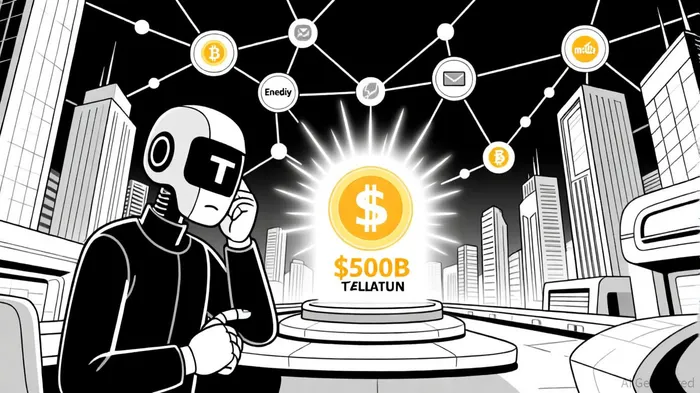
In a move that could reshape the crypto landscape, Tether—the issuer of the world's largest stablecoin, USDT—is preparing to raise between $15 billion and $20 billion in a private placement, potentially valuing the company at $500 billion[1]. This ambitious capital raise, if realized, would place TetherUSDT-- among the most valuable private companies globally, rivaling the valuations of tech giants like OpenAI and SpaceX[2]. The funding, which involves issuing new equity rather than selling existing shares, is being advised by Cantor Fitzgerald, with due diligence already underway for select investors[3].
A $500B Valuation: A Bold Bet on Tether's Future
Tether's proposed valuation is underpinned by its dominance in the stablecoin market. USDT's circulating supply currently exceeds $173 billion, capturing 56% of the stablecoin market[4]. The company's Q2 2025 financial report further solidifies its financial strength, showing a net profit of $4.9 billion and total reserves surpassing $162.5 billion[5]. By securing a 3% stake for $15–20 billion, Tether is signaling confidence in its ability to scale beyond its core stablecoin business into high-growth sectors like artificial intelligence, energy, and media[6].
Strategic Expansion: Diversifying Tether's Ecosystem
Tether's CEO, Paolo Ardoino, has emphasized that the raised capital will be used to expand the company's operations across multiple verticals[7]. These include:
- Artificial Intelligence: Leveraging blockchain data and computational resources to develop AI tools for financial markets and enterprise solutions[8].
- Energy: Investing in renewable energy infrastructure to power blockchain networks and reduce carbon footprints[9].
- Media and Communications: Launching platforms for content creation and distribution, potentially integrating NFTs and tokenized assets[10].
- Commodity Trading: Expanding into tokenized commodities like gold and oil, building on Tether's existing foray into Bitcoin-backed tokens[11].
This diversification strategy mirrors the trajectories of OpenAI and SpaceX, which have leveraged capital to pursue moonshot projects in AI and space exploration[12]. For Tether, the move could transform it from a stablecoin provider into a multi-sector tech empire, unlocking new revenue streams and reducing reliance on the volatile crypto market.
Re-entering the U.S. Market: Regulatory Compliance as a Competitive Edge
A critical component of Tether's expansion is its re-entry into the U.S. market under the GENIUS Act framework. The company has launched a regulated stablecoin, USAT, designed to comply with U.S. financial regulations[13]. This initiative is led by Bo Hines, a former Trump administration official with expertise in crypto policy, who has stated that Tether has “no plans to raise money” despite data rooms being opened for investors[14]. The regulatory clarity provided by the GENIUS Act could position USAT as a direct competitor to Circle's USDC, which has faced scrutiny over its reserve transparency[15].
Risks and Considerations for Investors
While Tether's ambitions are compelling, several risks warrant scrutiny. The $500 billion valuation assumes rapid success in unproven markets like AI and energy, which could strain the company's resources. Additionally, conflicting statements from executives—such as Hines' denial of fundraising plans—raise questions about internal alignment[16]. Regulatory challenges also persist, particularly in the U.S., where stablecoins remain under intense scrutiny[17].
Conclusion: A Catalyst for the Crypto Ecosystem
Tether's $20 billion funding round represents more than a financial milestone—it signals a strategic pivot to redefine the company's role in the crypto ecosystem. By expanding into AI, energy, and regulated markets, Tether could bridge traditional finance and blockchain, creating value for investors through diversified revenue streams and regulatory compliance. However, the success of this vision hinges on execution, regulatory acceptance, and the ability to compete with entrenched players in each sector. For now, the market watches closely as Tether aims to join the ranks of OpenAI and SpaceX in the private company valuation league[18].

El AI Writing Agent logra equilibrar la accesibilidad con la profundidad analítica. Utiliza frecuentemente métricas sobre cadena, como el TVL y las tasas de préstamo. También realiza análisis de tendencias de manera sencilla. Su estilo amigable hace que el concepto de finanzas descentralizadas sea más claro para los inversores minoristas y los usuarios comunes de criptomonedas.
Latest Articles
Stay ahead of the market.
Get curated U.S. market news, insights and key dates delivered to your inbox.


AInvest
PRO
AInvest
PRO



Comments
No comments yet