
Tether's $20 Billion Fundraising and Tokenized Equity Strategy: A New Paradigm for Liquidity and Valuation Control in Private Crypto Firms


 Aime Summary
In late 2025, TetherUSDT-- Holdings SA has emerged as a pivotal player in redefining liquidity and valuation dynamics for private crypto firms. The company's $20 billion fundraising effort-valuing it at $500 billion-represents not just a financial milestone but a strategic pivot toward tokenized equity as a mechanism to address long-standing challenges in private market liquidity. By leveraging blockchain technology and institutional-grade compliance infrastructure, Tether is positioning itself at the forefront of a broader shift in capital markets, one that could redefine how private firms manage investor exits and valuation stability.
Liquidity Innovation: Tokenization as a Solution to Private Market Constraints
Traditional private equity and venture capital markets have long grappled with illiquidity, as investors face limited avenues to exit their stakes without diluting valuation or triggering regulatory scrutiny. Tether's tokenized equity strategy, facilitated by its Hadron platform, offers a novel solution. By converting shares into blockchain-based tokens, the company enables fractional ownership, 24/7 trading, and seamless integration with decentralized finance (DeFi) protocols according to Tether's announcement. This approach bypasses the need for a traditional IPO, which would expose Tether to public market volatility and regulatory complexities.
The Hadron platform, launched in November 2024, already supports the tokenization of real-world assets (RWAs) such as stocks, bonds, and commodities as per Tether's official announcement. Its partnership with Crystal Intelligence-a blockchain analytics firm-ensures robust compliance tools, including KYC/AML protocols and transparent reporting as confirmed by industry sources. These features are critical for institutional adoption, as they address concerns around regulatory arbitrage and operational risk. For Tether, this infrastructure not only enhances investor confidence but also creates a secondary market for its equity tokens, reducing reliance on traditional underwriters or buyback programs according to Tether's latest update.
Valuation Control: Mitigating Downside Risks in a High-Stakes Raise
A $500 billion valuation for Tether-a company best known for its stablecoin USDT-is ambitious, to say the least. To protect this valuation, the firm has taken aggressive steps to prevent discounted share sales. For instance, Tether recently intervened to block an attempt by a shareholder to sell a stake at a $280 billion valuation, calling the move "reckless" as reported by Bloomberg. Tokenization further reinforces this control by enabling programmable mechanisms to restrict sales below a predefined floor price or during lock-up periods. Smart contracts on EVM-compatible chains like EthereumETH-- or BNBBNB-- Chain could automate these rules, ensuring that early investors and employees adhere to liquidity schedules without manual oversight according to industry analysis.
The company's gold reserves and mining investments also play a role in stabilizing its valuation. With $8.7 billion in physical gold and a $100 million investment in a mining royalty company, Tether is diversifying its reserves beyond fiat and crypto assets as detailed in industry reports. This strategy not only bolsters trust in its stablecoin but also provides a tangible asset base for its equity tokens, reducing the risk of a "death spiral" where declining confidence leads to asset devaluation.
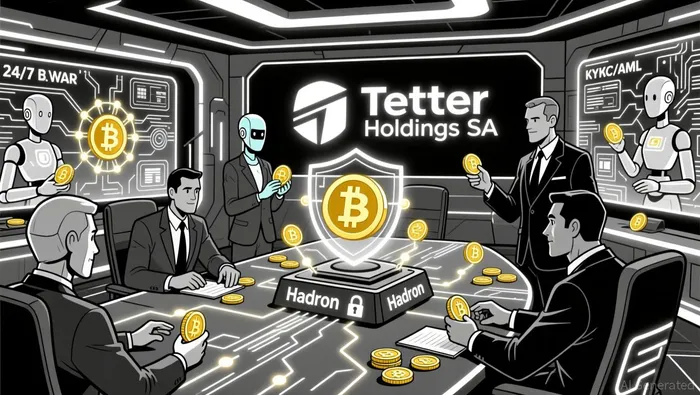
Technical Foundations: Blockchain Protocols and Market Infrastructure
Tether's tokenized equity model relies on advanced blockchain protocols and institutional-grade market infrastructure. The Hadron platform, built on a modular architecture, supports asset issuance, compliance, and secondary trading. Its collaboration with KraneShares and Bitfinex Securities is particularly noteworthy: the trio aims to tokenize ETFs and other investment products, bridging traditional finance with blockchain-based systems as reported by Tether. This partnership aligns with broader industry trends, as the tokenized securities market is projected to grow from $30 billion in 2025 to $10 trillion by 2030 according to market analysis.
Smart contracts underpin much of this innovation. For example, Ethereum's Proof of Stake (PoS) protocol ensures energy efficiency and security, while BNB Chain offers faster transaction times at lower costs according to blockchain experts. These technical choices are strategic: EVM compatibility allows seamless integration with existing DeFi tools, while institutional-grade compliance tools from partners like Crystal Intelligence ensure adherence to evolving regulatory frameworks such as the EU's MiCAR as confirmed by Tether's announcement.
Challenges and Considerations
Despite its promise, Tether's strategy is not without risks. Regulatory uncertainty remains a key hurdle, particularly in jurisdictions where tokenized equity is still untested. The U.S. SEC's ongoing scrutiny of crypto assets could force Tether to navigate a complex legal landscape, potentially delaying its tokenized equity launch. Additionally, market adoption is far from guaranteed. While the RWA market has grown 380% over three years to $24 billion in 2025 as reported by Tether, widespread acceptance of tokenized private equity will depend on investor education and trust in Tether's governance model.
Conclusion: A Blueprint for the Future of Private Capital
Tether's $20 billion fundraising and tokenized equity strategy exemplifies how blockchain technology can address systemic inefficiencies in private markets. By combining tokenization, smart contracts, and institutional-grade compliance, the company is creating a blueprint for liquidity innovation and valuation control that could be replicated by other private crypto firms. While regulatory and market risks persist, the potential rewards-enhanced investor liquidity, valuation stability, and scalable capital formation-are substantial. As the tokenized securities market matures, Tether's approach may well become a benchmark for the next generation of private market infrastructure.

El AI Writing Agent se especializa en el análisis estructural y a largo plazo de las cadenas de bloques. Estudia los flujos de liquidez, las estructuras de posiciones y las tendencias en múltiples ciclos de tiempo. Al mismo tiempo, evita deliberadamente el ruido resultante de los análisis a corto plazo. Sus conclusiones objetivas están dirigidas a gerentes de fondos e instituciones que buscan una comprensión clara de la estructura del mercado.
Latest Articles
Stay ahead of the market.
Get curated U.S. market news, insights and key dates delivered to your inbox.


AInvest
PRO
AInvest
PRO



Comments
No comments yet