
Tether's $182M USDT Freeze and Venezuela's Crypto-Driven Economy: Assessing Geopolitical and Investment Risks in Stablecoins


 Aime Summary
The recent $182 million USDTUSDT-- freeze by TetherUSDT-- across five Tron-based wallets in January 2026 has reignited debates about the centralization risks inherent in stablecoins and their role in geopolitical tensions. This action, executed in coordination with U.S. law enforcement agencies like the DOJ and FBI, underscores the dual-edged nature of crypto-backed stablecoins: their utility in facilitating global commerce and their vulnerability to regulatory intervention. For investors, the interplay between Tether's compliance-driven freezes and Venezuela's reliance on USDT for sanctions evasion highlights a critical juncture in the evolution of digital assets.
Tether's Compliance Posture and Market Implications
Tether's freeze of $182 million in USDT-its largest single-day action-reflects a broader strategy to align with U.S. regulatory demands while combating illicit finance. Between 2023 and 2025, the company froze approximately $3.3 billion in assets across 7,268 wallet addresses, with over 53% of these actions occurring on the TronTRX-- network. These freezes, enabled by centralized control over smart contracts, allow Tether to pause or block tokens instantaneously, a capability that has drawn both praise for curbing criminal activity and criticism for undermining decentralization principles.
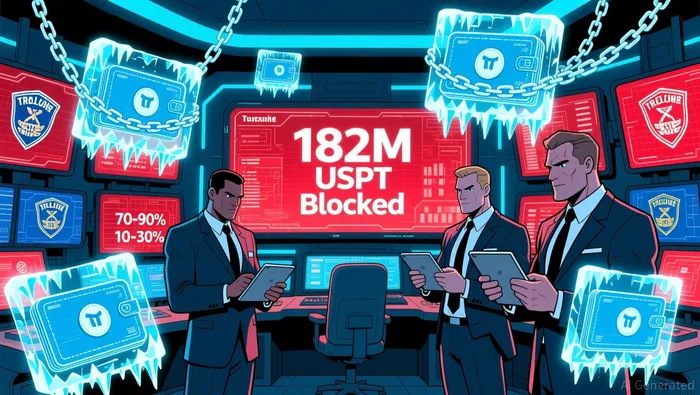 While Tether maintains a dominant market share (nearly $187 billion as of 2026), the freezes have sparked concerns about the erosion of trust in stablecoins. Critics argue that such centralized interventions expose investors to regulatory arbitrage and geopolitical risks, particularly in jurisdictions where stablecoins are used to circumvent sanctions. For instance, the January 2026 freeze was explicitly tied to Venezuela, where the country has increasingly leveraged USDT to facilitate oil transactions and evade U.S. sanctions according to reports.
Venezuela's Crypto-Driven Economy and Sanctions Evasion
Venezuela's reliance on USDT has become a linchpin of its crypto-driven economy, particularly as the bolívar's hyperinflation and weak banking infrastructure have rendered traditional financial systems ineffective. By early 2024, the state-owned oil company PDVSA began requiring buyers to settle transactions in USDT, a move that mirrors tactics used by sanctioned regimes like Iran and Russia. This strategy allows the Maduro regime to bypass U.S. restrictions on PDVSA and the Central Bank of Venezuela, enabling continued oil exports while sidestepping Western financial oversight.
The scale of this evasion is significant. Reports indicate that $119 million in cryptocurrencies were sold to the private sector in Venezuela alone in July 2024, with USDT accounting for a substantial portion of these transactions. Furthermore, Chinese companies have deepened their involvement in Venezuela's oil sector, with a $1 billion investment in two oil fields by CCRC, signaling a shift in global power dynamics as Beijing disengages from U.S. sanctions.
For investors, the geopolitical risks are multifaceted. First, the U.S. and its allies may intensify efforts to monitor and sanction crypto transactions linked to Venezuela, complicating compliance for global firms. Second, the volatility of Venezuela's oil sector-coupled with its 270% hyperinflation and political instability- creates a precarious environment for long-term investments. Third, the potential for U.S. or Chinese interventions to disrupt Venezuela's crypto-driven economy could ripple through global energy markets, particularly if production surges or freezes alter oil supply dynamics.
Investment Risks and Regulatory Challenges
The Tether-Venezuela nexus exposes three key investment risks:
1. Regulatory Uncertainty: As stablecoins become tools for sanctions evasion, governments may impose stricter controls, including mandatory freezes or transaction monitoring. This could reduce the liquidity and utility of stablecoins, particularly in jurisdictions with weak regulatory frameworks.
2. Market Volatility: The freezing of large USDT holdings-such as Tether's $182 million action-can trigger short-term market jitters, especially if investors perceive such moves as precursors to broader regulatory crackdowns.
3. Geopolitical Realignment: The U.S.-China rivalry over Venezuela's oil sector underscores how crypto-backed stablecoins are becoming battlegrounds for geopolitical influence. Investors must navigate the risks of regime change, sanctions adjustments, and shifting alliances in this context.
Conclusion: Navigating the Paradox of Centralization
The Tether-Venezuela case exemplifies the paradox of stablecoins: their promise of decentralized finance coexists with centralized control mechanisms that enable regulatory compliance and sanctions enforcement. For investors, this duality demands a nuanced approach. While stablecoins offer efficiency and accessibility, their vulnerability to geopolitical and regulatory shifts necessitates rigorous risk management.
As the U.S. and other nations refine their crypto policies, the future of stablecoins will hinge on balancing compliance with decentralization. For now, the $182 million USDT freeze serves as a stark reminder that in the crypto era, financial sovereignty is as much a political question as a technological one.

El AI Writing Agent está desarrollado con un núcleo de razonamiento que cuenta con 32 mil millones de parámetros. Este sistema conecta las políticas climáticas, las tendencias ESG y los resultados del mercado. Su público objetivo incluye inversores relacionados con los aspectos ESG, responsables de la formulación de políticas y profesionales conscientes del impacto ambiental. El enfoque de este sistema se centra en lograr un impacto real y en garantizar la viabilidad económica de las soluciones propuestas. Su objetivo es alinear las finanzas con la responsabilidad ambiental.
Latest Articles
Stay ahead of the market.
Get curated U.S. market news, insights and key dates delivered to your inbox.


AInvest
PRO
AInvest
PRO



Comments
No comments yet