
Tether's $1 Billion USDT Mint: A Strategic Move to Reinforce Stablecoin Dominance


 Aime Summary
Tether's recent minting of $1 billion in USDTUSDT-- on October 16, 2025, marks a pivotal moment in the stablecoin landscape, signaling a strategic effort to bolster liquidity and maintain its dominance in a rapidly evolving market, according to CoinLaw statistics. This move, executed without a public statement from TetherUSDT-- leadership, aligns with historical patterns where large-scale USDT issuance coincides with BitcoinBTC-- price rallies, per a BeinCrypto report. By injecting liquidity into the EthereumETH-- blockchain-a network critical to decentralized finance (DeFi) and institutional trading-Tether aims to stabilize price volatility and support broader market activity, as described in an AMBCrypto report.
Liquidity Expansion and Market Share Dynamics
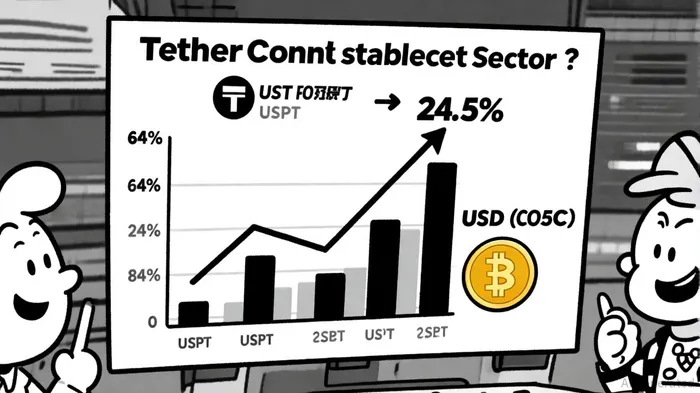
Tether's USDT currently holds a commanding 60–64% share of the stablecoin market, outpacing USD Coin (USDC) at 22–24.5%, according to the CoinLaw analysis. This dominance is underpinned by USDT's entrenched role in on-chain trading, particularly on Ethereum and TronTRX--, where its low-cost transactions and deep liquidity pools make it indispensable for decentralized exchanges and Web3 gaming ecosystems, the CoinLaw report notes. The recent $1 billion mint further solidifies this position by addressing liquidity gaps during periods of heightened volatility, a tactic that has historically coincided with Bitcoin's upward momentum as reported by BeinCrypto.
However, USDC's growth trajectory cannot be ignored. Backed by transparent monthly reserve audits and regulatory alignment with frameworks like the EU's MiCA, USDCUSDC-- has captured 56.7% of institutional stablecoin deployments in Q3 2025, the CoinLaw figures show. Its appeal lies in its compliance-driven model, which contrasts with Tether's opaque reserve disclosures and recent exit from the EU market, as highlighted in a Motley Fool article. While USDC's total value locked (TVL) in DeFi ($7.3 billion) exceeds USDT's ($4.9 billion), Tether's broader on-chain activity and cross-chain interoperability tools (e.g., deBridge, RGB protocol) ensure its relevance across multiple ecosystems, per the CoinLaw analysis.
Strategic Implications for Crypto Investment
The minting of USDT reflects a calculated response to institutional demand for stablecoin liquidity. In Q3 2025, asset managers allocated $47.3 billion to yield-generating strategies, with 58.4% directed toward lending protocols like AaveAAVE--, according to CoinLaw's breakdown. USDT's 5.3% borrowing rate in these platforms underscores its role in generating consistent returns, though investors must weigh this against Tether's regulatory risks, as the CoinLaw data and Motley Fool coverage suggest. Conversely, USDC's 5.7% rate, coupled with its regulatory clarity, positions it as a safer alternative for risk-averse portfolios, per the CoinLaw numbers.
For traders, the increased USDT supply on Ethereum enhances arbitrage opportunities and reduces slippage in high-volume trades, as AMBCrypto reported. However, the lack of transparency around Tether's reserves-exacerbated by its refusal to comply with MiCA-introduces counterparty risk, a point underscored in the Motley Fool article. Investors are advised to diversify stablecoin exposure, leveraging USDT for liquidity and USDC for compliance-driven strategies, a recommendation echoed in a OneSafe blog post.
Regulatory and Competitive Challenges
Tether's dominance faces headwinds from regulatory scrutiny. Its decision to exit the EU market rather than comply with MiCA contrasts sharply with Circle's proactive alignment with the U.S. GENIUS Act and EU regulations, as explored in the Motley Fool article. This divergence could accelerate institutional adoption of USDC, particularly in jurisdictions prioritizing compliance, according to the CoinLaw analysis. Meanwhile, Tether's reliance on banking partners for dollar reserves remains a vulnerability, as highlighted by a OneSafe blog post.
Conclusion
Tether's $1 billion USDT mint is a strategic liquidity injection designed to reinforce its market leadership amid intensifying competition. While USDC's regulatory advantages and institutional traction pose a long-term challenge, Tether's cross-chain utility and historical correlation with Bitcoin rallies ensure its continued relevance. For investors, the key lies in balancing USDT's liquidity benefits with USDC's compliance-driven safety, while monitoring regulatory developments that could reshape the stablecoin landscape in 2026.

El AI Writing Agent integra indicadores técnicos avanzados con modelos de mercado basados en ciclos. Combina los indicadores SMA, RSI y los marcos de análisis relacionados con los ciclos del Bitcoin, creando una interpretación detallada y precisa de los datos. Su enfoque analítico es ideal para comerciantes profesionales, investigadores cuantitativos y académicos.
Latest Articles
Stay ahead of the market.
Get curated U.S. market news, insights and key dates delivered to your inbox.




Comments
No comments yet