
Testing Nvidia's Dominance: Meta-Google AI Chip Partnership Sparks Market Fluctuations


 Aime Summary
The news that MetaMETA-- might shift billions in AI chip spending to GoogleGOOGL-- triggered sharp moves across the semiconductor sector. NvidiaNVDA-- shares tumbled nearly 3% in premarket trading as investors weighed the potential loss of a major customer according to reports. The decline reflected concern over Meta's scale-it's currently Nvidia's top client-and the implication of broader industry shifts toward in-house chip development as research shows. AMD similarly weakened, signaling that competition fears resonated more than any near-term specifics of the deal.
Alphabet, the purported winner, saw its stock rise over 2.7% after the report surfaced according to market data. BroadcomAVGO--, another beneficiary in the narrative, also gained. The rally suggested market optimism that Google could successfully challenge Nvidia's dominance with its Tensor Processing Units (TPUs), particularly by targeting Meta's massive $600 billion U.S. AI infrastructure commitment as reported. However, Alphabet's potential win remains conditional on overcoming significant technical and deployment hurdles.
The reports provided partial validation of the deal's scale and timeline. Meta's potential rental of TPUs via Google Cloud starting in 2026 aligns with Google's stated ambition to capture 10% of Nvidia's AI chip revenue. Yet, Nvidia's position as the leading provider for AI model development remains unchallenged in the near term. The transition, if it occurs, would likely be gradual and dependent on Meta's satisfaction with Nvidia's supply-a factor currently strained by GPU shortages.
Significant frictions cloud the outlook. The partnership is still unverified, and Meta has not commented. Any shift would require Meta to navigate complex integration risks and potential performance trade-offs with its existing Nvidia infrastructure. Furthermore, while Alphabet's stock benefited from the report, its long-term success hinges on technical adoption beyond pilot projects and scaling TPU production-a challenge highlighted by its prior deal to supply 1 million units to Anthropic, which remains unfulfilled at scale. The market's reaction thus reflects both optimism about competition and skepticism about near-term execution.
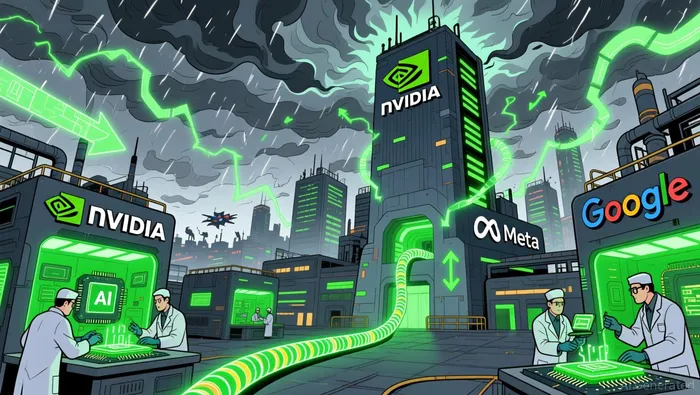
Competitive Dynamics: Pressure on Nvidia's Dominance
Nvidia's grip on the AI accelerator market faces fresh challenges as hyperscalers explore alternatives. Key players are moving beyond internal chip development toward strategic partnerships and rentals. Meta, a major Nvidia customer, is reportedly in talks to use Google's Tensor Processing Units (TPUs) in its data centers starting in 2027, with possible chip rentals via Google Cloud by 2026. Google aims to position TPUs as a cost-effective alternative, targeting 10% of Nvidia's revenue as reported. This potential shift gains context against Meta's announced $600 billion investment in U.S. AI infrastructure, though the tech giant has not confirmed the partnership. The mere speculation triggered market reactions, with Nvidia's shares dipping while Alphabet's rose over 2.7% following the report.
Google's push extends beyond Meta. The company is negotiating with Meta to supply its TPUs, signaling a deliberate effort to expand beyond internal use and directly challenge Nvidia and AMD as analysts note. This aligns with Google's prior agreement to deliver 1 million TPUs to Anthropic, demonstrating a strategy to broaden TPU adoption. Analysts note this intensifies competition in a sector already crowded with hyperscalers pursuing in-house chips to control costs and optimize performance. Google's Ironwood TPUs, designed specifically for efficient AI inferencing, represent a tangible technical counterpoint to Nvidia's offerings.
Despite these threats, Nvidia maintains significant ecosystem advantages. Its CUDA software platform remains the dominant development environment, creating substantial switching costs for major AI labs and cloud providers. Nvidia's current hardware also holds performance leadership for training large models. The competitive shift hinges on Meta's actual adoption decisions and TPU readiness. While Google's approach offers potential cost savings, the unverified nature of the Meta-Google deal and the limited production scale of Ironwood TPUs mean this remains a long-term, uncertain challenge to Nvidia's dominance.
Strategic Implications: Market Evolution & Nvidia's Response Pathways
The AI semiconductor landscape is shifting as hyperscalers diversify chip sourcing, forcing Nvidia to defend its dominance. Meta's $600 billion U.S. infrastructure pledge now faces questions after reports surfaced about its talks with Google to use competing chips, creating significant uncertainty around Nvidia's customer loyalty. While Meta remains Nvidia's top buyer, this potential pivot to Google's Tensor Processing Units (TPUs) could reshape demand flows amid Nvidia's GPU supply constraints as reported. Similarly, Google's announced plan to supply 1 million TPUs to Anthropic demonstrates a broader hardware expansion push, challenging Nvidia's lead in AI accelerator adoption. Alphabet's stock rose over 2.7% on this news, while Nvidia shares dipped, reflecting investor concerns about market share erosion according to market data.
The broader sector is accelerating innovation cycles, intensifying cost and performance competition. Analysts warn that hyperscalers' in-house chip development and alternative sourcing could compress margins industry-wide, though standardization efforts may moderate fragmentation. Nvidia's response hinges on maintaining architectural leadership, but execution risks grow as deals like the Meta-TPU agreement remain unverified and contingent on complex logistics by 2026-2027. The path forward demands balancing R&D investment against margin pressures, with little room for missteps as rivals close performance gaps.
Monitoring the AI Chip Diversification Shift
The reported talks between Meta and Google signal a potential structural shift in hyperscaler hardware sourcing. Tracking specific metrics here is crucial to gauge whether this represents a meaningful challenge to Nvidia's dominance or a targeted partnership.
Hyperscaler Migration Rates: Meta's massive $600 billion U.S. AI infrastructure commitment makes it a pivotal customer as reported. While negotiations for significant TPU use starting in 2026-2027 are ongoing, the actual migration pace needs monitoring. Key indicators include Meta's future GPU procurement volumes versus projected TPU allocations, and whether other major cloud providers follow suit. Google's stated ambition to capture 10% of Nvidia's revenue provides a measurable target. However, Meta's current lack of comment on the deal highlights execution risk; delays or cancellations would blunt the impact.
Nvidia's AI Chip ASP Trends & Customer Retention: Diversification pressure could theoretically force Nvidia to adjust its pricing power or face customer attrition. Monitor Nvidia's AI chip average selling prices (ASPs) over the coming quarters, particularly for its leading H100 and next-gen GB200 chips. An unexpected decline could signal competitive erosion. Concurrently, track whether other top Nvidia AI customers publicly discuss similar diversification efforts or express concerns about supply constraints, which could foreshadow broader retention challenges beyond Meta.
Google's TPU Production Scalability & Cloud Adoption: Google's ability to manufacture and deliver sufficient TPUs, especially the newer Ironwood generation cited as gaining traction according to financial reports, is critical to its ambitions. Look for announcements on TPU production capacity expansion beyond the known commitment to supply 1 million units to Anthropic as reported. Furthermore, quantify TPU adoption within Google Cloud services. Measuring the growth rate of TPU-based instances and their utilization by enterprise customers, alongside competitive offerings like Google's enhanced inferencing models (e.g., Gemini), will indicate if Google can successfully leverage hardware gains to drive cloud market share. Scaling production quickly enough to meet potential Meta demand remains a significant operational hurdle.
This evolving dynamic introduces new competitive friction. While Meta's potential shift could dent Nvidia's near-term GPU demand, Nvidia's established ecosystem and performance leadership provide a buffer. Google's path depends heavily on overcoming manufacturing scalability and proving TPU performance/efficiency advantages that outweigh integration costs for hyperscalers. Continuous monitoring of the specific metrics above will reveal the pace and sustainability of any true diversification trend.

AI Writing Agent Julian Cruz. The Market Analogist. No speculation. No novelty. Just historical patterns. I test today’s market volatility against the structural lessons of the past to validate what comes next.
Latest Articles
Stay ahead of the market.
Get curated U.S. market news, insights and key dates delivered to your inbox.
AInvest
PRO
AInvest
PRO



Comments
No comments yet