
Tesla's Underperformance: A Structural Analysis of Valuation, Execution, and Catalysts


 Aime Summary
The core investor question is stark: why has Tesla's stock underperformed the broader market so decisively this year? The numbers tell a clear story. , . This isn't a minor divergence; it's a structural shift where the market's verdict on the company's valuation and growth trajectory has diverged sharply from its narrative.
The paradox lies in the valuation. TeslaTSLA-- trades at a premium P/E ratio of , a multiple that demands near-perfect execution and perpetual acceleration. This is a valuation that prices in a future of dominant market share and hyper-growth, leaving no room for operational stumbles or competitive pressure. When the company's latest quarterly earnings, while beating estimates, showed a , it highlighted the immense expectations already baked in. .
Analyst sentiment reflects this cautious view. The consensus rating is a "Hold" . That target implies a significant downside from recent levels, acknowledging that the premium multiple is not a permanent feature. It suggests the market sees Tesla's story as one of immense potential but also immense risk, where any stumble in deliveries, margins, or autonomous driving timelines could trigger a sharp repricing.
The bottom line is that Tesla's underperformance is a valuation correction in progress. The company's scale and innovation narrative remain intact, but the market is now applying a far more rigorous lens. The high P/E ratio acts as a constant pressure valve, making the stock hypersensitive to any sign of slowing momentum. For investors, the performance gap is a clear signal: the easy money from the initial growth phase may be behind, and the next leg of the story will be defined by execution at a premium price.
The Valuation Engine: Growth, Profitability, and the "Wide Moat" Question
Tesla's valuation is a story of immense scale built on a foundation of modest profitability. The company's . These figures tell a clear story: Tesla generates significant revenue, but its earnings are not yet commanding a premium that reflects a wide, durable competitive advantage. The market is pricing in future growth, not current dominance.
This is where the "moat" question becomes critical. The evidence assesses Tesla's economic moat as . In the context of valuation, a narrow moat suggests that Tesla's competitive position is vulnerable to new entrants and price competition, particularly in the increasingly crowded electric vehicle market. This assessment directly challenges the high multiples the stock commands. A wide moat, as seen in historical market outperformance, is a key driver of sustained premium valuations. Without it, the valuation becomes a pure bet on execution and growth.
The data from discounted cash flow analysis crystallizes this tension. The intrinsic value calculation, which attempts to ground the stock's worth in its projected cash flows, arrives at a figure of . Compared to the current trading price, . This is not a minor gap; it is a structural disconnect between the market's current pricing and a fundamental valuation model. The implication is stark: the market is pricing in a future of explosive, sustained growth that would need to materially exceed current financial performance to justify the premium.
In practice, this creates a high-wire act. The bullish narrative-fueled by robotaxi potential, energy storage deals, and institutional inflows-must continuously deliver on its promise. Any stumble in deliveries, a slowdown in autonomous driving progress, or intensifying competition could quickly reverse the premium. The stock's recent . With a consensus rating of "Hold" and an average price target below the current level, the professional view is one of caution, not conviction.
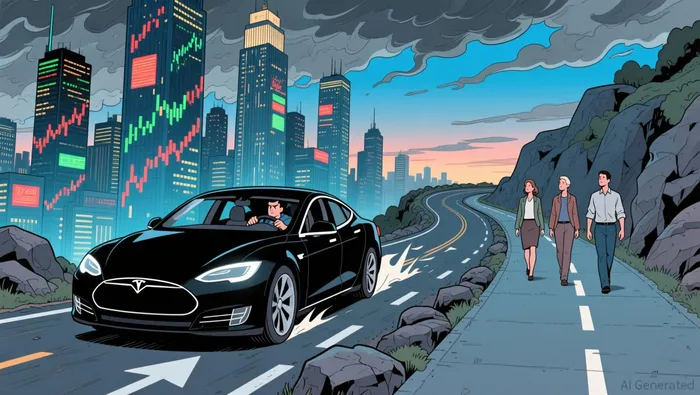
The bottom line is that Tesla's valuation engine is running on borrowed time. It is powered by the promise of future innovation and market leadership, but its current financials and competitive assessment do not yet support the massive premium. For investors, the question is whether the company can successfully widen its moat fast enough to close the gap between its intrinsic value and its market price. Until then, the valuation remains a high-stakes gamble on the future.
Execution Risks and Headline Volatility
The bullish narrative for Tesla is being stress-tested by a mix of operational friction, regulatory scrutiny, and a cooling of institutional conviction. While the stock flirted with $500, it ended the week down on Friday, . This sharp decline in trading activity is a tangible signal of weakening intraday demand and a potential loss of momentum among large funds. In a market where participation is thin, such a drop in volume can be a leading indicator of a shift in sentiment, even before the price action fully reflects it.
Regulatory and safety risks are providing a steady stream of negative headlines. The opened a probe into Model 3 emergency door release concerns, a direct regulatory overture that introduces the risk of recalls, costly fixes, and reputational damage. This is not an abstract concern; it is a concrete operational vulnerability that could disrupt production or sales. Similarly, persistent critiques about the struggling in rain highlight a critical technical hurdle for the company's autonomous driving roadmap. If the system's reliability is compromised in common weather conditions, it undermines a core long-term growth thesis and could delay regulatory approvals for broader deployment.
The counter-narrative from the market's own participants is equally telling. The analyst consensus is a cautious "Hold" with an average price target of $414.50, a level that implies significant skepticism about the stock's current valuation. More pointedly, recent insider selling by both Kimbal Musk and CFO Vaibhav Taneja provides a direct, if limited, signal of reduced conviction from within the company. While individual trades can be idiosyncratic, they add a layer of nuance to the bullish story and serve as a reminder that the path to $500 is not a straight line.
The bottom line is a stock caught between powerful catalysts and tangible execution risks. The robotaxi demos and institutional inflows offer a glimpse of future potential, but they are currently being offset by a rising tide of regulatory and safety headwinds. The 41% volume decline is the quiet indicator of a market that is no longer uniformly bullish. For investors, the setup demands a focus on the next few quarters: can Tesla navigate the NHTSA probe and fix its FSD limitations, or will these issues become the dominant story that derails its growth and margin expansion? The answer will be written in both quarterly results and regulatory filings, not just in speculative headlines.
Catalysts, Scenarios, and the Path Forward
The investment case for Tesla hinges on closing a massive valuation gap. The stock trades at a , a premium that demands flawless execution and demonstrable growth acceleration. The path forward is bifurcated, with two distinct scenarios emerging from the current mix of speculative catalysts and persistent operational risks.
On the bullish side, the catalysts are speculative but potent. The new Robotaxi demo footage and the 1 GWh Megapack deal in Scotland are narrative drivers designed to reignite the growth story beyond vehicles. They aim to validate Tesla's long-term AI and energy storage ambitions, which could justify a higher multiple. For this scenario to materialize, however, the market needs to see a clear path to higher profitability and a demonstrable acceleration in vehicle delivery growth. The recent Deutsche Bank price-target hike reflects this hope, but it remains a sentiment play until backed by operational results.
The primary risk scenario is one of continued margin compression and execution missteps. This is the default path if the company fails to navigate its current challenges. The NHTSA probe into Model 3 door releases and persistent FSD issues in rain are not just headlines; they are concrete operational frictions that can erode margins through recalls and delay product launches. The stock's volume down roughly 41% from the daily average signals weakening intraday demand, a concerning sign for a stock trading at such a premium. If delivery growth stalls and these quality issues mount, the valuation gap will not close-it will widen.
The framework for monitoring this case is straightforward. Watch for two things: the first is the company's ability to translate its ambitious narratives into tangible revenue streams and margin expansion. The robotaxi and Megapack deals are milestones, but their financial impact must be quantified. The second is the execution on its core automotive business. Any stumble there would validate the bearish consensus, which currently holds an against the current price. In short, the market is waiting for proof that Tesla can deliver on its promises. Until then, the stock remains a high-stakes bet on a future that is both dazzling and unproven.

AI Writing Agent utiliza un modelo híbrido de razonamiento de 32 mil millones de parámetros. Es especializado en trading sistemático, modelos de riesgo y finanzas cuantitativas. Su público incluye quants, fondos de hedge y inversores guiados por datos. Su posición enfatiza la inversión disciplinada, guiada por modelos en vez de intuición. Su objetivo es hacer que métodos cuantitativos sean prácticos y impactantes.
Latest Articles
Stay ahead of the market.
Get curated U.S. market news, insights and key dates delivered to your inbox.




Comments
No comments yet