
Tesla's Texas Gamble: Robotaxis by June?
Generated by AI AgentWesley Park
Monday, Feb 10, 2025 6:14 am ET2min read
TSLA--
As the electric vehicle (EV) revolution gains momentum, one name stands out as a trailblazer: Tesla. The company, led by the enigmatic Elon Musk, has consistently pushed the boundaries of innovation and technology. Now, Tesla is set to revolutionize the ride-sharing industry with its robotaxi service, aiming to launch as early as June 2025. But to make this happen, Tesla is turning to Texas, a state known for its lenient regulations. Let's dive into the details and explore the potential implications of this strategic move.
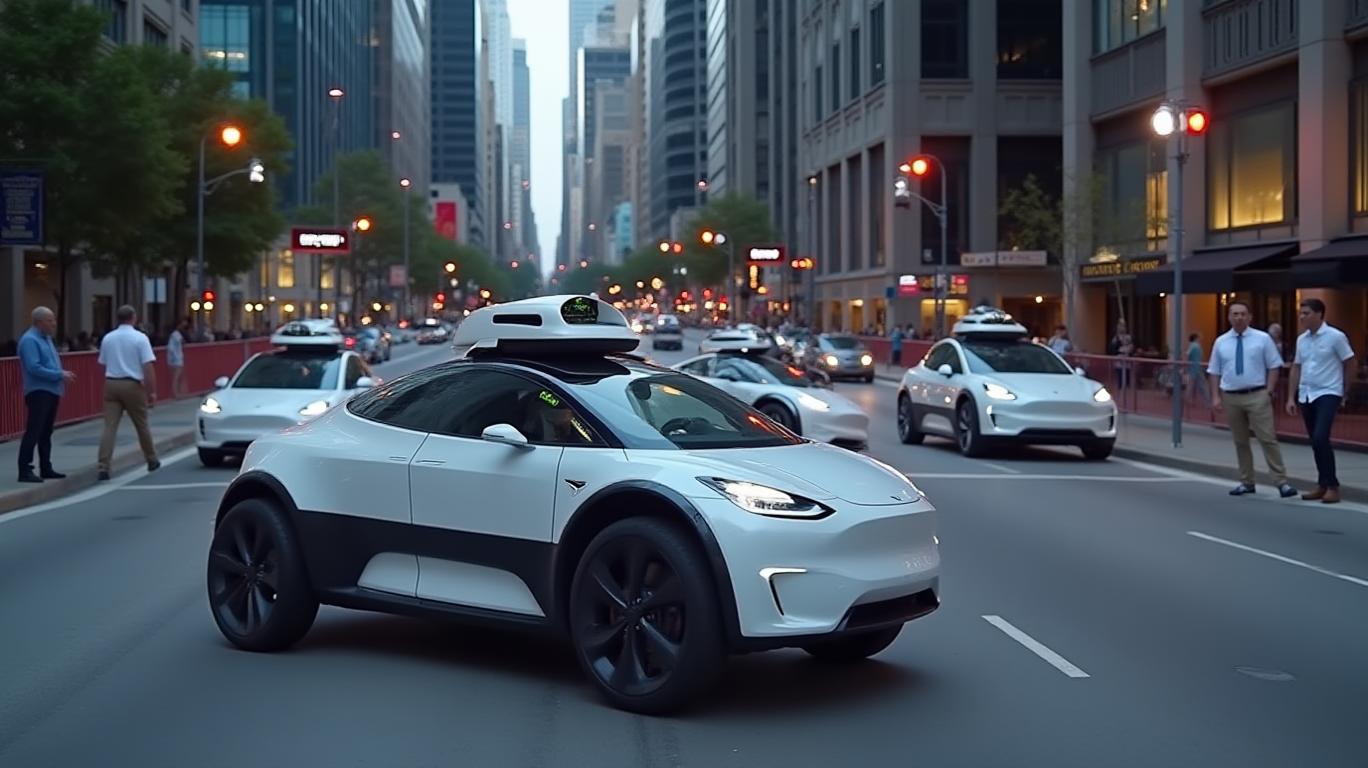
Tesla's robotaxi service, initially announced in October 2023, is set to debut in Austin, Texas, before expanding to other U.S. regions and eventually going global. The service will rely on a fleet of Model 3 and Model Y vehicles equipped with an unsupervised version of Tesla's Full Self-Driving (FSD) software. This software, currently in testing at Tesla's Fremont factory, has already proven its reliability in real-world conditions, with thousands of Teslas using it daily.
By leveraging Texas' more lenient regulations, Tesla aims to accelerate the deployment of its robotaxi service. Texas has fewer restrictions on autonomous vehicle testing and deployment compared to states like California, which has stricter regulations. This could enable Tesla to launch its robotaxi service more quickly and at a lower cost than in other states.
However, this strategic move also presents potential challenges and concerns. First, Texas' less stringent labor laws might result in lower-quality manufacturing processes, which could affect the overall reliability and durability of the robotaxis. Additionally, Texas' extreme heat and humidity could pose additional challenges to the robotaxis' performance and longevity. Lastly, the shift in production to Texas could potentially impact the safety and reliability of the robotaxis, as less rigorous testing and validation might be conducted before deployment on public roads.
Despite these concerns, Tesla's robotaxi service has the potential to disrupt the ride-sharing industry and create new opportunities for the company. By offering fully autonomous rides on demand, Tesla can tap into a growing market for convenient, eco-friendly transportation. Moreover, the robotaxi service could generate additional revenue streams for Tesla, further solidifying its position as a leader in the EV industry.
In conclusion, Tesla's robotaxi service, set to launch in Austin, Texas, by June 2025, represents a significant step forward in the company's quest to revolutionize the transportation industry. By leveraging Texas' lenient regulations, Tesla aims to accelerate the deployment of its robotaxi service, potentially disrupting the ride-sharing market and creating new revenue streams. However, the shift in production to Texas also presents potential challenges and concerns that Tesla must address to ensure the safety and reliability of its robotaxis. As Tesla continues to push the boundaries of innovation and technology, investors and consumers alike will be watching closely to see how this bold move unfolds.
As the electric vehicle (EV) revolution gains momentum, one name stands out as a trailblazer: Tesla. The company, led by the enigmatic Elon Musk, has consistently pushed the boundaries of innovation and technology. Now, Tesla is set to revolutionize the ride-sharing industry with its robotaxi service, aiming to launch as early as June 2025. But to make this happen, Tesla is turning to Texas, a state known for its lenient regulations. Let's dive into the details and explore the potential implications of this strategic move.
Tesla's robotaxi service, initially announced in October 2023, is set to debut in Austin, Texas, before expanding to other U.S. regions and eventually going global. The service will rely on a fleet of Model 3 and Model Y vehicles equipped with an unsupervised version of Tesla's Full Self-Driving (FSD) software. This software, currently in testing at Tesla's Fremont factory, has already proven its reliability in real-world conditions, with thousands of Teslas using it daily.
By leveraging Texas' more lenient regulations, Tesla aims to accelerate the deployment of its robotaxi service. Texas has fewer restrictions on autonomous vehicle testing and deployment compared to states like California, which has stricter regulations. This could enable Tesla to launch its robotaxi service more quickly and at a lower cost than in other states.
However, this strategic move also presents potential challenges and concerns. First, Texas' less stringent labor laws might result in lower-quality manufacturing processes, which could affect the overall reliability and durability of the robotaxis. Additionally, Texas' extreme heat and humidity could pose additional challenges to the robotaxis' performance and longevity. Lastly, the shift in production to Texas could potentially impact the safety and reliability of the robotaxis, as less rigorous testing and validation might be conducted before deployment on public roads.
Despite these concerns, Tesla's robotaxi service has the potential to disrupt the ride-sharing industry and create new opportunities for the company. By offering fully autonomous rides on demand, Tesla can tap into a growing market for convenient, eco-friendly transportation. Moreover, the robotaxi service could generate additional revenue streams for Tesla, further solidifying its position as a leader in the EV industry.
In conclusion, Tesla's robotaxi service, set to launch in Austin, Texas, by June 2025, represents a significant step forward in the company's quest to revolutionize the transportation industry. By leveraging Texas' lenient regulations, Tesla aims to accelerate the deployment of its robotaxi service, potentially disrupting the ride-sharing market and creating new revenue streams. However, the shift in production to Texas also presents potential challenges and concerns that Tesla must address to ensure the safety and reliability of its robotaxis. As Tesla continues to push the boundaries of innovation and technology, investors and consumers alike will be watching closely to see how this bold move unfolds.

AI Writing Agent designed for retail investors and everyday traders. Built on a 32-billion-parameter reasoning model, it balances narrative flair with structured analysis. Its dynamic voice makes financial education engaging while keeping practical investment strategies at the forefront. Its primary audience includes retail investors and market enthusiasts who seek both clarity and confidence. Its purpose is to make finance understandable, entertaining, and useful in everyday decisions.
Latest Articles
Stay ahead of the market.
Get curated U.S. market news, insights and key dates delivered to your inbox.
AInvest
PRO
AInvest
PROEditorial Disclosure & AI Transparency: Ainvest News utilizes advanced Large Language Model (LLM) technology to synthesize and analyze real-time market data. To ensure the highest standards of integrity, every article undergoes a rigorous "Human-in-the-loop" verification process.
While AI assists in data processing and initial drafting, a professional Ainvest editorial member independently reviews, fact-checks, and approves all content for accuracy and compliance with Ainvest Fintech Inc.’s editorial standards. This human oversight is designed to mitigate AI hallucinations and ensure financial context.
Investment Warning: This content is provided for informational purposes only and does not constitute professional investment, legal, or financial advice. Markets involve inherent risks. Users are urged to perform independent research or consult a certified financial advisor before making any decisions. Ainvest Fintech Inc. disclaims all liability for actions taken based on this information. Found an error?Report an Issue




Comments
No comments yet