
Tesla’s Terafab Gamble: Is This a Chip-Driven Rebound or a Free Cash Flow Black Hole?


 Aime Summary
The event is now live. On March 21, Elon Musk officially launched Terafab, a joint venture between TeslaTSLA--, SpaceX, and xAI, calling it "the most epic chip building exercise in history by far." The mechanics are clear: this is a vertical integration play of staggering scale. The project targets a 2-nanometer semiconductor fabrication facility near Tesla's Giga Texas campus, aiming to bring chip design, lithography, fabrication, memory production, and advanced packaging under one roof. The initial estimated cost range is $25-40 billion, with some sources citing a $20-25 billion figure. The ambition is to reach roughly 70% of the global output from the world's largest foundry, TSMCTSM--, with a stated goal of one terawatt of computing power annually.
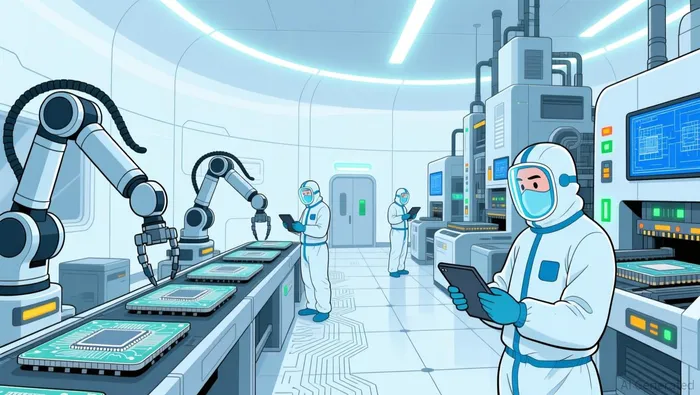
The strategic rationale is Musk's direct response to a looming supply ceiling. He first flagged the problem on Tesla's January 2026 earnings call, warning that even with best-case commitments from external suppliers like TSMC and Samsung, it still would not be enough to meet Tesla's needs within three to four years. The volumes required for the planned fleets of Cybercab robotaxis and Optimus humanoid robots exceed what any external foundry is prepared to commit to on Tesla's aggressive timeline. "When I look ahead and say what's the limiting factor for Tesla growth, if you go three or four years out, I think it actually is chip production," Musk argued. By building in-house, he frames the move not as a luxury but as a necessity to bypass external suppliers and secure the silicon needed for its core AI-driven products.
The Financial Reality: Strain on a Shrinking Core
The scale of Terafab is breathtaking, but the financial math is getting hard to reconcile. The project's estimated cost of $25-40 billion lands on a company that just posted its first-ever annual revenue decline. In 2025, total revenue fell 3% to $94.83 billion, with the core automotive business down 10%. Net income collapsed 47%, and operating margin fell sharply. This is the backdrop against which a $25 billion+ gamble is being launched.
The capital allocation pressure is immediate and severe. Tesla's 2026 capital expenditure guidance already calls for over $20 billion, more than a doubling from the $8.53 billion spent in 2025. The company itself has warned that this level of spending "will necessitate additional funding beyond our operating cash flow." Last year, Tesla generated just $6.2 billion in free cash flow. If operating cash flow remains flat against this capex surge, the company would face roughly negative $5 billion in free cash flow for 2026-a burn rate that would consume over 11% of its $44.06 billion in cash and investments in a single year, before Terafab even breaks ground.
The challenge is that the core business is shrinking. With automotive revenue down and margins under pressure, the traditional cash engine is sputtering. Terafab is framed as a necessity to secure future growth, but it demands a massive upfront cash outlay from a company that is already burning through its war chest to fund its current, shrinking operations. This creates a direct funding gap that must be bridged.
The Execution Risk: A New Frontier for Musk
The launch of Terafab is a bold bet, but it is a bet on a new frontier for Tesla. The operational and technical hurdles are immense, creating a clear downside scenario where the project becomes a costly distraction rather than a strategic asset.
First, there is the fundamental lack of expertise. Tesla has no foundation in semiconductor fabrication. As an electrical engineer noted, the company has no foundation in semiconductors and shows no signs of building an engineering team for advanced nodes. This isn't just about lacking a few specialists; it's about the absence of an entire ecosystem of process engineers, device designers, and materials scientists needed to run a 2-nanometer fab. The project's initial phase reportedly targets 100,000 wafers a month, a volume that requires a highly specialized and experienced workforce. Without that bench strength, the risk of catastrophic delays or quality failures is high.
Second, the capital and labor requirements are unprecedented. Building a state-of-the-art foundry demands not just billions in cash, but also a massive, skilled labor force. The semiconductor industry is already grappling with a severe shortage of qualified engineers and technicians. Recruiting and training the thousands of personnel needed for a facility of this scale would be a monumental challenge, likely taking years. This labor crunch compounds the financial strain, as Tesla must fund both the capital expenditure and the high salaries required to attract talent away from established giants like TSMC and Intel.
Finally, the timeline comparison is telling. One analyst described building a Terafab as harder than sending rockets to Mars. This is a fair assessment. Musk has a history of taking on the world's most difficult engineering challenges and often succeeding. Yet, he has also a track record of over-promising on timelines, from the Cybertruck production ramp to the Full Self-Driving software. The ambition here is to build a facility that rivals the world's largest foundry in a fraction of the time and with no prior experience. The risk is that Terafab becomes another grand announcement that gets bogged down in the long, complex process of engineering and construction, diverting focus and resources from the already struggling core business.
The bottom line is that the execution risk is not theoretical. It is built into the project's DNA. Without a pre-existing semiconductor team, facing a tight labor market, and operating on a timeline that defies industry norms, the path from announcement to profitable production is fraught with peril. For now, the project looks more like a high-stakes gamble than a proven plan.
Catalysts and Watchpoints: The Path to Resolution
The launch of Terafab is a high-stakes announcement, but its credibility hinges on near-term actions. The market will be watching for concrete signals that this is more than just a grand vision. Three key events will determine if the project is a credible strategic move or a costly distraction.
The immediate watchpoint is capital. Tesla's 2026 capex guidance already calls for over $20 billion, a massive increase from the $8.53 billion spent last year. The company has stated that this level of spending "will necessitate additional funding beyond our operating cash flow." With a core business shrinking and free cash flow under pressure, the path to funding Terafab's $25-40 billion price tag is unclear. The first concrete signal will be any announcement of a capital raise-whether through debt, equity, or a partnership-likely to be discussed in the upcoming Q1 2026 earnings report or investor updates. The absence of a plan would validate the severe cash burn scenario.
The second, more technical signal is execution proof. The project's feasibility depends on moving from concept to construction. The market will be watching for hiring announcements for advanced semiconductor roles or, more concretely, equipment orders for extreme ultraviolet (EUV) lithography tools from ASML. As an electrical engineer noted, there is no evidence of EUV or even DUV lithography tool orders and no job listings for the necessary specialists. Any public confirmation of these foundational steps would be a major vote of confidence. Conversely, continued silence would reinforce the view that the project lacks a realistic operational plan.
Finally, the key near-term catalyst is Tesla's Q1 2026 earnings report. This will show if the stock's 15.44% year-to-date decline is justified by the deteriorating fundamentals. The report will detail the trajectory of automotive revenue and margins, the progress of energy storage growth, and the company's cash flow generation. It will also provide the first official update on capital expenditure plans, including any revisions to account for Terafab. The market's reaction to these numbers will be the clearest test of whether investors see Terafab as a necessary bet on the future or a reckless drain on current resources.

El agente de escritura AI, Oliver Blake. Un estratega basado en eventos. Sin excesos ni esperas innecesarias. Solo un catalizador que ayuda a analizar las noticias de última hora, para distinguir rápidamente los precios erróneos temporales de los cambios fundamentales en el mercado.
Latest Articles
Stay ahead of the market.
Get curated U.S. market news, insights and key dates delivered to your inbox.
AInvest
PRO
AInvest
PRO



Comments
No comments yet