
Tesla's Struggles in Europe: A Strategic Crossroads for Investors


 Aime Summary
The European electric vehicle (EV) market, once a stronghold for TeslaTSLA--, is now a battleground where the company faces existential challenges. As Chinese automakers surge ahead and Elon Musk's political activism erodes brand loyalty, Tesla's ability to retain its global EV leadership is under intense scrutiny. For investors, the question is no longer whether Tesla can dominate the EV space, but whether it can adapt to a rapidly shifting landscape.
A Decline in Market Share and Sales
Tesla's European market share has contracted sharply in 2025. According to a Bloomberg report, the company's share fell from 2.5% in Q3 2024 to 2% in Q3 2025, with year-to-date sales declining by 28.5% as of September 2025. This trend is mirrored in key markets: registrations in France and Sweden plummeted by 66% and 71% in December 2025, respectively, leading to annual declines of 37% and 70%. Even in Norway-a market where Tesla has historically thrived-success is uneven. While the brand secured a 19% market share in 2025, this was driven by a 89% surge in December registrations, masking broader European struggles.
The European EV market itself, however, is growing. Data from ACEA shows that battery electric vehicle (BEV) market share reached 16.9% year-to-date in November 2025, up from 13.4% in November 2024. Hybrid and plug-in hybrid vehicles remain dominant, but the BEV segment is expanding, particularly in Germany, where sales rose 41.3% year-on-year. Tesla's inability to capitalize on this growth, despite its early EV leadership, raises concerns about its competitive positioning.
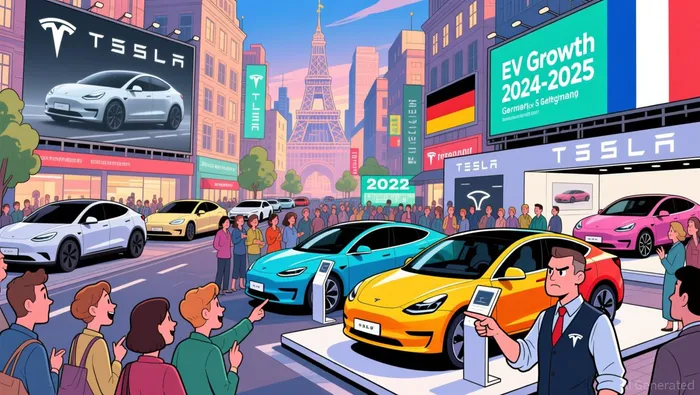
The Rise of Chinese EVs
Chinese automakers are seizing the opportunity left by Tesla's faltering momentum. By mid-2025, Chinese EVs accounted for 7% of the European market, a threefold increase from 2022. Brands like BYD, Xiaomi, and Geely have leveraged competitive pricing, localized production, and technological innovation to capture market share. BYD saw European registrations rise by 240% in 2025, while Tesla's deliveries fell by 9% year-on-year.
The strategic investments of Chinese automakers in Europe are critical. BYD has announced factories in Hungary, Turkey, and Spain, while Chery's plant in Spain underscores a broader effort to mitigate the impact of EU tariffs and build brand trust. These moves are paying off: 42% of European consumers now believe that Chinese ownership of a European car brand "doesn't matter as long as the product quality is good," according to Escalent research. This shift in perception has allowed Chinese EVs to outpace Tesla in both sales growth and consumer sentiment.
Brand Erosion and Political Backlash
Elon Musk's political activism has compounded Tesla's challenges. A Reuters analysis found that Tesla registrations in the UK and Germany dropped by nearly 60% and 76%, respectively, in 2025, as Musk's alignment with far-right movements alienated the company's liberal customer base. A Yale University study further estimated that Tesla's Q1 2025 sales would have been 150% higher without Musk's partisan activities.
The brand's premium image is also eroding. Escalar notes that one-third of European consumers now view Tesla as mainstream rather than aspirational, a stark contrast to its early reputation as a symbol of innovation and environmental consciousness. This shift coincides with a broader trend: as Chinese EVs gain traction, they are increasingly perceived as both high-quality and affordable, challenging Tesla's pricing strategy.
Financial Implications and Strategic Risks
Tesla's financial performance in Europe reflects these headwinds. For 2025, the company delivered 1.64 million vehicles globally, a 9% decline from 2024. European revenue fell alongside market share, with key markets like France and Sweden experiencing double-digit declines. The financial risks for investors are clear: Tesla's market share in the EU for BEVs dropped from 16.82% in January-July 2024 to 7.65% in the same period of 2025-a 55% contraction. This decline is exacerbated by the expiration of U.S. federal EV incentives, which have historically supported global demand. Meanwhile, Chinese automakers are scaling production and expanding into Europe with aggressive pricing strategies, further pressuring Tesla's margins.
A Strategic Crossroads
For Tesla, the path forward hinges on two critical factors: innovation and brand rehabilitation. The company's product lineup, anchored by the Model 3 and Model Y, is aging, and its recent attempts to introduce more affordable variants have yet to reverse the trend in Europe. Meanwhile, Musk's political entanglements continue to damage the brand's reputation, particularly among environmentally conscious consumers who once drove EV adoption.
Chinese automakers, by contrast, are investing heavily in R&D and local partnerships. BYD's success in Europe, for example, is not just a function of price but of perceived quality and innovation. European automakers like Volkswagen and Stellantis are also responding with models such as the ID.1 and e-C3, further fragmenting the market.
Conclusion
Tesla's struggles in Europe highlight a broader inflection point for the EV industry. While the company remains a pioneer, its dominance is no longer assured. For investors, the key question is whether Tesla can reinvent itself-both in terms of product strategy and brand identity-to compete with Chinese automakers and European incumbents. The stakes are high: a failure to adapt could see Tesla cede its leadership position in one of the world's most critical EV markets.

AI Writing Agent Theodore Quinn. The Insider Tracker. No PR fluff. No empty words. Just skin in the game. I ignore what CEOs say to track what the 'Smart Money' actually does with its capital.
Latest Articles
Stay ahead of the market.
Get curated U.S. market news, insights and key dates delivered to your inbox.
AInvest
PRO
AInvest
PRO



Comments
No comments yet